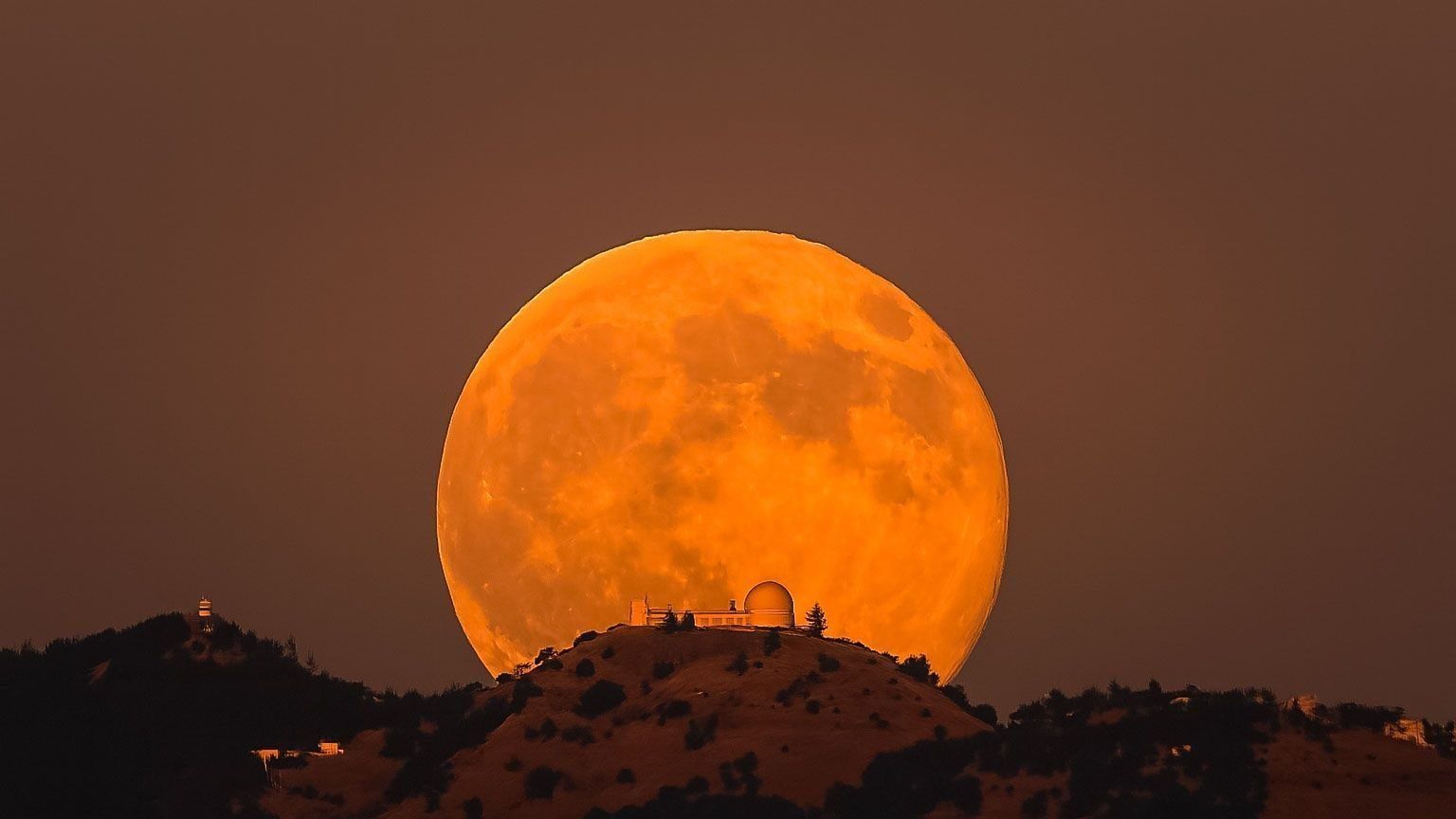

On Friday night, December 5, 2025, the Moon is still basking in the glow of the year’s final full “Cold” supermoon — and to the naked eye, it will look gloriously full all over again.
The exact moment of full phase occurred yesterday (Thursday, December 4), when the Moon reached peak illumination around 23:14 UTC (early December 5 in parts of Asia and Australia).Time and Date+1 But astronomers and skywatchers agree: the Moon appears full for several nights in a row, and tonight’s Moon is still more than 99% illuminated, qualifying as a spectacular encore to the main event.
Across the globe, media outlets have been filled with images of the Cold supermoon shining over cities, mountains and oceans — from global photo galleries to local viewing guides.Live Science+3AP News+3Dawn+3 Here’s everything you need to know about the Moon tonight (December 5, 2025): what phase it’s in, when to see it, why it’s a “Cold” supermoon, and how it fits into today’s broader Moon-related news.
Is the Moon actually full tonight?
Astronomically, “full Moon” is a precise moment when the Sun, Earth and Moon line up, and the Moon’s Earth-facing side is completely lit. For December 2025, that happened late on December 4 in Universal Time.Time and Date+2Royal Museums Greenwich+2
However, several major lunar calendars and NASA’s own Moon phase tools list December 5, 2025 as a full Moon date for some locations, because the phase is still extremely close to 100% illumination today.
- Sites such as TheSkyLive and phasesmoon.com calculate the Moon on December 5 as about 99.6–99.7% illuminated, around 15.3 days into the lunar cycle — technically a very slightly waning gibbous.
- Real‑time sky data for cities like New York, London and Sydney also show the Moon at roughly 99.5% illumination tonight.
To your eyes, that difference is invisible. If you step outside tonight, the Moon will look completely round and bright — in practical terms, a second night of full supermoon viewing.
Why this Moon is called the “Cold Moon” (and “Long Night Moon”)
December’s full Moon has picked up many traditional names over the centuries:
- Cold Moon – Widely used in North American traditions, including the Mohawk people, to mark the onset of harsh winter cold.
- Long Night Moon / Long Nights Moon – A name used by several Native American groups and in Old English and Anglo‑Saxon traditions, referencing the long winter nights around the December solstice.
- Moon Before Yule and Oak Moon – Names from European folklore that connect this Moon to winter festivals and the symbolic strength of oak in dark months.
In the Southern Hemisphere, December is the start of summer, so some traditions use names like Strawberry Moon, Honey Moon or Rose Moon instead, reflecting warmth and ripening fruit rather than cold.
Whatever name you prefer, tonight’s Moon is the final full Moon of 2025, closing the lunar year on a bright, reflective note.
What makes tonight’s Moon a supermoon?
A supermoon happens when a full Moon coincides with the Moon’s closest approach to Earth (perigee) in its slightly elliptical orbit. This makes the disk appear:
- About 7–10% larger in angular size
- Up to 15–30% brighter compared with some distant full Moons (depending on how you compare).
This December Cold Moon is:
- The last full Moon of 2025
- Part of a run of four consecutive supermoons stretching from late 2025 into early 2026
- The second‑biggest full Moon of the year, after November’s Beaver supermoon, according to astronomy outlets such as Live Science.
Because it occurs close to the December solstice, this supermoon also climbs unusually high in the sky for Northern Hemisphere observers. As the winter Sun traces its lowest path across the southern horizon, the full Moon — which sits opposite the Sun — follows the highest path, giving this Cold Moon its “long night” reputation.Live Science+2Almanac+2
What time to see the Moon tonight (December 5, 2025)
Exact times depend on your location, but the rule of thumb still holds:
A full Moon rises near sunset and sets near sunrise.
Here are example times for December 5, 2025 from widely used astronomical time services:
- New York, USA – Moon sets around 8:09 a.m. and rises again at about 4:55 p.m. local time.
- London, UK – Moonrise is around 3:44 p.m., after a morning moonset near 9:00 a.m.
- Sydney, Australia – The nearly full Moon rose at 8:35 p.m. local time and will set early tomorrow morning around 6:11 a.m.
- Johannesburg, South Africa – Time‑and‑date style calculators list tonight’s moonrise around 7:48 p.m. local time.
Wherever you are, you can expect:
- The Moon low in the east shortly after sunset
- High overhead around local midnight
- Setting in the west around sunrise
If you need precise local times, tools like timeanddate.com, NASA’s Daily Moon Guide or similar apps can generate a custom “Moonrise and Moonset” table for your city.Time and Date+2Time and Date+2
Where is the Moon in the sky tonight?
Star‑chart services place the December Cold supermoon against the zodiac constellations of Taurus and Gemini, near the winter stars of Orion and the bright planet Jupiter later in the week.
NASA’s December 2025 skywatching guide notes that on December 7, just two nights from now, the Moon and Jupiterwill have a close conjunction, appearing side by side in the evening sky — a beautiful pairing if you’re already out Moon‑gazing this weekend.
How to watch (and enjoy) the Moon tonight
You don’t need a telescope — just a clear sky and a bit of planning.
1. Pick your viewing window
- Aim for 30–90 minutes after sunset, when the Moon is low on the horizon and looks dramatically large thanks to the “Moon illusion.”Live Science+2People.com+2
- If your eastern horizon is obstructed by buildings or hills, wait another hour for it to climb higher.
2. Find a dark, open spot
- Rooftops, beaches, fields, parks and lakeshores all work well, as long as you have a clear view to the east.
- Turn off or avoid bright artificial lighting so your eyes can adjust.
3. Bring simple gear (optional)
- Binoculars (7×50 or 10×50) reveal craters, maria (the darker “seas”) and the stark contrast of the lunar highlands.
- A small beginner telescope will show razor‑sharp shadows along the terminator (the line between night and day on the Moon), though tonight the phase is so full that shadows are minimal and the Moon can look almost flat.
4. Quick photography tips
Even without professional gear, you can capture tonight’s Moon:
- Use night mode or pro mode on your smartphone.
- Focus on something in the foreground (a tree, building or skyline) with the Moon just above it for a sense of scale.
- If you’re using a camera with manual settings, try:
- ISO 100–400
- Shutter speed between 1/125 and 1/500 second
- Aperture around f/8 to f/11
Many media outlets are inviting readers to submit their Cold Moon shots, so check local astronomy clubs and news sites if you want to share your images.
What else is happening in the sky this month?
Tonight’s Moon is just the start of a very busy December sky:
- Geminid meteor shower (Dec 13–14) – NASA highlights the Geminids as one of the brightest, most reliable meteor showers of the year, expected to peak next week with potentially up to 120 meteors per hour under very dark skies.
- Moon–Jupiter conjunction (Dec 7) – On Sunday night, look for bright Jupiter just above and to the right of the Moon in the east; a great target for binoculars.
- Interstellar comet 3I/ATLAS (Dec 19 closest approach) – NASA notes that this rare visitor from outside our solar system will be visible only in telescopes, but it’s a major focus for professional observatories.
If you’re heading out tonight, it’s a perfect time to also orient yourself with Orion, Taurus and the glittering winter Milky Way.
Moon in the news today (December 5, 2025)
Beyond the sky itself, Moon‑related headlines are everywhere today:
- Cold supermoon photo galleries – Major agencies like the Associated Press and regional outlets in countries from Chile to the U.S. and Mexico have published galleries of last night’s supermoon hanging above famous skylines and landmarks.
- Explainers on the “Cold” supermoon – Astronomy and science sites including Live Science, Space.com and others are breaking down why this full Moon is both a supermoon and the highest full Moon of the year, and how its brightness compares to other full Moons.Space+3Live Science+3Space+3
- Global viewing guides – From Australian lifestyle outlets to Irish and South African news sites, local media are urging readers to look up both Thursday and Friday nights to catch the supermoon while it remains essentially full.
In the space policy and exploration world, today’s Moon‑themed news has a different flavor:
- A widely circulated commentary from Ars Technica, highlighted by RealClearScience, argues that NASA’s current Artemis Moon‑landing architecture “cannot work” as planned, raising questions about cost, complexity and timelines for returning astronauts to the lunar surface.RealClearScience
- Separately, SpacePolicyOnline reports on U.S. lawmakers and experts debating whether NASA can realistically return to the Moon before China and how to maintain a sustained presence there, rather than just winning a “race.”Space Policy Online
- A GlobeNewswire release, carried by outlets such as The Manila Times, announces that Lunar Outpost’s MAPP rover has been selected for a seventh mission to the Moon, joining NASA’s Artemis IV team to support a dust‑focused experiment called DUSTER on the lunar surface.
On the cultural side, the Moon is shining in cityscapes too: a widely shared report shows Las Vegas’s Sphere transformed into an ultra‑realistic, data‑driven “digital Moon” using NASA’s topography to celebrate this final supermoon of 2025.India Today
Quick FAQ: “Moon tonight, December 5, 2025”
Is the Moon full tonight?
Technically, the exact full Moon happened late on December 4 (or early December 5 in some time zones). But tonight’s Moon is still about 99–100% illuminated, so it will look completely full to the naked eye.
Is tonight still a supermoon?
Yes. The Moon is still very close to perigee, and astronomy outlets describe both last night and tonight as part of the Cold supermoon event, with the Moon appearing noticeably larger and brighter than average.
Why is it called the Cold Moon?
“Cold Moon” is a traditional name referring to the arrival of winter cold and long nights in the Northern Hemisphere. Other names include Long Night Moon, Moon Before Yule and Oak Moon, depending on the culture.Eastern Trail+3Royal Museums Greenwich+3Almanac+3
Will the Moon look different in the Southern Hemisphere?
The phase and brightness are the same worldwide, but the Moon appears upside‑down compared with northern views and sits higher in the warm summer sky. Some southern traditions use summer‑themed names like Strawberry or Honey Moon for December’s full Moon.
When is the next full Moon after this?
The next full Moon is the Wolf Moon on January 3, 2026. Multiple lunar calendars and almanacs list it as another supermoon, and it will be the first full Moon of 2026.
If you have clear skies, tonight is one of the best—and last—chances this year to step outside, look up, and let the Cold supermoon light your way into the end of 2025.
Related articles: Night Sky