Tashkent / Bishkek – December 5, 2025
Uzbekistan has unveiled one of the most ambitious clean‑energy packages in Central Asia to date, combining a €9.46 billion rollout of domestic renewable and grid projects with a 2026 financing start for the region‑defining Kambarata‑1 hydropower plant in Kyrgyzstan. Together, these moves are set to reshape the country’s energy mix, deepen regional integration and test how fast Central Asia can pivot from fossil fuels to climate‑resilient power.
A €9.46 billion clean‑energy package to power every Uzbek home
At the “Powering the Future – Sustainable Energy for New Uzbekistan” forum in Tashkent on 5 December, President Shavkat Mirziyoyev launched 42 new energy projects, valued at €9.46 billion, spanning generation, storage and grid infrastructure. euronews+1
According to official reports and coverage by Euronews and the state news agency UzA, the package includes:
- 16 new power plants – solar, wind, thermal and hydropower – with a combined capacity of 3,500 MW, located in Karakalpakstan and the Bukhara, Kashkadarya and Tashkent regions.
- 10 utility‑scale battery storage systems totalling 1,245 MW, designed to inject up to 1.5 billion kWh into the grid during peak demand.
- 11 major substations and 420 km of high‑voltage transmission lines to stabilize the national grid.
Once the new plants are fully operational, they are expected to generate 15 billion kWh annually. That will help push Uzbekistan’s green power output to 23 billion kWh in 2026, enough to cover the entire annual electricity consumption of the country’s population, while reducing natural gas use by about 7 billion cubic metres and avoiding around 11 million tonnes of harmful emissions.
Mirziyoyev framed the strategy around two core goals: ensuring reliable electricity for all sectors and doing so primarily through modern, environmentally friendly, renewable sources.
From laggard to regional frontrunner in renewables
The December 5 announcements build on a rapid – and relatively recent – acceleration of Uzbekistan’s clean‑energy sector.
According to Mirziyoyev’s address and government data:
- Since 2017, about $35 billion (roughly €32 billion) in foreign investment has flowed into the energy sector.
- Around 9,000 MW of new capacity has been commissioned, lifting total electricity generation from 60 billion kWh in 2017 to 85 billion kWh in 2024–2025.
- Roughly 5,000 MW of solar and wind and 400 MW of hydropower have already come online, taking green energy’s share of installed capacity to about 30% in 2025.
A separate analysis by The Times of Central Asia reports that by late October 2025, solar and wind alone generated a record 9 billion kWh, while total renewable output (hydro, solar, wind) reached 14.52 billion kWh, or roughly 23% of national electricity production.
In one summer month – July 2025 – solar, wind and hydro together produced 2.89 billion kWh, representing 27% of total generation, demonstrating how fast the renewables share is climbing when conditions are favourable.
Looking ahead, the government’s roadmap is even more aggressive:
- More than 17,000 MW of additional renewable capacity is slated to be commissioned by 2030.
- The share of green energy in overall generation is targeted to reach 54% by the end of the decade.
- To integrate the new capacity, Uzbekistan plans to build 6,000 km of high‑voltage lines, including 1,000 km already scheduled for 2026, plus new substations totalling 6,000 MW of transformer capacity.
These numbers put Uzbekistan near the front of the regional pack on utility‑scale renewables, even as it continues to rely on gas‑fired plants for baseload power and seasonal balancing.
Kambarata‑1 hydropower: regional megaproject moves toward financing
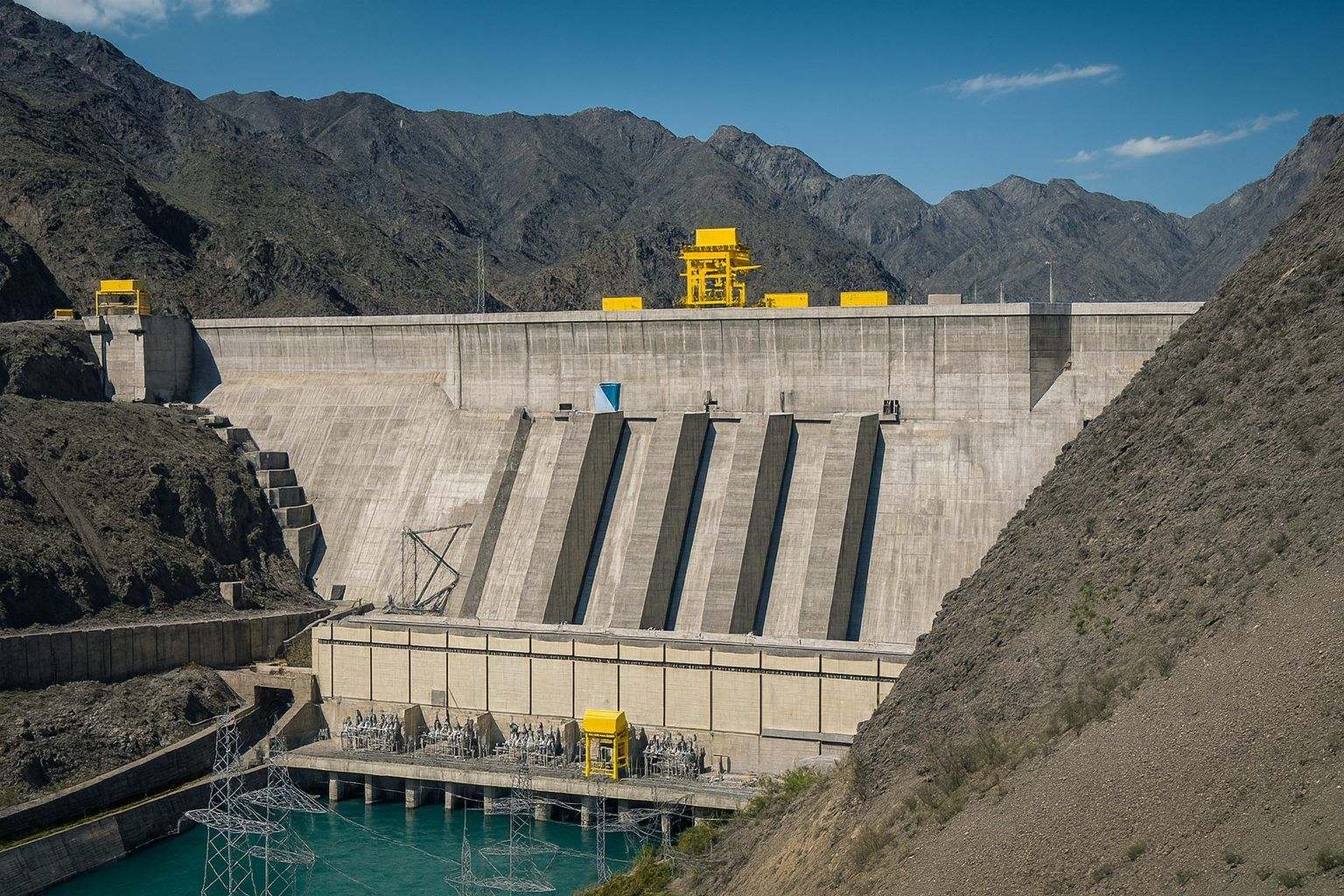
Alongside domestic projects, Mirziyoyev used the Tashkent forum to signal that funding for the Kambarata‑1 Hydropower Plant (HPP) will begin in 2026, in partnership with Kyrgyzstan and Kazakhstan.
A 1.86 GW anchor on the Naryn River
Kambarata‑1, to be built on the upper Naryn River in Kyrgyzstan, is emerging as one of Central Asia’s flagship clean‑energy projects:
- Capacity: about 1,800–1,860 MW (four turbines)
- Storage: reservoir of 5.4 billion m³
- Output: expected 5.6 billion kWh per year
- Construction cost: estimated at $4.2 billion, with pledged financing already around $5.6 billion
- Timeline: around 10 years to build, with construction that began in 2022
- Tariff: electricity planned to be sold at about 5.15 US cents per kWh
- Ownership concept: Kyrgyzstan to hold 34%, Uzbekistan and Kazakhstan 33% each, with power distributed proportionally but tradable based on market demand.
Uzbek and Kyrgyz officials emphasise that the design aims to follow international environmental and social standards, avoiding compulsory resettlements and improving downstream water regulation during the summer growing season – a politically sensitive issue in a region where water disputes have historically sparked tensions.
Backed by Europe’s Global Gateway and development banks
The project’s momentum has been reinforced by a wave of European and multilateral commitments in 2025:
- Under the EU’s Global Gateway initiative, Brussels, the European Investment Bank (EIB) and the European Bank for Reconstruction and Development (EBRD) have announced over €2 billion in new hydropower deals for Central Asia, with Kambarata‑1 at the centre.
- Memoranda of understanding cover €900 million in EU/EIB commitments plus a possible €1.3 billion from EBRD for Kambarata‑1.
- EBRD President Odile Renaud‑Basso has said the bank is considering up to $1.5 billion in sovereign loans – three tranches of up to $500 million each – to support the plant.
European officials describe Kambarata‑1 as “instrumental” in expanding renewable electricity trade across the region and improving both energy and water security. EEAS+2DevelopmentAid+2
For Uzbekistan, co‑financing Kambarata‑1 dovetails with its domestic green push: the plant could provide low‑carbon imports during peak periods and underpin a future regional power market in which Central Asian states trade clean electricity seasonally.
Carbon markets and iCRAFT: turning emissions cuts into cash
A distinctive feature of Uzbekistan’s energy transition is its early bet on carbon markets. At COP30 in Brazil, the government committed to cutting greenhouse‑gas emissions by 50% by 2035 compared with baseline levels.
To help reach that goal, Tashkent is implementing iCRAFT – Innovative Carbon Resources Application for Energy Transition, developed with the World Bank:
- The programme has already tracked 23 million tonnes of verified emission reductions, largely from efficiency and fuel‑switch measures in the power sector.
- In June 2024, Uzbekistan became the first country globally to receive a World Bank policy‑crediting payment, earning $7.5 million for cutting about 500,000 tonnes of CO₂ under iCRAFT.
- The initiative supports both domestic carbon‑credit trading and pilot international transactions under the Paris Agreement’s market mechanisms.
Uzbek officials say 17 large industrial enterprises have already moved to international green‑energy certification, with a target of 100 firms within two years, positioning export‑oriented companies to benefit from cleaner power and potential carbon‑pricing regimes in key markets.
If scaled, iCRAFT could make Uzbekistan a regional testbed for policy‑based carbon markets, blending climate finance with reforms such as phasing out inefficient energy subsidies.
Public–private partnerships, ACWA Power and a 500 MW data‑centre boom
Foreign investors are already deeply embedded in Uzbekistan’s power sector transformation. At the Tashkent forum and in accompanying coverage, authorities highlighted a long list of partners from Saudi Arabia, Türkiye, the UAE, China, France, Germany and Qatar, including ACWA Power, Masdar, Aksa Enerji, Cengiz Enerji, China Energy, EDF, Voltalia, TotalEnergies, Siemens Energy and Nebras Power.
Key developments include:
- Utility‑scale renewables: Saudi‑based ACWA Power remains one of the most active players; company representatives note that more than 2,500 MW were added to Uzbekistan’s grid in 2025 alone, and that the country’s 54% renewables‑by‑2030 goal aligns with ACWA’s long‑term investment horizon.
- Hybrid wind‑storage projects: France’s Voltalia has signed an agreement for a 200 MW hybrid wind‑and‑storage plant and is developing a 500 MW “Turan” battery project slated to start construction in 2026. euronews
- Gas‑fired back‑up: EDF and partners from Japan, Qatar and Germany are building two major gas‑fired plants, underscoring that Uzbekistan still sees high‑efficiency gas as a bridge fuel for reliability and industrial growth.
On the demand side, Mirziyoyev highlighted a 500 MW data centre project by Saudi company DataVolt, with an estimated $3 billion investment, as part of plans to attract digital, AI and IT firms. The expansion of such energy‑hungry infrastructure could increase national electricity demand by at least 1.5 times over the next several years, making the parallel build‑out of clean capacity even more critical.
Public–private partnerships (PPPs) are also moving beyond generation. In 2025, the Turkish firm Aksa Elektrik assumed private management of the Samarkand regional grid, committing to modernise infrastructure and halve losses, which authorities say could save around $20 million per year. grids in Jizzakh and Syrdarya are expected to be opened to investors in 2026, followed by Namangan and Tashkent regions in 2027.
New social model: 300 mahallas, 30,000 low‑income families, and micro‑hydro
Beyond utility‑scale megaprojects, Uzbekistan is experimenting with a decentralised, community‑focused model for its energy transition.
A nationwide programme will install 107 MW of rooftop and micro‑solar capacity across 300 mahallas (neighbourhoods) next year. The initiative is designed to supply 30,000 low‑income households with green electricity and allow them to sell surplus power into the grid, turning consumers into prosumers.
Entrepreneurs are also building small and micro‑hydropower plants:
- In 2025, 40 micro‑HPPs with combined capacity of 40 MW generated about 120 million kWh, providing both electricity and new income streams for local owners.
- By 2026, another 65 MW of micro‑hydro capacity is planned, which officials say could significantly improve supply for around 80,000 households.
If these projects are implemented successfully, Uzbekistan will have a multi‑tiered energy system, where big international investors build gigawatt‑scale plants while households and small businesses also gain a share of the benefits.
Cargill deal and broader investment wave into energy and water
The Tashkent forum comes amid a broader surge of energy‑related investment news. On 5 December, Reuters reported that a subsidiary of state energy company Uzbekneftegaz and Cargill signed a cooperation agreement to attract up to $3 billion in long‑term financing, with the possibility of expanding to $5 billion.
The funds are earmarked for household and industrial energy projects, infrastructure and water management – areas that dovetail with Uzbekistan’s push to modernise its grid, reduce gas dependence and upgrade irrigation systems stressed by climate change.
Local media also highlight a wave of regionally focused projects, from Sirdarya’s $720 million package of 40 industrial investments to announcements that Uzbekistan has attracted around $35 billion in energy investments and aims to launch $150 billion worth of broader projects in the near term.
Taken together, Uzbekistan is positioning energy – and especially clean energy plus water infrastructure – as a central pillar of its industrial and export strategy.
Regional energy and water security in a warming climate
The promise of Kambarata‑1 and Uzbekistan’s renewable build‑out has to be viewed against a stark regional backdrop: hydropower vulnerability to climate shocks.
On 2 December, Tajikistan imposed power rationing after an unusually warm and dry autumn left water levels at key dams dangerously low. Authorities said restrictions would affect electricity users representing almost 20% of Tajikistan’s GDP, while street lighting and power to many public buildings would be curtailed outside working hours.
The reservoir of Tajikistan’s Nurek dam – which generates about 70% of the country’s electricity – was reported to be 3.5 metres below its level a year earlier, forcing the government to seek imports from Uzbekistan, Turkmenistan and Kazakhstan. Kyrgyzstan has introduced similar measures, including turning off street lights and restricting commercial activity at night.
These developments underscore two critical points for Uzbekistan’s strategy:
- Hydropower is both essential and exposed. Kambarata‑1 could dramatically improve seasonal balancing and irrigation, but its long‑term output will depend on glacier and river dynamics in a warming climate.
- Regional interdependence is increasing. Tajikistan’s search for imports – and Uzbekistan’s readiness to supply when capacity allows – shows how Central Asian states are already acting as a de facto power pool, even before formal market integration.
European institutions backing Kambarata‑1 repeatedly stress the need for smart, climate‑resilient hydropower investments, paired with better water governance.
Forecast: how today’s announcements could reshape Central Asia’s energy map
If Uzbekistan delivers on the commitments announced on 5 December, several medium‑term shifts are likely:
1. Domestic power balance
- By 2026, the commissioning of 3,500 MW of new green capacity and 1,245 MW of storage could eliminate household power deficits in normal years, while cutting gas burn in the power sector.
- Reduced domestic gas use would free up more gas for industrial processing or export, potentially boosting foreign‑currency earnings – though this will depend on global gas prices and infrastructure constraints.
- The expansion of rooftop solar and micro‑hydro may buffer rural and low‑income communities against outages and tariff hikes if carbon‑pricing or subsidy reforms proceed under iCRAFT.
2. Regional integration
- Kambarata‑1, once completed, could become a cornerstone of a Central Asian green power market, enabling seasonal exchanges between water‑rich upstream states and demand‑heavy downstream economies.
- Together with projects like the Green Energy Corridor linking Azerbaijan, Kazakhstan and Europe, Central Asia is edging toward a future where it can export surplus clean power westwards, especially during hydrologically strong years.
3. Climate finance and carbon markets
- If iCRAFT continues to deliver verified emission reductions – and if global demand for high‑quality credits rises – Uzbekistan could attract tens or even hundreds of millions of dollars in additional results‑based climate finance over the coming decade.
- This would create further incentives to accelerate energy‑efficiency measures, grid upgrades and fuel‑switching away from coal and inefficient gas.
All of these outcomes, however, depend on execution: whether tenders are run transparently, environmental and social safeguards are enforced, tariffs remain politically manageable, and regional water cooperation holds steady as climate impacts intensify.
Key risks and unanswered questions
Despite the optimistic tone in Tashkent, several uncertainties could shape how these plans play out:
- Hydrological risk: Prolonged droughts like those currently affecting Tajikistan and Kyrgyzstan could reduce hydropower output, complicate debt repayment for big dams, and inflame water disputes.
- Financing conditions: While pledges for Kambarata‑1 exceed its estimated cost, the final mix of concessional loans, guarantees and private capital – and the terms attached – will influence power tariffs and fiscal risks for all three partner countries.
- Grid bottlenecks: Adding tens of gigawatts of intermittent renewables and cross‑border flows requires fast‑tracked transmission projects and sophisticated system operations; any lag on this front could lead to curtailment or instability.
- Social equity: iCRAFT‑linked reforms and PPPs may eventually require tariff adjustments; how costs are shared between households, industry and the state will be politically sensitive. Social programmes like mahalla‑level solar will be crucial in maintaining public support.
The bottom line
As of 5 December 2025, Uzbekistan is not just announcing projects; it is trying to redefine its economic model around clean power, regional hydropower cooperation and climate finance. The €9.46 billion package of 42 new facilities, the upcoming financing of Kambarata‑1, and the expansion of carbon‑market tools like iCRAFT together mark a decisive turn toward a more integrated, low‑carbon energy system in Central Asia.
Whether this vision becomes reality will be one of the most important stories to watch in the region’s energy and climate transition over the next decade.