Broadcom (AVGO) Stock in December 2025: AI Chip Boom, VMware Cloud Push and What to Expect From Q4 Earnings
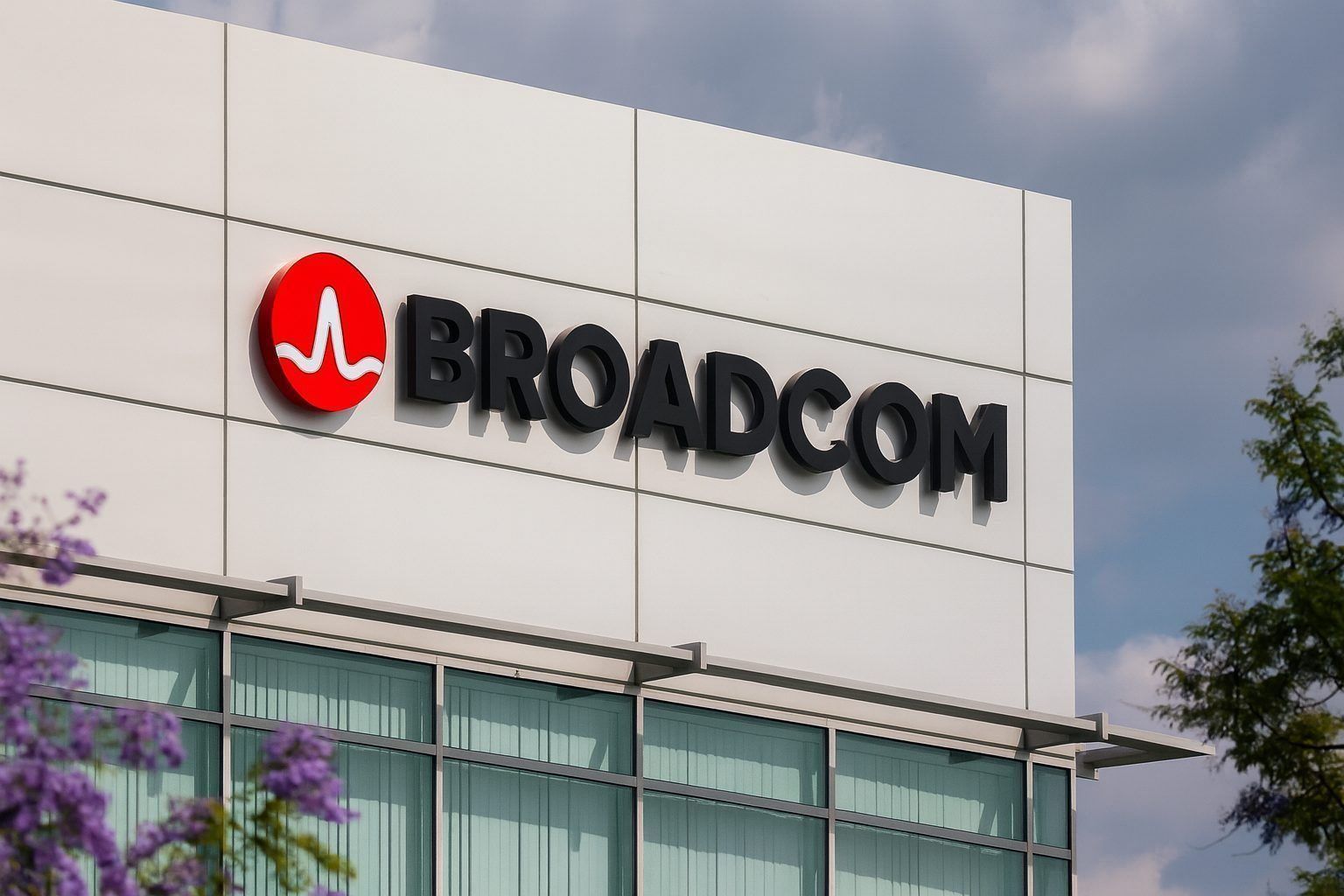
Broadcom Inc. NASDAQ:AVGO heads into its fiscal fourth‑quarter earnings report on Thursday, December 11, 2025, with its share price hovering near record territory and expectations for artificial intelligence (AI) revenue set sky‑high. As of Friday’s close, Broadcom stock traded around $390.24 per share, giving the company a market capitalization near $1.8 trillion and putting it among the most valuable chip and infrastructure software companies on the planet.
In the last month alone, AVGO has outpaced the broader tech sector, rising roughly 7% versus about 1–2% for the computer & technology group, according to Zacks data. Finviz Year‑to‑date, multiple outlets estimate the stock’s gain at close to 65%, fueled by relentless AI enthusiasm and Broadcom’s transformation into a central supplier of custom accelerators, networking silicon, and VMware‑powered private clouds.
Here’s a deep dive into the latest news, forecasts, and analysis on AVGO as of December 6, 2025, and what’s riding on the upcoming earnings release.
Where Broadcom Stock Stands Now: Performance and Valuation
Recent data show AVGO closing Friday at $390.24, up about 2.4% on the day and outperforming the S&P 500’s modest gain. Investing.com+1 Zacks notes that over the past month Broadcom has gained more than 7%, versus a roughly 1.6% move in its sector and about 0.7% for the S&P 500, underscoring how investors are still willing to pay up for AI‑linked names despite broader market jitters.
On valuation, the picture is more contentious:
- Zacks currently pegs Broadcom’s forward P/E multiple in the low‑40s, notably above the semiconductor industry average in the mid‑30s.
- Other analyses point to a trailing P/E around the mid‑90s and a price‑to‑sales multiple in the high‑20s, far richer than most chip peers — and even above Nvidia on some metrics.
In other words, the market is not treating Broadcom as a normal cyclical chipmaker anymore. It’s being priced as a long‑duration AI infrastructure franchise that must keep delivering 30%‑plus AI growth for years. That tension — stellar fundamentals versus lofty expectations — is the core of every current AVGO debate.
What Broadcom Already Delivered: Q3 Results and AI Momentum
Broadcom’s most recent reported quarter, fiscal Q3 2025 (results released September 4), set the stage for today’s enthusiasm:
- Total revenue: about $16.0 billion, up 22% year over year, beating consensus estimates.
- Adjusted EPS:$1.69, ahead of the roughly $1.65 expected and up sharply from a year earlier.
- Semiconductor Solutions revenue: about $9.2 billion, up 26% YoY.
- Infrastructure software revenue: roughly $6.8 billion, up 17% YoY, driven by VMware Cloud Foundation subscriptions.
- AI semiconductor revenue:$5.2 billion, a 63% YoY surge and the 10th consecutive quarter of AI revenue growth.
Management also highlighted a backlog of around $110 billion, with at least half tied to semiconductors and most of that to AI projects — a rare level of multi‑year visibility in the chip world.
Crucially, Broadcom issued very aggressive Q4 guidance:
- Q4 FY25 revenue guidance: about $17.4 billion, up roughly 24–25% YoY and above Wall Street’s then‑consensus near $17.0 billion.
- Q4 AI semiconductor revenue: expected to rise to $6.2 billion, implying 66% YoY growth and an 11th straight quarter of rising AI sales.
- EBITDA margin: guided to a robust 67% of revenue, flat with Q3 despite mix shifts toward XPUs and wireless.
A September analysis from CoinCentral framed the quarter as “record revenue driven by AI accelerators,” with Q3 free cash flow around $7 billion, representing roughly 44% of revenue, and a quarterly dividend of $0.59 per share approved for payment on September 30. CoinCentral
All of this is the backdrop for December 11. Investors already know the business is firing; the question now is whether Broadcom can beat its own high bar.
Fresh Headlines: VMware Cloud, Quantum‑Safe Storage and Wi‑Fi 8
While everyone stares at AI numbers, Broadcom has been quietly stacking up news on the software and storage side in late November and early December.
ING adopts VMware Cloud Foundation 9.0
On December 2, 2025, Broadcom and ING announced that the Dutch banking giant will adopt VMware Cloud Foundation 9.0 (VCF 9) as its strategic private‑cloud platform. The deal expands ING’s VMware environment into a multi‑region private cloud designed for workload mobility, operational consistency, data‑sovereignty compliance and faster rollout of digital banking services.
Broadcom pitches VCF 9 as a full‑stack, AI‑ready private cloud platform. ING will lean on Broadcom’s professional services for design, migration and ongoing optimization, highlighting that VMware is no longer just a license — it’s a managed infrastructure stack.
For investors, the key takeaway is that VMware isn’t simply being milked for price hikes; there are also marquee wins that support Broadcom’s thesis that VCF can be the default private cloud substrate for large enterprises.
Quantum‑safe SAN switches, NEC partnership and Wi‑Fi 8
On November 19, 2025, AVGO rallied after a cluster of product and partnership announcements:
- Broadcom introduced the world’s first quantum‑safe Gen 8 128G SAN switch portfolio, targeting next‑generation AI and high‑performance storage networks.
- Its VMware unit expanded a strategic partnership with NEC to push VMware Cloud Foundation as the standard for modern private clouds.
- The company also showcased Wi‑Fi 8 (802.11bn) progress via a collaboration with Rohde & Schwarz, which validated the CMP180 test platform for Broadcom’s upcoming Wi‑Fi 8 chipsets — a nod to future demand from XR, AI‑assisted apps and ultra‑low‑latency workloads.
None of these headlines move the needle like a $10‑billion AI chip order, but they reinforce the idea that Broadcom’s growth engine spans storage, networking, wireless and software, not just AI compute.
The AI Engine: OpenAI, Google, Meta and Custom Chips
Broadcom’s AI story is increasingly about custom silicon — application‑specific integrated circuits (ASICs) and XPUs tailored for hyperscalers — rather than commodity GPUs.
Multi‑billion‑dollar OpenAI deal and a “fourth XPU customer”
Multiple analyses and industry blogs point to Broadcom securing over $10 billion in AI infrastructure orders from OpenAI, including a multi‑year partnership to deploy 10 gigawatts of OpenAI‑designed AI accelerators built jointly with Broadcom.
A recent Barchart deep dive notes that Broadcom’s XPU business already accounts for about 65% of its AI revenue and that a “fourth XPU customer” has moved from prospect to full customer status after placing more than $10 billion in AI rack orders. That customer — not yet named publicly — is expected to begin shipping “pretty strongly” in early 2026, which management says has raised Broadcom’s internal growth outlook for fiscal 2026 beyond its prior 50–60% range for AI. Barchart.com
If those orders materialize as expected, they give Broadcom something most chip firms would kill for: multi‑year, contracted AI demand from several hyperscalers.
Google’s Gemini 3 and Mizuho’s “Top Pick for 2026”
TipRanks reports that Mizuho’s Vijay Rakesh — one of Wall Street’s highest‑ranked semiconductor analysts — maintains an Outperform rating and a $435 price target on AVGO, calling it a “Top Pick for 2026.” TipRanks
In his latest note:
- Rakesh cites steady demand from Alphabet’s Google, which is expanding TPU systems across its Gemini 3 and newer AI models. That expansion, he argues, should translate into more custom chip wins for Broadcom.
- He also points to increasing AI workloads at Meta, Apple and Anthropic, where custom accelerators and high‑speed networking from Broadcom are likely to play a growing role.
Custom AI silicon as a secular trend
Zooming out, the IEEE ComSoc Technology Blog recently emphasized that custom AI chips are becoming “the true backbone of modern computing,” with AI accelerators and edge AI devices forecast to grow rapidly through 2025 and beyond as more workloads move to inference and specialized hardware. Techblog+1
A long‑form analysis of Broadcom’s AI push estimates that its serviceable AI processor and networking market could reach $60–90 billion by fiscal 2027, with hyperscaler AI capex projected around $450 billion in 2026. FinancialContent That’s the macro tide Broadcom is surfing.
Wall Street’s View: Targets, Ratings and Long‑Term Forecasts
Broadcom’s fundamentals have turned it into an analyst favorite, even if there’s debate about how much upside is left at today’s prices.
Short‑ to medium‑term price targets
Key snapshots:
- TipRanks: AVGO carries a Strong Buy consensus based on 23 Buys and 2 Holds over the last three months, with an average price target of $425.13 — roughly 11–12% upside from current levels.
- Mizuho (via TipRanks): Rakesh’s $435 target implies about 14% upside, anchored in AI demand from Google and other hyperscalers plus networking strength and new chip programs planned for 2027–2028.
- Street‑wide stats (Barchart / Finbold / GuruFocus): One recent roundup of 40+ analysts shows 34 rating AVGO a “Strong Buy,” 3 a “Moderate Buy” and just 3 a “Hold,” with a mean target around $406–$410 and a high target in the $530+ range. Barchart.com+2Finbold+2
- Other aggregators, like MarketBeat, track average targets in the mid‑$370s to high‑$380s, reflecting data cut‑offs before the latest target hikes.
The exact average depends on the data provider and date, but the message is consistent: analysts broadly expect high‑single‑ to low‑double‑digit upside, with a few high‑conviction bulls calling for $450–$480+ if the AI trajectory holds.
Long‑term scenario: 2025–2030
For a longer lens, a detailed November forecast from 24/7 Wall St. models Broadcom’s financials and valuation out to 2030:
- They estimate 2025 revenue of $60.5 billion and EPS of $6.19, rising to over $106 billion in revenue and $18.66 in EPS by 2030.
- Their price path starts somewhat conservatively — $321.88 for 2025 (which has already been overtaken by reality, given today’s ~$390 price) and $364.50 in 2026 — but then ramps to:
- $423.36 in 2027
- $501.48 in 2028
- $597.20 in 2029
- $709.08 by 2030, implying more than 100% upside over five years from the level at which they wrote the report.
Those numbers are scenarios, not guarantees, but they capture how some forecasters view Broadcom: as an AI‑plus‑software compounder with a long runway — provided it can keep executing.
The Bull Case: Why Some See AVGO as Still Undervalued
Recent AI‑driven analyses try to justify Broadcom’s lofty multiple with equally lofty growth assumptions.
An AI‑generated but human‑reviewed piece from AInvest highlights several bullish pillars:
- Broadcom’s AI semiconductor revenue in fiscal 2024 is estimated at $12.2 billion, up more than 200% year over year, with the company projecting about $19.9 billion in AI revenue for 2025 — roughly 31% of total sales.
- A projected 29% compound annual growth rate (CAGR) for AI‑driven revenue through 2027 underpins the view that Broadcom is not just in a one‑off AI spike, but an extended build‑out.
- Structural tailwinds include the shift from training to inference workloads, which favor custom accelerators and high‑efficiency networking gear, areas where Broadcom is particularly strong.
Meanwhile, product‑centric research (cited in TS2’s November 19 recap) points to a record $110 billion backlog, at least half semiconductor‑related and heavily skewed toward AI projects, as evidence that demand is contracted years in advance.
Layer on top:
- VMware software margins: Infrastructure software gross margins near 93% and operating margins in the mid‑70s, thanks to VMware Cloud Foundation’s subscription model and a tight product focus.
- High institutional ownership: Roughly 76–80% of shares held by institutions, plus a 15‑year dividend‑growth streak with a yield near 0.7% and payout ratio around 60%.
Put together, bulls argue that Broadcom is not just another AI trade; it’s a hybrid of:
- A high‑growth AI hardware platform, and
- A high‑margin, recurring‑revenue infrastructure‑software business.
That combo is what leads some valuation models (for example, those cited by Simply Wall St. and Futurum) to still describe AVGO as “undervalued” or fairly priced, even with a headline P/E that would normally make value investors faint. TechStock²+1
The Bear Case: Valuation Risk, VMware Backlash and AI Hangover Fears
The counter‑arguments are not trivial, and they’ve grown louder as the stock’s multiple expanded.
1. Valuation leaves little room for error
AInvest and Investing.com both highlight that Broadcom’s P/E in the 90s and price‑to‑sales around 28x make it extraordinarily sensitive to even a small earnings miss or slowdown in AI orders.
If AI revenue growth slips below 30% per year or if non‑AI segments deteriorate further, models that currently justify the multiple start to wobble. In that scenario, multiple compression could hurt the stock even if revenue keeps growing.
2. Non‑AI segments are still sluggish
Q3 results showed that non‑AI semiconductor revenue — roughly $4 billion — remains weak, with management guiding for a 7–8% decline for fiscal 2025 in those legacy areas.
Enterprise networking, storage and industrial demand are in a slow U‑shaped recovery at best. That effectively increases Broadcom’s dependence on AI, making the stock more exposed to any future AI spending pause.
3. VMware licensing backlash and lawsuits
Broadcom’s aggressive overhaul of VMware’s licensing and partner programs is generating real friction:
- A widely cited Reuters‑covered lawsuit filed by Fidelity Technology Group alleges that Broadcom’s plan to cut off access to key VMware software could risk “massive outages” and trading disruptions if access ends before the firm can migrate, forcing a tight 18–24 month re‑platforming window. TechStock²
- European cloud trade groups and large customers have complained about steep price hikes and inflexible bundling, creating openings for competitors like Nutanix, Microsoft’s Azure Stack HCI, and open‑source alternatives.
For AVGO shareholders, the risk isn’t just potential damages; it’s reputational risk and customer churn. If too many enterprises view VMware as a “tax” rather than a value‑add, the long‑term software margin story begins to fracture.
4. Geopolitics and China exposure
AInvest also flags China‑related trade restrictions and broader semiconductor export controls as a headwind, noting that AI chip demand and supply chains are increasingly entangled in U.S.–China tensions.
While Broadcom benefits from diversification across U.S. cloud giants and European customers like ING, any escalation in restrictions could restrain upside in certain markets.
5. Is AI a secular build‑out or an over‑investment cycle?
Finally, there’s the meta‑question haunting every AI‑linked stock: are we in the early innings of a multi‑year infrastructure build‑out, or are hyperscalers front‑loading spending in a way that will eventually overshoot actual demand?
Recent commentary on Investing.com and TS2 notes that AVGO trades like an “AI infrastructure barometer”: when Nvidia posts blowout quarters and hyperscalers talk up AI clusters, Broadcom rallies; when investors rotate out of pricey growth names, AVGO gets hit disproportionately. Investing.com+2TechStock²+2
If the market starts to doubt that AI capex will generate adequate returns, richly valued names like Broadcom could see their multiples compress even if the fundamentals stay strong.
December 11: What Matters Most in Broadcom’s Q4 Report
Given all of this, what are investors and analysts likely to focus on when Broadcom reports on Thursday, December 11, 2025?
Based on recent research notes and long‑form analyses, here are the big checkpoints:
- Can Broadcom hit or beat its own guidance?
- Revenue near $17.4 billion and $6.2 billion in AI semiconductor sales are the headline numbers. Beating consensus but missing guidance could still disappoint a market that now thinks in terms of “guidance beats,” not just “Street beats.”
- AI backlog and the OpenAI/XPU story
- Any color on how the $10+ billion OpenAI order and that mysterious fourth XPU customer are flowing into the backlog and production schedules will shape expectations for 2026–2027.
- VMware momentum vs backlash
- Investors will want updated metrics on VCF adoption, churn, and subscription mix, along with commentary about lawsuits and regulatory scrutiny of VMware pricing and licensing.
- Non‑AI semiconductor recovery
- Signs that enterprise networking, storage, and industrial demand are stabilizing or recovering would reduce the risk of Broadcom becoming too AI‑dependent.
- 2026 AI revenue outlook
- Several firms, including Morgan Stanley and AInvest, have floated scenarios where Broadcom’s AI revenue grows 30%+ annually through 2027 and potentially outpaces Nvidia in processor growth in 2026 on a percentage basis.
- Management’s initial 2026 commentary will heavily influence where fresh price targets land.
- Capital returns and balance sheet
- With AI capex exploding, investors will pay attention to Broadcom’s dividend policy, potential buybacks and any hints about future M&A or divestitures in software.
Bottom Line: Broadcom as an AI Infrastructure Barometer
In December 2025, Broadcom has become one of the purest public proxies for global AI infrastructure spending:
- Its AI semiconductor revenue is compounding at 60%+, backed by multi‑billion‑dollar custom chip deals with OpenAI and deepening engagements with Google, Meta, Apple and others.
- VMware Cloud Foundation is slowly morphing into an AI‑ready private‑cloud platform, winning marquee customers like ING even as licensing changes provoke pushback elsewhere.
- The stock trades on a premium multiple that assumes this AI‑and‑cloud machine will keep running smoothly well into the next decade.
For optimists, AVGO is a rare combination of AI hyper‑growth, software‑like margins and a growing dividend, with the potential to double again by 2030 in some long‑term scenarios.
For skeptics, it’s a brilliant business priced as if very little can go wrong — in a world where technology cycles, regulation and geopolitics regularly remind investors that plenty can.
Either way, Broadcom’s December 11 earnings will be about more than one quarter. They’ll be an early verdict on whether the AI infrastructure super‑cycle is still in full stride — and whether one of its biggest beneficiaries can continue to live up to a valuation that already assumes years of success.
This article is for informational purposes only and does not constitute financial or investment advice. Always do your own research or consult a licensed financial adviser before making investment decisions.
Further reading on Broadcom (AVGO)
2 days agoBroadcom (AVGO) Stock in December 2025: AI Chip Boom, VMware Cloud Push and What to Expect From Q4 Earnings
Broadcom Inc. NASDAQ:AVGO heads into its fiscal fourth‑quarter earnings report on Thursday, December 11, 2025, with its share price hovering near record territory and expectations for artificial intelligence (AI) revenue set sky‑high. As of Friday’s close, Broadcom stock traded around $390.24 per share, giving the company a market capitalization near $1.8 trillion and putting it among the most valuable chip and infrastructure software companies on the planet.
In the last month alone, AVGO has outpaced the broader tech sector, rising roughly 7% versus about 1–2% for the computer & technology group, according to Zacks data. Finviz Year‑to‑date, multiple outlets estimate the stock’s gain at close to 65%, fueled by relentless AI enthusiasm and Broadcom’s transformation into a central supplier of custom accelerators, networking silicon, and VMware‑powered private clouds.
Here’s a deep dive into the latest news, forecasts, and analysis on AVGO as of December 6, 2025, and what’s riding on the upcoming earnings release.
Where Broadcom Stock Stands Now: Performance and Valuation
Recent data show AVGO closing Friday at $390.24, up about 2.4% on the day and outperforming the S&P 500’s modest gain. Investing.com+1 Zacks notes that over the past month Broadcom has gained more than 7%, versus a roughly 1.6% move in its sector and about 0.7% for the S&P 500, underscoring how investors are still willing to pay up for AI‑linked names despite broader market jitters.
On valuation, the picture is more contentious:
- Zacks currently pegs Broadcom’s forward P/E multiple in the low‑40s, notably above the semiconductor industry average in the mid‑30s.
- Other analyses point to a trailing P/E around the mid‑90s and a price‑to‑sales multiple in the high‑20s, far richer than most chip peers — and even above Nvidia on some metrics.
In other words, the market is not treating Broadcom as a normal cyclical chipmaker anymore. It’s being priced as a long‑duration AI infrastructure franchise that must keep delivering 30%‑plus AI growth for years. That tension — stellar fundamentals versus lofty expectations — is the core of every current AVGO debate.
What Broadcom Already Delivered: Q3 Results and AI Momentum
Broadcom’s most recent reported quarter, fiscal Q3 2025 (results released September 4), set the stage for today’s enthusiasm:
- Total revenue: about $16.0 billion, up 22% year over year, beating consensus estimates.
- Adjusted EPS:$1.69, ahead of the roughly $1.65 expected and up sharply from a year earlier.
- Semiconductor Solutions revenue: about $9.2 billion, up 26% YoY.
- Infrastructure software revenue: roughly $6.8 billion, up 17% YoY, driven by VMware Cloud Foundation subscriptions.
- AI semiconductor revenue:$5.2 billion, a 63% YoY surge and the 10th consecutive quarter of AI revenue growth.
Management also highlighted a backlog of around $110 billion, with at least half tied to semiconductors and most of that to AI projects — a rare level of multi‑year visibility in the chip world.
Crucially, Broadcom issued very aggressive Q4 guidance:
- Q4 FY25 revenue guidance: about $17.4 billion, up roughly 24–25% YoY and above Wall Street’s then‑consensus near $17.0 billion.
- Q4 AI semiconductor revenue: expected to rise to $6.2 billion, implying 66% YoY growth and an 11th straight quarter of rising AI sales.
- EBITDA margin: guided to a robust 67% of revenue, flat with Q3 despite mix shifts toward XPUs and wireless.
A September analysis from CoinCentral framed the quarter as “record revenue driven by AI accelerators,” with Q3 free cash flow around $7 billion, representing roughly 44% of revenue, and a quarterly dividend of $0.59 per share approved for payment on September 30. CoinCentral
All of this is the backdrop for December 11. Investors already know the business is firing; the question now is whether Broadcom can beat its own high bar.
Fresh Headlines: VMware Cloud, Quantum‑Safe Storage and Wi‑Fi 8
While everyone stares at AI numbers, Broadcom has been quietly stacking up news on the software and storage side in late November and early December.
ING adopts VMware Cloud Foundation 9.0
On December 2, 2025, Broadcom and ING announced that the Dutch banking giant will adopt VMware Cloud Foundation 9.0 (VCF 9) as its strategic private‑cloud platform. The deal expands ING’s VMware environment into a multi‑region private cloud designed for workload mobility, operational consistency, data‑sovereignty compliance and faster rollout of digital banking services.
Broadcom pitches VCF 9 as a full‑stack, AI‑ready private cloud platform. ING will lean on Broadcom’s professional services for design, migration and ongoing optimization, highlighting that VMware is no longer just a license — it’s a managed infrastructure stack.
For investors, the key takeaway is that VMware isn’t simply being milked for price hikes; there are also marquee wins that support Broadcom’s thesis that VCF can be the default private cloud substrate for large enterprises.
Quantum‑safe SAN switches, NEC partnership and Wi‑Fi 8
On November 19, 2025, AVGO rallied after a cluster of product and partnership announcements:
- Broadcom introduced the world’s first quantum‑safe Gen 8 128G SAN switch portfolio, targeting next‑generation AI and high‑performance storage networks.
- Its VMware unit expanded a strategic partnership with NEC to push VMware Cloud Foundation as the standard for modern private clouds.
- The company also showcased Wi‑Fi 8 (802.11bn) progress via a collaboration with Rohde & Schwarz, which validated the CMP180 test platform for Broadcom’s upcoming Wi‑Fi 8 chipsets — a nod to future demand from XR, AI‑assisted apps and ultra‑low‑latency workloads.
None of these headlines move the needle like a $10‑billion AI chip order, but they reinforce the idea that Broadcom’s growth engine spans storage, networking, wireless and software, not just AI compute.
The AI Engine: OpenAI, Google, Meta and Custom Chips
Broadcom’s AI story is increasingly about custom silicon — application‑specific integrated circuits (ASICs) and XPUs tailored for hyperscalers — rather than commodity GPUs.
Multi‑billion‑dollar OpenAI deal and a “fourth XPU customer”
Multiple analyses and industry blogs point to Broadcom securing over $10 billion in AI infrastructure orders from OpenAI, including a multi‑year partnership to deploy 10 gigawatts of OpenAI‑designed AI accelerators built jointly with Broadcom.
A recent Barchart deep dive notes that Broadcom’s XPU business already accounts for about 65% of its AI revenue and that a “fourth XPU customer” has moved from prospect to full customer status after placing more than $10 billion in AI rack orders. That customer — not yet named publicly — is expected to begin shipping “pretty strongly” in early 2026, which management says has raised Broadcom’s internal growth outlook for fiscal 2026 beyond its prior 50–60% range for AI. Barchart.com
If those orders materialize as expected, they give Broadcom something most chip firms would kill for: multi‑year, contracted AI demand from several hyperscalers.
Google’s Gemini 3 and Mizuho’s “Top Pick for 2026”
TipRanks reports that Mizuho’s Vijay Rakesh — one of Wall Street’s highest‑ranked semiconductor analysts — maintains an Outperform rating and a $435 price target on AVGO, calling it a “Top Pick for 2026.” TipRanks
In his latest note:
- Rakesh cites steady demand from Alphabet’s Google, which is expanding TPU systems across its Gemini 3 and newer AI models. That expansion, he argues, should translate into more custom chip wins for Broadcom.
- He also points to increasing AI workloads at Meta, Apple and Anthropic, where custom accelerators and high‑speed networking from Broadcom are likely to play a growing role.
Custom AI silicon as a secular trend
Zooming out, the IEEE ComSoc Technology Blog recently emphasized that custom AI chips are becoming “the true backbone of modern computing,” with AI accelerators and edge AI devices forecast to grow rapidly through 2025 and beyond as more workloads move to inference and specialized hardware. Techblog+1
A long‑form analysis of Broadcom’s AI push estimates that its serviceable AI processor and networking market could reach $60–90 billion by fiscal 2027, with hyperscaler AI capex projected around $450 billion in 2026. FinancialContent That’s the macro tide Broadcom is surfing.
Wall Street’s View: Targets, Ratings and Long‑Term Forecasts
Broadcom’s fundamentals have turned it into an analyst favorite, even if there’s debate about how much upside is left at today’s prices.
Short‑ to medium‑term price targets
Key snapshots:
- TipRanks: AVGO carries a Strong Buy consensus based on 23 Buys and 2 Holds over the last three months, with an average price target of $425.13 — roughly 11–12% upside from current levels.
- Mizuho (via TipRanks): Rakesh’s $435 target implies about 14% upside, anchored in AI demand from Google and other hyperscalers plus networking strength and new chip programs planned for 2027–2028.
- Street‑wide stats (Barchart / Finbold / GuruFocus): One recent roundup of 40+ analysts shows 34 rating AVGO a “Strong Buy,” 3 a “Moderate Buy” and just 3 a “Hold,” with a mean target around $406–$410 and a high target in the $530+ range. Barchart.com+2Finbold+2
- Other aggregators, like MarketBeat, track average targets in the mid‑$370s to high‑$380s, reflecting data cut‑offs before the latest target hikes.
The exact average depends on the data provider and date, but the message is consistent: analysts broadly expect high‑single‑ to low‑double‑digit upside, with a few high‑conviction bulls calling for $450–$480+ if the AI trajectory holds.
Long‑term scenario: 2025–2030
For a longer lens, a detailed November forecast from 24/7 Wall St. models Broadcom’s financials and valuation out to 2030:
- They estimate 2025 revenue of $60.5 billion and EPS of $6.19, rising to over $106 billion in revenue and $18.66 in EPS by 2030.
- Their price path starts somewhat conservatively — $321.88 for 2025 (which has already been overtaken by reality, given today’s ~$390 price) and $364.50 in 2026 — but then ramps to:
- $423.36 in 2027
- $501.48 in 2028
- $597.20 in 2029
- $709.08 by 2030, implying more than 100% upside over five years from the level at which they wrote the report.
Those numbers are scenarios, not guarantees, but they capture how some forecasters view Broadcom: as an AI‑plus‑software compounder with a long runway — provided it can keep executing.
The Bull Case: Why Some See AVGO as Still Undervalued
Recent AI‑driven analyses try to justify Broadcom’s lofty multiple with equally lofty growth assumptions.
An AI‑generated but human‑reviewed piece from AInvest highlights several bullish pillars:
- Broadcom’s AI semiconductor revenue in fiscal 2024 is estimated at $12.2 billion, up more than 200% year over year, with the company projecting about $19.9 billion in AI revenue for 2025 — roughly 31% of total sales.
- A projected 29% compound annual growth rate (CAGR) for AI‑driven revenue through 2027 underpins the view that Broadcom is not just in a one‑off AI spike, but an extended build‑out.
- Structural tailwinds include the shift from training to inference workloads, which favor custom accelerators and high‑efficiency networking gear, areas where Broadcom is particularly strong.
Meanwhile, product‑centric research (cited in TS2’s November 19 recap) points to a record $110 billion backlog, at least half semiconductor‑related and heavily skewed toward AI projects, as evidence that demand is contracted years in advance.
Layer on top:
- VMware software margins: Infrastructure software gross margins near 93% and operating margins in the mid‑70s, thanks to VMware Cloud Foundation’s subscription model and a tight product focus.
- High institutional ownership: Roughly 76–80% of shares held by institutions, plus a 15‑year dividend‑growth streak with a yield near 0.7% and payout ratio around 60%.
Put together, bulls argue that Broadcom is not just another AI trade; it’s a hybrid of:
- A high‑growth AI hardware platform, and
- A high‑margin, recurring‑revenue infrastructure‑software business.
That combo is what leads some valuation models (for example, those cited by Simply Wall St. and Futurum) to still describe AVGO as “undervalued” or fairly priced, even with a headline P/E that would normally make value investors faint. TechStock²+1
The Bear Case: Valuation Risk, VMware Backlash and AI Hangover Fears
The counter‑arguments are not trivial, and they’ve grown louder as the stock’s multiple expanded.
1. Valuation leaves little room for error
AInvest and Investing.com both highlight that Broadcom’s P/E in the 90s and price‑to‑sales around 28x make it extraordinarily sensitive to even a small earnings miss or slowdown in AI orders.
If AI revenue growth slips below 30% per year or if non‑AI segments deteriorate further, models that currently justify the multiple start to wobble. In that scenario, multiple compression could hurt the stock even if revenue keeps growing.
2. Non‑AI segments are still sluggish
Q3 results showed that non‑AI semiconductor revenue — roughly $4 billion — remains weak, with management guiding for a 7–8% decline for fiscal 2025 in those legacy areas.
Enterprise networking, storage and industrial demand are in a slow U‑shaped recovery at best. That effectively increases Broadcom’s dependence on AI, making the stock more exposed to any future AI spending pause.
3. VMware licensing backlash and lawsuits
Broadcom’s aggressive overhaul of VMware’s licensing and partner programs is generating real friction:
- A widely cited Reuters‑covered lawsuit filed by Fidelity Technology Group alleges that Broadcom’s plan to cut off access to key VMware software could risk “massive outages” and trading disruptions if access ends before the firm can migrate, forcing a tight 18–24 month re‑platforming window. TechStock²
- European cloud trade groups and large customers have complained about steep price hikes and inflexible bundling, creating openings for competitors like Nutanix, Microsoft’s Azure Stack HCI, and open‑source alternatives.
For AVGO shareholders, the risk isn’t just potential damages; it’s reputational risk and customer churn. If too many enterprises view VMware as a “tax” rather than a value‑add, the long‑term software margin story begins to fracture.
4. Geopolitics and China exposure
AInvest also flags China‑related trade restrictions and broader semiconductor export controls as a headwind, noting that AI chip demand and supply chains are increasingly entangled in U.S.–China tensions.
While Broadcom benefits from diversification across U.S. cloud giants and European customers like ING, any escalation in restrictions could restrain upside in certain markets.
5. Is AI a secular build‑out or an over‑investment cycle?
Finally, there’s the meta‑question haunting every AI‑linked stock: are we in the early innings of a multi‑year infrastructure build‑out, or are hyperscalers front‑loading spending in a way that will eventually overshoot actual demand?
Recent commentary on Investing.com and TS2 notes that AVGO trades like an “AI infrastructure barometer”: when Nvidia posts blowout quarters and hyperscalers talk up AI clusters, Broadcom rallies; when investors rotate out of pricey growth names, AVGO gets hit disproportionately. Investing.com+2TechStock²+2
If the market starts to doubt that AI capex will generate adequate returns, richly valued names like Broadcom could see their multiples compress even if the fundamentals stay strong.
December 11: What Matters Most in Broadcom’s Q4 Report
Given all of this, what are investors and analysts likely to focus on when Broadcom reports on Thursday, December 11, 2025?
Based on recent research notes and long‑form analyses, here are the big checkpoints:
- Can Broadcom hit or beat its own guidance?
- Revenue near $17.4 billion and $6.2 billion in AI semiconductor sales are the headline numbers. Beating consensus but missing guidance could still disappoint a market that now thinks in terms of “guidance beats,” not just “Street beats.”
- AI backlog and the OpenAI/XPU story
- Any color on how the $10+ billion OpenAI order and that mysterious fourth XPU customer are flowing into the backlog and production schedules will shape expectations for 2026–2027.
- VMware momentum vs backlash
- Investors will want updated metrics on VCF adoption, churn, and subscription mix, along with commentary about lawsuits and regulatory scrutiny of VMware pricing and licensing.
- Non‑AI semiconductor recovery
- Signs that enterprise networking, storage, and industrial demand are stabilizing or recovering would reduce the risk of Broadcom becoming too AI‑dependent.
- 2026 AI revenue outlook
- Several firms, including Morgan Stanley and AInvest, have floated scenarios where Broadcom’s AI revenue grows 30%+ annually through 2027 and potentially outpaces Nvidia in processor growth in 2026 on a percentage basis.
- Management’s initial 2026 commentary will heavily influence where fresh price targets land.
- Capital returns and balance sheet
- With AI capex exploding, investors will pay attention to Broadcom’s dividend policy, potential buybacks and any hints about future M&A or divestitures in software.
Bottom Line: Broadcom as an AI Infrastructure Barometer
In December 2025, Broadcom has become one of the purest public proxies for global AI infrastructure spending:
- Its AI semiconductor revenue is compounding at 60%+, backed by multi‑billion‑dollar custom chip deals with OpenAI and deepening engagements with Google, Meta, Apple and others.
- VMware Cloud Foundation is slowly morphing into an AI‑ready private‑cloud platform, winning marquee customers like ING even as licensing changes provoke pushback elsewhere.
- The stock trades on a premium multiple that assumes this AI‑and‑cloud machine will keep running smoothly well into the next decade.
For optimists, AVGO is a rare combination of AI hyper‑growth, software‑like margins and a growing dividend, with the potential to double again by 2030 in some long‑term scenarios.
For skeptics, it’s a brilliant business priced as if very little can go wrong — in a world where technology cycles, regulation and geopolitics regularly remind investors that plenty can.
Either way, Broadcom’s December 11 earnings will be about more than one quarter. They’ll be an early verdict on whether the AI infrastructure super‑cycle is still in full stride — and whether one of its biggest beneficiaries can continue to live up to a valuation that already assumes years of success.
This article is for informational purposes only and does not constitute financial or investment advice. Always do your own research or consult a licensed financial adviser before making investment decisions.
Further reading on Broadcom (AVGO)
Broadcom Inc. NASDAQ:AVGO heads into its fiscal fourth‑quarter earnings report on Thursday, December 11, 2025, with its share price hovering near record territory and expectations for artificial intelligence (AI) revenue set sky‑high. As of Friday’s close, Broadcom stock traded around $390.24 per share, giving the company a market capitalization near $1.8 trillion and putting it among the most valuable chip and infrastructure software companies on the planet.
In the last month alone, AVGO has outpaced the broader tech sector, rising roughly 7% versus about 1–2% for the computer & technology group, according to Zacks data. Finviz Year‑to‑date, multiple outlets estimate the stock’s gain at close to 65%, fueled by relentless AI enthusiasm and Broadcom’s transformation into a central supplier of custom accelerators, networking silicon, and VMware‑powered private clouds.
Here’s a deep dive into the latest news, forecasts, and analysis on AVGO as of December 6, 2025, and what’s riding on the upcoming earnings release.
Where Broadcom Stock Stands Now: Performance and Valuation
Recent data show AVGO closing Friday at $390.24, up about 2.4% on the day and outperforming the S&P 500’s modest gain. Investing.com+1 Zacks notes that over the past month Broadcom has gained more than 7%, versus a roughly 1.6% move in its sector and about 0.7% for the S&P 500, underscoring how investors are still willing to pay up for AI‑linked names despite broader market jitters.
On valuation, the picture is more contentious:
- Zacks currently pegs Broadcom’s forward P/E multiple in the low‑40s, notably above the semiconductor industry average in the mid‑30s.
- Other analyses point to a trailing P/E around the mid‑90s and a price‑to‑sales multiple in the high‑20s, far richer than most chip peers — and even above Nvidia on some metrics.
In other words, the market is not treating Broadcom as a normal cyclical chipmaker anymore. It’s being priced as a long‑duration AI infrastructure franchise that must keep delivering 30%‑plus AI growth for years. That tension — stellar fundamentals versus lofty expectations — is the core of every current AVGO debate.
What Broadcom Already Delivered: Q3 Results and AI Momentum
Broadcom’s most recent reported quarter, fiscal Q3 2025 (results released September 4), set the stage for today’s enthusiasm:
- Total revenue: about $16.0 billion, up 22% year over year, beating consensus estimates.
- Adjusted EPS:$1.69, ahead of the roughly $1.65 expected and up sharply from a year earlier.
- Semiconductor Solutions revenue: about $9.2 billion, up 26% YoY.
- Infrastructure software revenue: roughly $6.8 billion, up 17% YoY, driven by VMware Cloud Foundation subscriptions.
- AI semiconductor revenue:$5.2 billion, a 63% YoY surge and the 10th consecutive quarter of AI revenue growth.
Management also highlighted a backlog of around $110 billion, with at least half tied to semiconductors and most of that to AI projects — a rare level of multi‑year visibility in the chip world.
Crucially, Broadcom issued very aggressive Q4 guidance:
- Q4 FY25 revenue guidance: about $17.4 billion, up roughly 24–25% YoY and above Wall Street’s then‑consensus near $17.0 billion.
- Q4 AI semiconductor revenue: expected to rise to $6.2 billion, implying 66% YoY growth and an 11th straight quarter of rising AI sales.
- EBITDA margin: guided to a robust 67% of revenue, flat with Q3 despite mix shifts toward XPUs and wireless.
A September analysis from CoinCentral framed the quarter as “record revenue driven by AI accelerators,” with Q3 free cash flow around $7 billion, representing roughly 44% of revenue, and a quarterly dividend of $0.59 per share approved for payment on September 30. CoinCentral
All of this is the backdrop for December 11. Investors already know the business is firing; the question now is whether Broadcom can beat its own high bar.
Fresh Headlines: VMware Cloud, Quantum‑Safe Storage and Wi‑Fi 8
While everyone stares at AI numbers, Broadcom has been quietly stacking up news on the software and storage side in late November and early December.
ING adopts VMware Cloud Foundation 9.0
On December 2, 2025, Broadcom and ING announced that the Dutch banking giant will adopt VMware Cloud Foundation 9.0 (VCF 9) as its strategic private‑cloud platform. The deal expands ING’s VMware environment into a multi‑region private cloud designed for workload mobility, operational consistency, data‑sovereignty compliance and faster rollout of digital banking services.
Broadcom pitches VCF 9 as a full‑stack, AI‑ready private cloud platform. ING will lean on Broadcom’s professional services for design, migration and ongoing optimization, highlighting that VMware is no longer just a license — it’s a managed infrastructure stack.
For investors, the key takeaway is that VMware isn’t simply being milked for price hikes; there are also marquee wins that support Broadcom’s thesis that VCF can be the default private cloud substrate for large enterprises.
Quantum‑safe SAN switches, NEC partnership and Wi‑Fi 8
On November 19, 2025, AVGO rallied after a cluster of product and partnership announcements:
- Broadcom introduced the world’s first quantum‑safe Gen 8 128G SAN switch portfolio, targeting next‑generation AI and high‑performance storage networks.
- Its VMware unit expanded a strategic partnership with NEC to push VMware Cloud Foundation as the standard for modern private clouds.
- The company also showcased Wi‑Fi 8 (802.11bn) progress via a collaboration with Rohde & Schwarz, which validated the CMP180 test platform for Broadcom’s upcoming Wi‑Fi 8 chipsets — a nod to future demand from XR, AI‑assisted apps and ultra‑low‑latency workloads.
None of these headlines move the needle like a $10‑billion AI chip order, but they reinforce the idea that Broadcom’s growth engine spans storage, networking, wireless and software, not just AI compute.
The AI Engine: OpenAI, Google, Meta and Custom Chips
Broadcom’s AI story is increasingly about custom silicon — application‑specific integrated circuits (ASICs) and XPUs tailored for hyperscalers — rather than commodity GPUs.
Multi‑billion‑dollar OpenAI deal and a “fourth XPU customer”
Multiple analyses and industry blogs point to Broadcom securing over $10 billion in AI infrastructure orders from OpenAI, including a multi‑year partnership to deploy 10 gigawatts of OpenAI‑designed AI accelerators built jointly with Broadcom.
A recent Barchart deep dive notes that Broadcom’s XPU business already accounts for about 65% of its AI revenue and that a “fourth XPU customer” has moved from prospect to full customer status after placing more than $10 billion in AI rack orders. That customer — not yet named publicly — is expected to begin shipping “pretty strongly” in early 2026, which management says has raised Broadcom’s internal growth outlook for fiscal 2026 beyond its prior 50–60% range for AI. Barchart.com
If those orders materialize as expected, they give Broadcom something most chip firms would kill for: multi‑year, contracted AI demand from several hyperscalers.
Google’s Gemini 3 and Mizuho’s “Top Pick for 2026”
TipRanks reports that Mizuho’s Vijay Rakesh — one of Wall Street’s highest‑ranked semiconductor analysts — maintains an Outperform rating and a $435 price target on AVGO, calling it a “Top Pick for 2026.” TipRanks
In his latest note:
- Rakesh cites steady demand from Alphabet’s Google, which is expanding TPU systems across its Gemini 3 and newer AI models. That expansion, he argues, should translate into more custom chip wins for Broadcom.
- He also points to increasing AI workloads at Meta, Apple and Anthropic, where custom accelerators and high‑speed networking from Broadcom are likely to play a growing role.
Custom AI silicon as a secular trend
Zooming out, the IEEE ComSoc Technology Blog recently emphasized that custom AI chips are becoming “the true backbone of modern computing,” with AI accelerators and edge AI devices forecast to grow rapidly through 2025 and beyond as more workloads move to inference and specialized hardware. Techblog+1
A long‑form analysis of Broadcom’s AI push estimates that its serviceable AI processor and networking market could reach $60–90 billion by fiscal 2027, with hyperscaler AI capex projected around $450 billion in 2026. FinancialContent That’s the macro tide Broadcom is surfing.
Wall Street’s View: Targets, Ratings and Long‑Term Forecasts
Broadcom’s fundamentals have turned it into an analyst favorite, even if there’s debate about how much upside is left at today’s prices.
Short‑ to medium‑term price targets
Key snapshots:
- TipRanks: AVGO carries a Strong Buy consensus based on 23 Buys and 2 Holds over the last three months, with an average price target of $425.13 — roughly 11–12% upside from current levels.
- Mizuho (via TipRanks): Rakesh’s $435 target implies about 14% upside, anchored in AI demand from Google and other hyperscalers plus networking strength and new chip programs planned for 2027–2028.
- Street‑wide stats (Barchart / Finbold / GuruFocus): One recent roundup of 40+ analysts shows 34 rating AVGO a “Strong Buy,” 3 a “Moderate Buy” and just 3 a “Hold,” with a mean target around $406–$410 and a high target in the $530+ range. Barchart.com+2Finbold+2
- Other aggregators, like MarketBeat, track average targets in the mid‑$370s to high‑$380s, reflecting data cut‑offs before the latest target hikes.
The exact average depends on the data provider and date, but the message is consistent: analysts broadly expect high‑single‑ to low‑double‑digit upside, with a few high‑conviction bulls calling for $450–$480+ if the AI trajectory holds.
Long‑term scenario: 2025–2030
For a longer lens, a detailed November forecast from 24/7 Wall St. models Broadcom’s financials and valuation out to 2030:
- They estimate 2025 revenue of $60.5 billion and EPS of $6.19, rising to over $106 billion in revenue and $18.66 in EPS by 2030.
- Their price path starts somewhat conservatively — $321.88 for 2025 (which has already been overtaken by reality, given today’s ~$390 price) and $364.50 in 2026 — but then ramps to:
- $423.36 in 2027
- $501.48 in 2028
- $597.20 in 2029
- $709.08 by 2030, implying more than 100% upside over five years from the level at which they wrote the report.
Those numbers are scenarios, not guarantees, but they capture how some forecasters view Broadcom: as an AI‑plus‑software compounder with a long runway — provided it can keep executing.
The Bull Case: Why Some See AVGO as Still Undervalued
Recent AI‑driven analyses try to justify Broadcom’s lofty multiple with equally lofty growth assumptions.
An AI‑generated but human‑reviewed piece from AInvest highlights several bullish pillars:
- Broadcom’s AI semiconductor revenue in fiscal 2024 is estimated at $12.2 billion, up more than 200% year over year, with the company projecting about $19.9 billion in AI revenue for 2025 — roughly 31% of total sales.
- A projected 29% compound annual growth rate (CAGR) for AI‑driven revenue through 2027 underpins the view that Broadcom is not just in a one‑off AI spike, but an extended build‑out.
- Structural tailwinds include the shift from training to inference workloads, which favor custom accelerators and high‑efficiency networking gear, areas where Broadcom is particularly strong.
Meanwhile, product‑centric research (cited in TS2’s November 19 recap) points to a record $110 billion backlog, at least half semiconductor‑related and heavily skewed toward AI projects, as evidence that demand is contracted years in advance.
Layer on top:
- VMware software margins: Infrastructure software gross margins near 93% and operating margins in the mid‑70s, thanks to VMware Cloud Foundation’s subscription model and a tight product focus.
- High institutional ownership: Roughly 76–80% of shares held by institutions, plus a 15‑year dividend‑growth streak with a yield near 0.7% and payout ratio around 60%.
Put together, bulls argue that Broadcom is not just another AI trade; it’s a hybrid of:
- A high‑growth AI hardware platform, and
- A high‑margin, recurring‑revenue infrastructure‑software business.
That combo is what leads some valuation models (for example, those cited by Simply Wall St. and Futurum) to still describe AVGO as “undervalued” or fairly priced, even with a headline P/E that would normally make value investors faint. TechStock²+1
The Bear Case: Valuation Risk, VMware Backlash and AI Hangover Fears
The counter‑arguments are not trivial, and they’ve grown louder as the stock’s multiple expanded.
1. Valuation leaves little room for error
AInvest and Investing.com both highlight that Broadcom’s P/E in the 90s and price‑to‑sales around 28x make it extraordinarily sensitive to even a small earnings miss or slowdown in AI orders.
If AI revenue growth slips below 30% per year or if non‑AI segments deteriorate further, models that currently justify the multiple start to wobble. In that scenario, multiple compression could hurt the stock even if revenue keeps growing.
2. Non‑AI segments are still sluggish
Q3 results showed that non‑AI semiconductor revenue — roughly $4 billion — remains weak, with management guiding for a 7–8% decline for fiscal 2025 in those legacy areas.
Enterprise networking, storage and industrial demand are in a slow U‑shaped recovery at best. That effectively increases Broadcom’s dependence on AI, making the stock more exposed to any future AI spending pause.
3. VMware licensing backlash and lawsuits
Broadcom’s aggressive overhaul of VMware’s licensing and partner programs is generating real friction:
- A widely cited Reuters‑covered lawsuit filed by Fidelity Technology Group alleges that Broadcom’s plan to cut off access to key VMware software could risk “massive outages” and trading disruptions if access ends before the firm can migrate, forcing a tight 18–24 month re‑platforming window. TechStock²
- European cloud trade groups and large customers have complained about steep price hikes and inflexible bundling, creating openings for competitors like Nutanix, Microsoft’s Azure Stack HCI, and open‑source alternatives.
For AVGO shareholders, the risk isn’t just potential damages; it’s reputational risk and customer churn. If too many enterprises view VMware as a “tax” rather than a value‑add, the long‑term software margin story begins to fracture.
4. Geopolitics and China exposure
AInvest also flags China‑related trade restrictions and broader semiconductor export controls as a headwind, noting that AI chip demand and supply chains are increasingly entangled in U.S.–China tensions.
While Broadcom benefits from diversification across U.S. cloud giants and European customers like ING, any escalation in restrictions could restrain upside in certain markets.
5. Is AI a secular build‑out or an over‑investment cycle?
Finally, there’s the meta‑question haunting every AI‑linked stock: are we in the early innings of a multi‑year infrastructure build‑out, or are hyperscalers front‑loading spending in a way that will eventually overshoot actual demand?
Recent commentary on Investing.com and TS2 notes that AVGO trades like an “AI infrastructure barometer”: when Nvidia posts blowout quarters and hyperscalers talk up AI clusters, Broadcom rallies; when investors rotate out of pricey growth names, AVGO gets hit disproportionately. Investing.com+2TechStock²+2
If the market starts to doubt that AI capex will generate adequate returns, richly valued names like Broadcom could see their multiples compress even if the fundamentals stay strong.
December 11: What Matters Most in Broadcom’s Q4 Report
Given all of this, what are investors and analysts likely to focus on when Broadcom reports on Thursday, December 11, 2025?
Based on recent research notes and long‑form analyses, here are the big checkpoints:
- Can Broadcom hit or beat its own guidance?
- Revenue near $17.4 billion and $6.2 billion in AI semiconductor sales are the headline numbers. Beating consensus but missing guidance could still disappoint a market that now thinks in terms of “guidance beats,” not just “Street beats.”
- AI backlog and the OpenAI/XPU story
- Any color on how the $10+ billion OpenAI order and that mysterious fourth XPU customer are flowing into the backlog and production schedules will shape expectations for 2026–2027.
- VMware momentum vs backlash
- Investors will want updated metrics on VCF adoption, churn, and subscription mix, along with commentary about lawsuits and regulatory scrutiny of VMware pricing and licensing.
- Non‑AI semiconductor recovery
- Signs that enterprise networking, storage, and industrial demand are stabilizing or recovering would reduce the risk of Broadcom becoming too AI‑dependent.
- 2026 AI revenue outlook
- Several firms, including Morgan Stanley and AInvest, have floated scenarios where Broadcom’s AI revenue grows 30%+ annually through 2027 and potentially outpaces Nvidia in processor growth in 2026 on a percentage basis.
- Management’s initial 2026 commentary will heavily influence where fresh price targets land.
- Capital returns and balance sheet
- With AI capex exploding, investors will pay attention to Broadcom’s dividend policy, potential buybacks and any hints about future M&A or divestitures in software.
Bottom Line: Broadcom as an AI Infrastructure Barometer
In December 2025, Broadcom has become one of the purest public proxies for global AI infrastructure spending:
- Its AI semiconductor revenue is compounding at 60%+, backed by multi‑billion‑dollar custom chip deals with OpenAI and deepening engagements with Google, Meta, Apple and others.
- VMware Cloud Foundation is slowly morphing into an AI‑ready private‑cloud platform, winning marquee customers like ING even as licensing changes provoke pushback elsewhere.
- The stock trades on a premium multiple that assumes this AI‑and‑cloud machine will keep running smoothly well into the next decade.
For optimists, AVGO is a rare combination of AI hyper‑growth, software‑like margins and a growing dividend, with the potential to double again by 2030 in some long‑term scenarios.
For skeptics, it’s a brilliant business priced as if very little can go wrong — in a world where technology cycles, regulation and geopolitics regularly remind investors that plenty can.
Either way, Broadcom’s December 11 earnings will be about more than one quarter. They’ll be an early verdict on whether the AI infrastructure super‑cycle is still in full stride — and whether one of its biggest beneficiaries can continue to live up to a valuation that already assumes years of success.
This article is for informational purposes only and does not constitute financial or investment advice. Always do your own research or consult a licensed financial adviser before making investment decisions.
Further reading on Broadcom (AVGO)
Related articles: NASDAQ:AVGO