
Hubble, ESA’s Juice spacecraft and ALMA are now all locked onto the rare interstellar visitor 3I/ATLAS, revealing dramatic jets, twin tails and a rich mix of organic molecules as the comet makes a safe, distant pass through the inner solar system.
A once‑in‑a‑lifetime visitor, now in the spotlight
Interstellar comet 3I/ATLAS – officially C/2025 N1 (ATLAS) – has moved from obscure sky dot to global headline-maker in just a few months.
In the last few days:
- NASA’s Hubble Space Telescope released a new post‑perihelion image of 3I/ATLAS taken on November 30.
- ESA’s Jupiter Icy Moons Explorer (Juice) unveiled a teaser navigation-camera view showing the comet bristling with activity in early November.
- A new ALMA study and accompanying coverage today report unusually high levels of methanol and hydrogen cyanide in the comet’s atmosphere, molecules tied to the chemistry that precedes life.
All this is happening just as 3I/ATLAS heads toward its closest approach to Earth on December 19, 2025, when it will still remain a comfortable ~1.8 astronomical units away (about 170 million miles / 270 million km) – nearly twice the distance between Earth and the Sun. NASA repeatedly stresses that the comet poses no threat to our planet.
3I/ATLAS is the third known object from outside our solar system (after 1I/ʻOumuamua and 2I/Borisov), and only the second known interstellar comet. It was first reported on July 1, 2025 by the ATLAS survey telescope in Chile and its hyperbolic orbit clearly traces back to interstellar space, not the distant fringes of our own Oort cloud.
The comet swung closest to the Sun around October 30, 2025, skimming just inside Mars’s orbit at about 1.4 AU from our star. Since then it has been racing outward again at roughly 130,000 mph (210,000 km/h), brightening dramatically as solar heat blasts ices off its surface and feeds a growing coma and tail.
Hubble’s second look: a teardrop coma and subtle jets
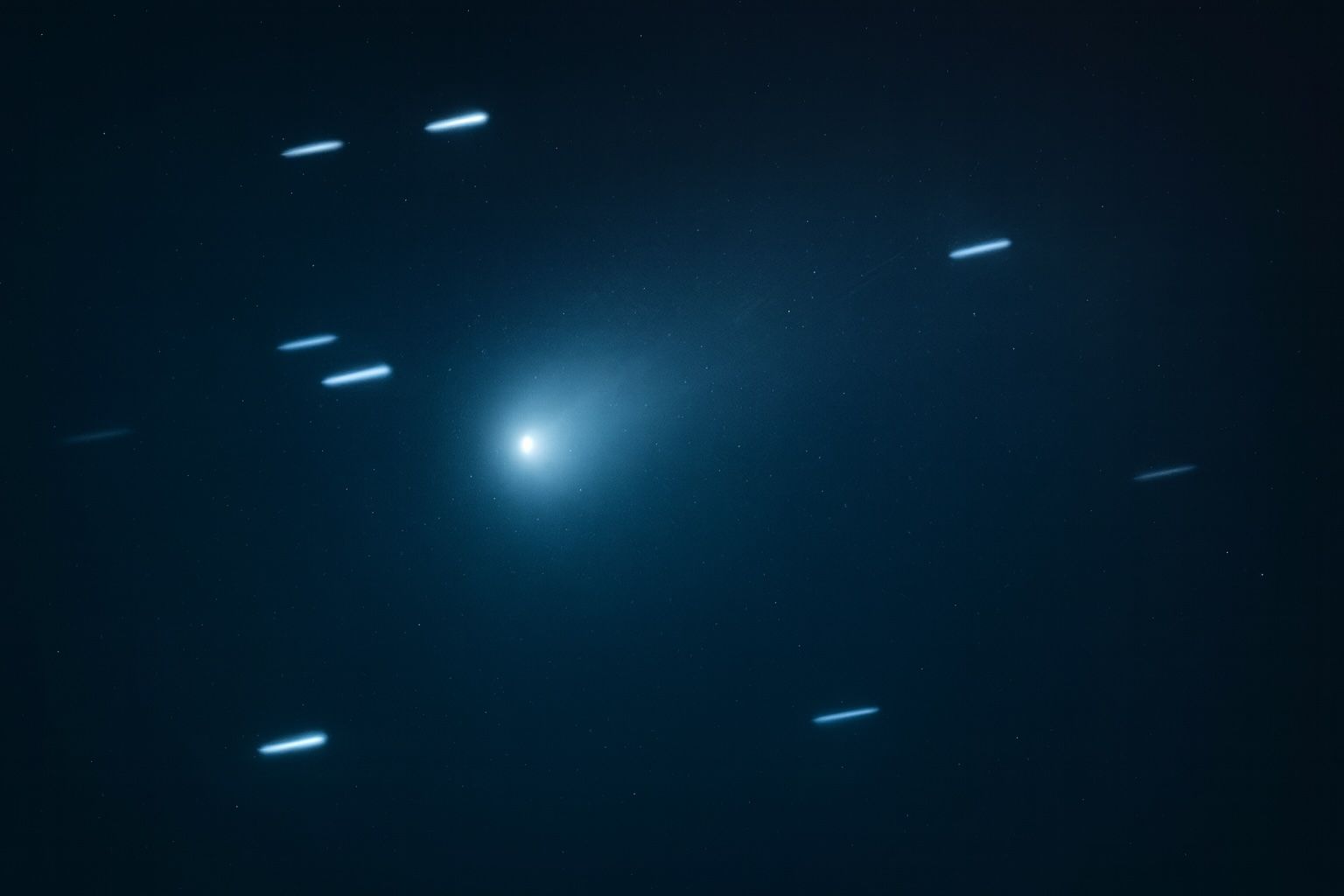
NASA’s latest Hubble image, captured on November 30 with the Wide Field Camera 3, shows 3I/ATLAS as a compact white knot wrapped in a soft halo of light – the coma – while background stars appear as streaks because the telescope tracked the comet’s motion across the sky. At the time, the comet was roughly 178 million miles (286 million km) from Earth.
Subtle structure in the Hubble frame hints at both a faint tail and jets of gas and dust erupting from sunlit regions of the nucleus. As with ordinary comets, sunlight warms embedded ices, which sublimate into gas; radiation pressure and the solar wind then sweep this material away, sculpting tails that always point roughly away from the Sun, while localized vents on the surface can produce narrow jets angled toward it.
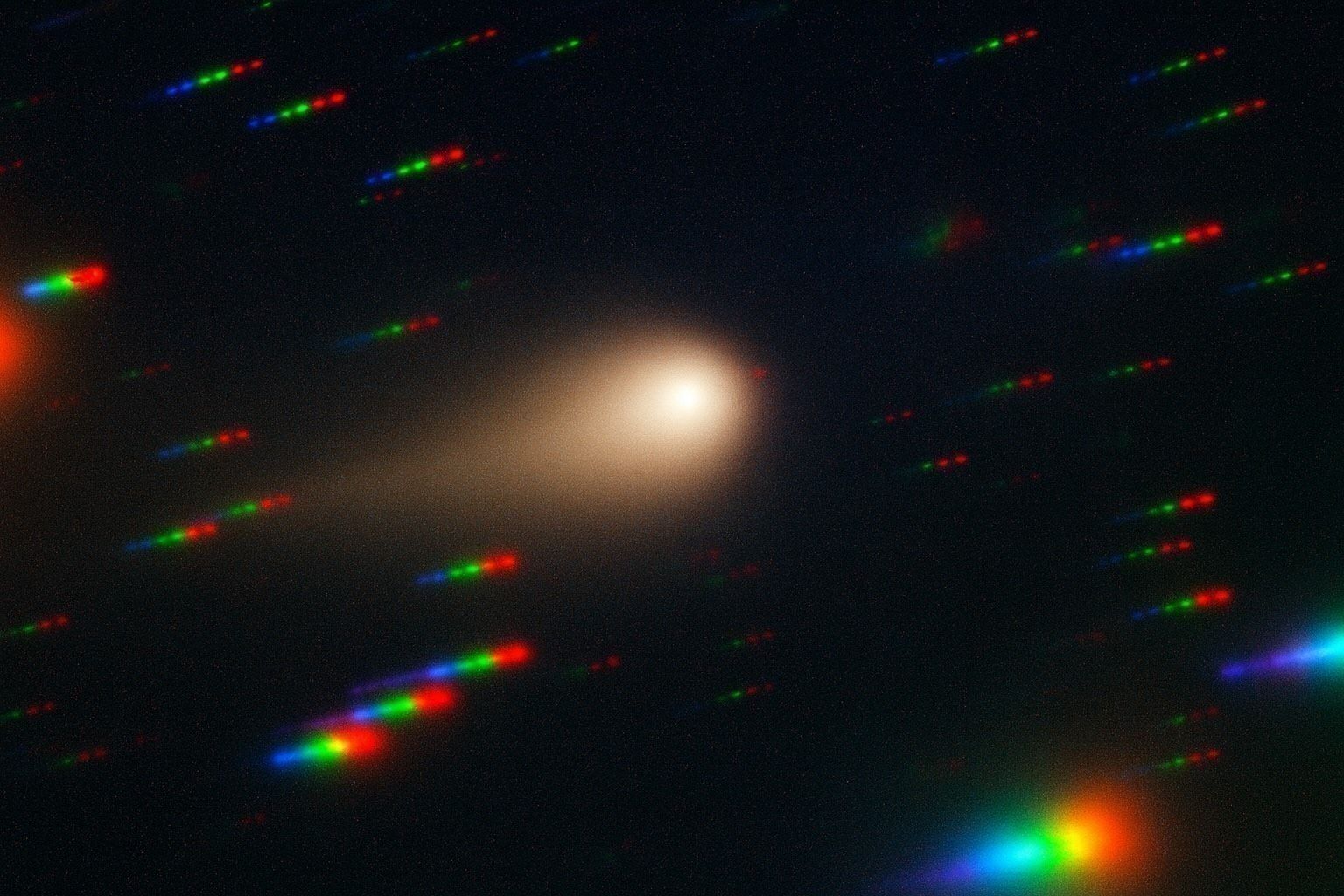
This isn’t Hubble’s first encounter with 3I/ATLAS. A July 21, 2025 image – taken when the comet was about 277 million miles (446 million km) away – allowed astronomers to estimate the size of its solid nucleus as somewhere between ~440 meters and 5.6 km across, making it likely the largest interstellar object yet studied.
The new post‑perihelion image is scientifically crucial: comparing the July and November views will help researchers track how the coma’s brightness, shape and composition evolve as the comet heats and cools, and refine models of what kinds of ices and dust grains it carries from its long‑lost home system. NASA expects Hubble and other observatories to keep following 3I/ATLAS for several months as it recedes back into deep space.
Juice’s teaser image: twin tails from a spacecraft en route to Jupiter
While Hubble watched from Earth orbit, ESA’s Juice spacecraft – launched to study Jupiter’s icy moons – briefly turned its instruments toward the interstellar visitor in November 2025.
Juice used five science instruments plus its navigation camera (NavCam) to observe 3I/ATLAS. Because the spacecraft is currently using its main high‑gain antenna as a heat shield during a close solar passage, only a sliver of data could be downlinked: a quarter of a single NavCam frame taken on November 2, just two days before Juice’s closest approach to the comet on November 4 at about 66 million km (41 million miles).
Even that preview is striking. The grainy black‑and‑white shot shows:
- A bright central coma – the glowing envelope of gas around the nucleus
- A plasma tail, made of electrically charged gas, stretching toward the top of the frame
- A fainter dust tail, formed by tiny solid particles, angling off toward the lower left
Together they confirm that 3I/ATLAS is highly active just after perihelion, shedding gas and dust into space in classic – if unusually intense – cometary fashion.
The teaser is only the beginning. Juice’s main science instruments (JANUS, MAJIS, UVS, SWI and PEP) collected spectroscopy, imaging and particle data throughout its November observing campaign. ESA expects those data to arrive in February 2026, when the spacecraft can once again use its high‑gain antenna instead of sacrificing it as a makeshift heat shield. Those measurements should reveal what the comet’s gas is made of, how fast material is flowing off the nucleus and how its activity varies with time.
A solar‑system‑wide observing campaign
3I/ATLAS is not just the target of two flagship missions. NASA has orchestrated a fleet‑wide, opportunistic campaign to track the interstellar comet from as many vantage points as possible.
According to NASA’s 3I/ATLAS observation timeline, spacecraft that have already observed the comet include:
- Hubble and James Webb Space Telescope, providing high‑resolution optical and infrared views
- The infrared surveyor SPHEREx
- The Psyche mission (en route to a metal‑rich asteroid)
- The Lucy mission to Jupiter’s Trojan asteroids
- PUNCH, SOHO, and other solar‑observing spacecraft
- Mars Reconnaissance Orbiter and MAVEN from Martian orbit
- The Perseverance rover, which briefly looked up from Jezero Crater to image the comet in the Martian night sky NASA Science+2NASA Science+2
The goal is to build a 3D, time‑lapse picture of how an interstellar comet behaves under solar heating, from multiple angles and wavelengths that no single observatory could provide.
One particularly useful data set comes from NASA’s Psyche spacecraft, which turned its multispectral imager on 3I/ATLAS on September 8–9, 2025. From about 33 million miles (53 million km) away, Psyche gathered eight hours of images that helped refine the comet’s trajectory and revealed a faint coma surrounding the nucleus. These measurements slot into NASA’s broader effort to track potentially hazardous objects and understand the diversity of small bodies passing near Earth, even when – as in this case – they are perfectly harmless.
Chemical surprises: methanol and hydrogen cyanide in abundance
If the new images show what 3I/ATLAS looks like, recent radio observations begin to reveal what it is made of.
A study submitted to arXiv on November 25, 2025, led by Nathan Roth and Martin Cordiner, reports detections of methanol (CH₃OH) and hydrogen cyanide (HCN) in 3I/ATLAS using the Atacama Compact Array of the ALMA observatory in Chile. Observations from late August to early October captured the comet before perihelion, at distances of 2.6–1.7 AU from the Sun.
Key findings from the ALMA data and today’s reporting include:
- Hydrogen cyanide (HCN) appears to be coming directly from the nucleus, consistent with simple sublimation of ices.
- Methanol (CH₃OH), by contrast, shows signs of an extended source in the coma and is enhanced on the sunward side, suggesting it is being produced or released in secondary processes after ices have left the surface.
- The CH₃OH production rate increased sharply from August through October, especially as the comet crossed inward of about 2 AU, near the inner edge of the water‑ice sublimation zone.
- On two September dates, the team derived CH₃OH/HCN ratios of ~79–124, among the highest ever measured in any comet, rivaled only by the chemically peculiar solar‑system comet C/2016 R2 (PanSTARRS).
Reporting today in The Indian Express adds additional context from the research team: HCN appears to be streaming off the nucleus at roughly 250–500 grams per second, while methanol is pouring out at around 40 kilograms per second – about 8% of all vapor coming from the comet, compared with roughly 2% typical for solar‑system comets.
These extreme values point to unusual chemistry:
- High methanol production hints that 3I/ATLAS may be rich in metals such as iron, because reactions between melted subsurface water and iron‑bearing minerals are expected to generate methanol efficiently.
- The different spatial distributions of HCN and CH₃OH suggest that the nucleus is patchy and compositionally diverse, with some regions venting directly and others feeding complex chemistry in the coma.
Methanol itself is a simple carbon‑based molecule, but it sits on key pathways toward more complex organics. Chemists regard it as a building block in prebiotic chemistry, the cascade of reactions that can eventually lead to amino acids, sugars and other ingredients of life. The ALMA detections therefore put 3I/ATLAS squarely in the middle of ongoing debates about how widely the “raw materials” for life may be scattered between star systems. arXiv+2The Indian Express+2
None of this means the comet carries life. What it does demonstrate is that star systems other than our own can produce icy bodies loaded with complex organics, and that those bodies occasionally pass through our backyard where we can study them up close.
How close will 3I/ATLAS get – and can you see it?
Despite some breathless headlines, 3I/ATLAS is not coming anywhere near a collision course with Earth. NASA’s trajectory models show that on December 19, 2025, the comet will be about 1.8 AU from our planet – around 170 million miles (270 million km) away. That’s farther from Earth than Mars ever gets at its closest and nearly twice Earth’s distance from the Sun.
For skywatchers, the bad news is that 3I/ATLAS will never become a naked‑eye spectacle like some historic comets. As it emerged from behind the Sun in early December, estimates put its brightness at around magnitude 11–12, making it a target for moderate to large amateur telescopes under dark skies, not binoculars.
According to current ephemerides, the comet is:
- Reappearing in the morning sky, moving from the constellation Virgo toward Leo through December
- Brightening slightly around mid‑month before gradually fading as it heads back outward from the Sun Wikipedia+1
To attempt an observation, observers will need:
- A detailed, up‑to‑date star chart or planetarium app using current 3I/ATLAS coordinates
- At least a 20 cm (8‑inch) telescope under reasonably dark skies
- Patience: the comet is small and diffuse, more like a softly glowing puff than a classic bright “comet with a tail” in amateur eyepieces
NASA’s interactive “Eyes on the Solar System” tool also lets users follow the comet’s path in 3D and see exactly where it is relative to Earth, the Sun and spacecraft chasing it. NASA Science
Are the “alien probe” and “seeding life” claims credible?
The dramatic behaviour of 3I/ATLAS – its sudden brightness surges, color changes and unusual sunward‑pointing dust structures (“anti‑tails”) – has fuelled intense online speculation.
Harvard astrophysicist Avi Loeb, known for provocative ideas about interstellar objects, has argued in blog posts and interviews that 3I/ATLAS might be a technological artifact or part of a “cosmic gardening” campaign by advanced civilizations, potentially delivering life‑forming ingredients to planets like Earth. These ideas, summarised in coverage by outlets such as The Economic Times, lean on the comet’s odd orbit, chemistry and reported “heartbeat‑like” variations in brightness. The Economic Times+1
Mainstream planetary scientists, however, see no hard evidence that 3I/ATLAS is anything other than a highly active, natural comet:
- NASA’s official communications consistently describe 3I/ATLAS as an interstellar comet with a hyperbolic trajectory and explicitly state that it is a natural object which poses no threat to Earth.
- Features like anti‑tails – where dust appears to stream toward the Sun rather than away from it – are well‑known in comet science and arise from combinations of dust grain dynamics and viewing geometry, not technology.
- The “weird” chemistry revealed by ALMA (high methanol, unusual CH₃OH/HCN ratios) fits comfortably within models of volatile‑rich or metal‑rich comets and does not require artificial explanations. European Space Agency+3arXiv+3The Indian Express+3
In other words, 3I/ATLAS is exciting precisely because it is an extreme natural comet from another star system – not because it breaks the known laws of physics. The data we’re collecting now are helping refine those laws, not overturn them.
Why 3I/ATLAS matters long after it’s gone
As 3I/ATLAS speeds toward and past its December 19 closest approach to Earth, every new observation adds to an unprecedented dataset:
- Multi‑wavelength images from Hubble, Juice, Psyche, Mars orbiters and solar missions are mapping how an interstellar comet switches on and off as it moves through a foreign star’s environment – ours.
- ALMA’s chemical maps show that at least some interstellar comets carry abundant, complex organics like methanol and hydrogen cyanide, strengthening the idea that star systems can swap prebiotic “starter kits” via comets and debris. arXiv+2The Indian Express+2
- Age estimates suggest 3I/ATLAS may be older than our Sun, perhaps formed over 7 billion years ago in a different stellar nursery, making it a literal fossil from another epoch of the Milky Way.
Future missions may one day intercept such visitors directly – concepts exist for fast‑chase spacecraft that could rendezvous with an interstellar comet if it’s discovered early enough – but 3I/ATLAS arrived too suddenly for that. Instead, humanity is doing the next best thing: turning every available telescope toward it, from professional observatories to backyard scopes.
In a few months, 3I/ATLAS will fade beyond the reach of even our best instruments and slip back into the “cosmic dark” between the stars. The images and spectra we are gathering right now – from Hubble’s streaked star fields to Juice’s twin‑tailed snapshot and ALMA’s chemical fingerprints – will be our enduring record of this brief encounter with a messenger from another world.
Related articles: NASA