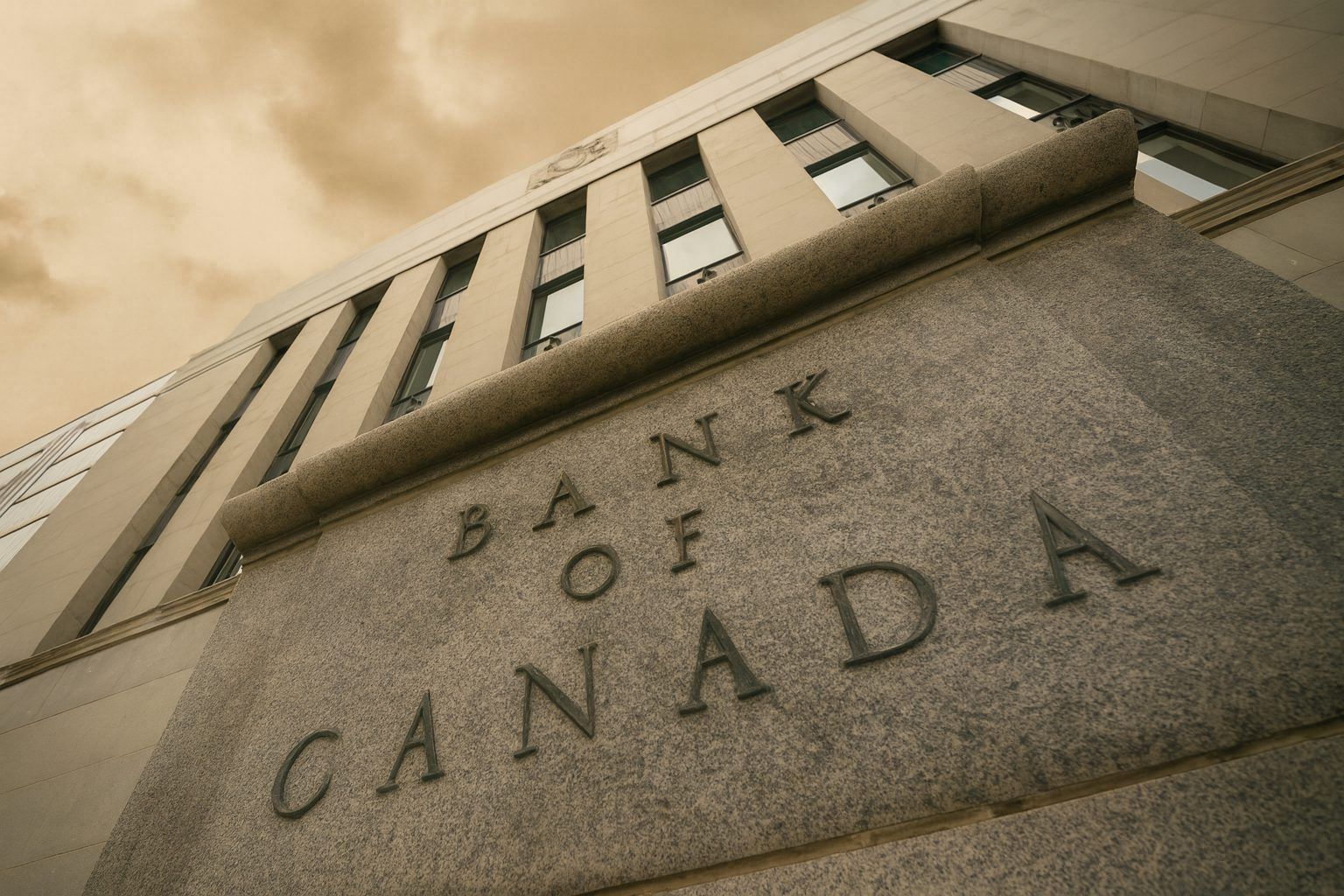
Ottawa / Toronto / New York – December 8, 2025
With just two days to go before the Bank of Canada’s final interest rate announcement of 2025, markets and economists are almost unanimous: the Bank will likely hold its key rate at 2.25% on Wednesday, even as the U.S. Federal Reserve is widely expected to deliver another quarter‑point cut the same day.
The twin decisions, landing within minutes of each other on December 10, will cap a year defined by aggressive rate cuts, tariff‑driven uncertainty and a surprisingly resilient North American economy.
When and how the Bank of Canada will announce its decision
The Bank of Canada has formally confirmed that it will announce its December interest rate decision on Wednesday, December 10, 2025 at 9:45 a.m. Eastern. A press release explaining the move will be published on the Bank’s website at the same time, followed by a 10:30 a.m. press conference with Governor Tiff Macklem and Senior Deputy Governor Carolyn Rogers.
Key logistics for the day:
- 9:45 a.m. ET – Policy statement and press release posted online; media lock‑up embargo ends.
- 10:30 a.m. ET (approx.) – Live press conference and webcast from the Bank’s Ottawa headquarters.
On the other side of the border, the U.S. Federal Reserve’s Federal Open Market Committee (FOMC) is set to conclude its own two‑day meeting on December 10, with markets overwhelmingly expecting a 25‑basis‑point rate cut from the current 3.75–4.00% target range. Futures and poll data put the probability of a cut around 85–90%, according to a combination of Reuters reporting, CME FedWatch data and recent bank research.
Together, the BoC and Fed decisions are the marquee macro events on this week’s economic calendar, highlighted in market previews and weekly outlooks from Baystreet/Baystreet.ca and RBC Economics.
A year of cuts: how we got to 2.25%
The Bank of Canada’s key interest rate currently sits at 2.25%, down a full percentage point from 3.25% at the start of 2025 and 2.50% as recently as September.
According to the Bank’s official policy rate history, the path this year has been:
- January 29, 2025 – Cut 25 bps to 3.00%
- March 12, 2025 – Cut 25 bps to 2.75%
- September 17, 2025 – Cut 25 bps to 2.50%
- October 29, 2025 – Cut 25 bps to 2.25%
The October move came with a strong hint that the easing cycle was at or near its end. In its October statement and related commentary, the Bank signalled that “the current policy rate is about the right level” to keep inflation near its 2% target while helping the economy adjust to steep U.S. tariffs and supply‑chain reconfiguration. Bank of Canada+2Bank of Canada+2
A Reuters poll of 33 economists conducted between December 2 and 5 found unanimous expectations that the Bank will hold at 2.25% on December 10. After cumulative cuts of 275 basis points—one of the most aggressive easing cycles among G10 central banks—most economists now suspect the Bank is done cutting at least until 2027.
Why economists see “no major compelling reason” to cut again
As of December 8, the emerging consensus among analysts is that there is “no major compelling reason” for the Bank of Canada to trim rates again this week. That phrase comes from a widely shared Financial Post/Yahoo Finance piece summarising economists’ views ahead of Wednesday’s decision. Yahoo Finance
Several strands of analysis point in the same direction:
- C.D. Howe Institute’s Monetary Policy Council (MPC) — a “shadow” council including chief economists from major banks and academic experts — recommended on December 4 that the Bank hold its overnight rate at 2.25% at this meeting and keep it there for the coming year. The group concluded there was no compelling evidence for a change in policy since the October decision. C.D. Howe Institute
- Reuters poll — All economists surveyed expect a hold; the majority think the Bank will stay on hold at least until 2027, barring a major shock.
- Canadian Press / CityNews reporting — A Canadian Press piece published December 8 notes that economists expect the Bank to “move to the sidelines” after guiding the economy through a year dominated by trade and tariff uncertainty, having already cut four times in 2025. CityNews Ottawa
In short, after a front‑loaded easing campaign, the prevailing view is that monetary policy is now appropriately stimulative, and further cuts would risk re‑igniting inflation or overheating interest‑sensitive sectors like housing.
The data behind the call: inflation, jobs and growth
Inflation is back near target – but not too low
Canada’s inflation picture has cooled markedly compared with the peaks of previous years:
- Headline CPI rose 2.2% year‑over‑year in October 2025, down from 2.4% in September and comfortably within the Bank’s 1–3% target band.
- The Bank’s own dashboard shows total inflation “around 2%” and underlying inflation metrics around 2½%, consistent with its October Monetary Policy Report. Statistics Canada+2Bank of Canada+2
A key driver of the recent moderation has been lower gasoline and softer grocery inflation, partly helped by the removal of the carbon levy on gasoline and lower global oil prices. Mortgage interest costs—which spiked earlier in the tightening cycle—have also eased as rate cuts feed through, even as rent inflation remains elevated.
From the Bank’s perspective, this is almost textbook: inflation is close to target but not dangerously low, and “core” measures have drifted down rather than collapsing. That combination makes a further rate cut harder to justify unless growth or employment suddenly weaken.
Labour market resilience reduces pressure for more easing
The November Labour Force Survey delivered another upside surprise:
- Unemployment fell to 6.5% in November, its lowest level in 16 months and down from 7.1% in September.
- Canada added roughly 53,000 jobs in November, marking the third straight month of solid gains, led by healthcare and social assistance.
RBC Economics notes that the labour market has “firmed again,” with rising employment and declining joblessness offsetting the weakness seen earlier in 2025 when tariffs first hit export‑exposed sectors. RBC+1
In practical terms, a job market that is strengthening rather than deteriorating undermines the case for further emergency‑style easing. It supports the argument—echoed by both the C.D. Howe MPC and many bank economists—that the Bank can now stand back and watch how previous cuts filter through the economy.
Growth has rebounded from a mid‑year slump
Real GDP data tell a similar story of “better than feared” resilience:
- Q3 2025 GDP grew 0.6% quarter‑over‑quarter (about 2.6% annualized), reversing a 0.5% contraction in Q2. The rebound was driven by improving net exports and government spending, while household consumption and business investment remained mixed.
- The Bank’s October Monetary Policy Report framed this as the economy adjusting to steep U.S. tariffs and changing trade patterns rather than sliding into outright recession.
For the December decision, this backdrop matters: it suggests the Canadian economy is growing modestly, not contracting, even as it navigates trade disruptions and political uncertainty in Washington. Combining moderate growth with near‑target inflation is exactly the environment in which central banks typically prefer to hold rather than move rates.
Trade shocks, tariffs and a year of uncertainty
Much of 2025’s monetary policy drama has been driven by trade:
- The U.S. administration’s sweeping tariffs on many trading partners, including steep levies on Canadian steel, aluminum and selected manufactured goods, forced the Bank of Canada to model a wide range of scenarios earlier in the year.
- For several months, the Bank refrained from giving a single central economic forecast, instead publishing scenario analysis that balanced the risk of a stagflationary shock—weak growth and higher prices—with the possibility that tariffs would mainly hit output.
As more data have rolled in, the picture has become clearer: growth slowed but did not collapse; inflation has stayed near 2%; and the labour market has stabilised. That explains why Governor Macklem and his Governing Council were comfortable cutting to 2.25% in October, then signalling that the policy rate is now likely at its “about right” level if the outlook unfolds as expected. Bank of Canada+2Livesquawk+2
How the Fed’s expected cut could affect Canada
While the Bank of Canada is expected to stand pat, the Fed is widely seen as moving in the opposite direction this week:
- Multiple global brokerages, including Nomura, JPMorgan and Morgan Stanley, now forecast a 25‑basis‑point Fed cut at the December 9–10 meeting, after previously expecting a hold.
- Futures pricing via the CME FedWatch tool shows roughly 85–90% odds of a cut, according to Reuters and market commentary.
- Analysts also expect a split FOMC, with several hawkish dissents, making this one of the most contentious Fed meetings since 2019.
RBC Economics and other forecasters characterize the expected move as the third consecutive 25‑basis‑point Fed cut, aimed at insuring against a cooling U.S. labour market and softer spending data.
For Canada, a Fed cut alongside a BoC hold could have several implications:
- Canadian dollar – All else equal, a relatively higher Canadian policy rate tends to support the loonie, though trade tensions and oil prices are also critical drivers. Recent stronger jobs data already pushed the currency to a 10‑week high.
- Bond yields – Canadian short‑term yields may track U.S. yields lower, even if the BoC doesn’t move, tightening or loosening financial conditions at the margin.
- Future BoC flexibility – If the Fed moves more aggressively in 2026, it could give the Bank of Canada more room to stay on hold without putting excessive downward pressure on the Canadian dollar, or it could eventually nudge the Bank toward hikes if global financial conditions loosen too quickly.
For now, though, most Canadian analysts see the Fed’s likely cut and the BoC’s likely hold as complementary rather than conflicting: both are trying to keep growth alive while ensuring inflation remains tamed.
What it means for mortgages, housing and households
Mortgages and borrowing costs
After four quarter‑point cuts in 2025, many variable‑rate borrowers have already seen noticeably lower interest payments compared with late 2024. Banks and mortgage lenders have gradually passed lower policy rates through to prime rates and, to varying degrees, to new fixed‑rate offers.
A hold at 2.25% on December 10 would likely mean:
- Little immediate change for variable‑rate borrowers, aside from minor moves driven by bank funding costs and bond yields.
- Fixed mortgage rates—key for new buyers and refinancers—would remain more sensitive to global bond markets and the Fed decision than to the BoC hold itself.
Housing market and affordability
Despite the large BoC cuts since 2024, Canada’s housing market has been slow to fully rebound:
- Reuters reports that national home prices have fallen about 3.2% in 2025, even as low borrowing costs gradually revive demand.
- The same poll suggests prices will start rising again—1.8% in 2026 and 3.5% in 2027—as rate cuts work their way through and affordability improves for first‑time buyers.
Economists at RBC and others argue that the existing rate cuts have already “unlocked” some pent‑up demand among would‑be buyers sidelined by the earlier high‑rate environment. A stable rate at 2.25% could reinforce this trend by giving buyers more confidence that borrowing costs won’t suddenly surge again. Reuters+1
Key things to watch on December 10
Even if the headline result is “no change,” the details of Wednesday’s announcements will matter.
1. Tone of the Bank of Canada statement
Markets will scrutinize whether the Bank:
- Emphasizes downside risks from trade wars and global growth, or
- Starts to hint at the conditions under which it might raise rates again in 2026 or beyond.
Any shift in language away from October’s “about the right level” phrase will be closely parsed. Bank of Canada+2Livesquawk+2
2. Discussion of inflation metrics and data “noise”
After a year of distorted inflation readings—affected by tariffs, supply‑chain shifts and the removal of the carbon price—the Bank has acknowledged it must refine how it measures underlying inflation. Analysts will listen for clues about which metrics the Governing Council now trusts most and how that might shape future decisions.
3. Any hints on the 2026 mandate renewal
The Bank’s formal mandate is due for renewal in 2026, and the question of whether it should keep its current 2% inflation‑target framework or tweak it (for example, toward a dual inflation‑and‑employment focus) is already on economists’ radar. Expect questions at the press conference about how this year’s experience with tariffs and noisy data might influence that debate.
Bottom line: A likely pause in Canada as the Fed moves again
As of December 8, 2025, the story on both sides of the border can be summed up simply:
- Bank of Canada – After one of the steepest easing cycles in the developed world, the Bank is widely expected to hold its policy rate at 2.25% on December 10 and stay on the sidelines for much of 2026, unless the economy takes an unexpected turn.
- Federal Reserve – Markets and major banks expect a quarter‑point cut this week, though the decision is likely to be contentious, with several hawkish officials dissenting.
For Canadian households, businesses and investors, that combination points to a period of relative stability in domestic borrowing costs, even as global financial conditions ease further. The real action on Wednesday may not be the BoC’s headline “no change,” but rather what policymakers say about 2026 and beyond.