
As of about 12:30 p.m. ET on Friday, Dec. 12, 2025, big tech stocks are under pressure as Broadcom’s margin warning and Oracle’s OpenAI data-center delays reignite “AI bubble” debate, while Nvidia’s China chip demand story and fresh Apple/Google legal headlines shape sentiment.
NEW YORK — Big tech is having a rough midday on the U.S. stock market, with investors rotating away from AI-linked hardware and mega-cap growth after a pair of closely watched signals: Broadcom’s earnings beat paired with a margin caution, and Oracle’s stumbles tied to its OpenAI infrastructure push. Those headlines have pushed the tech-heavy complex lower even as the broader market tries to hold onto its recent post‑Fed momentum.
Below is where the major names stand around 12:30 p.m. ET, what’s driving the move, and what analysts are watching next.
Midday market snapshot: Tech is leading the pullback
Trading action has deteriorated since the open. Early Friday, Reuters noted the Dow was up while the S&P 500 and Nasdaq slipped, underscoring rotation away from mega-cap tech.
By roughly 12:30 p.m. ET, ETF proxies show the selling pressure has broadened:
- Invesco QQQ (Nasdaq 100 proxy): down about 1.85%
- Technology Select Sector SPDR (XLK): down about 2.60%
- VanEck Semiconductor ETF (SMH): down about 3.78%
- SPDR S&P 500 ETF (SPY): down about 1.09%
- SPDR Dow Jones Industrial Average ETF (DIA): down about 0.48%
Macro context still matters. Investopedia notes the 10-year Treasury yield rose to about 4.19% from 4.08%, and points out the Fed cut its key rate this week by a quarter point to a 3.5%–3.75% range—a backdrop that can help equities, but doesn’t eliminate valuation and profitability worries in AI-heavy names.
The big catalyst: AI profitability anxiety is back in the driver’s seat
Broadcom: Beat-and-raise meets “margin dilution” fears
Broadcom became the day’s lightning rod. Even with an upbeat revenue outlook, investors are focused on the company’s warning that gross margins will dip as AI becomes a larger share of sales—an uncomfortable message in a market that’s priced AI infrastructure as a high-margin bonanza.
Reuters reported Broadcom forecast quarterly revenue of $19.1 billion (above estimates) but warned margins would fall, with management pointing to a richer mix of lower-margin AI-related business; CFO commentary flagged roughly 100 basis points of sequential margin pressure. Reuters also noted Broadcom is investing heavily in AI systems and custom chips, with management highlighting a $73 billion backlog over the next 18 months concentrated in a small number of large customers.
At about 12:30 p.m. ET, Broadcom shares are down roughly 10.7%.
Why it matters for the whole sector: When a bellwether suggests AI revenue can be “good” but less profitable than hoped, the market quickly marks down adjacent names—especially semis and high-multiple AI software beneficiaries.
Oracle: OpenAI-linked delays and spending shock rattle the AI trade
Oracle is the other epicenter of the selloff narrative. Reuters reported Oracle has pushed back the completion dates for some data centers it is developing for OpenAI to 2028 from 2027, citing a Bloomberg News report that attributed delays to labor and material shortages. Reuters added that Oracle’s shares were down nearly 5% at the time and that other AI-linked chip names fell in sympathy.
At about 12:30 p.m. ET, Oracle is down roughly 5.1%.
This comes on top of the earlier shock from Oracle’s earnings cycle: Reuters analysis described how Oracle shares fell as much as 16.5% Thursday after the company warned its fiscal 2026 capex would be $15 billion higher than it had estimated in September—reigniting concern over AI spending, debt, and the timing of returns.
Nvidia: China demand headlines collide with geopolitics and supply constraints
Nvidia is also in the spotlight—though today’s tape is less about earnings and more about policy and demand.
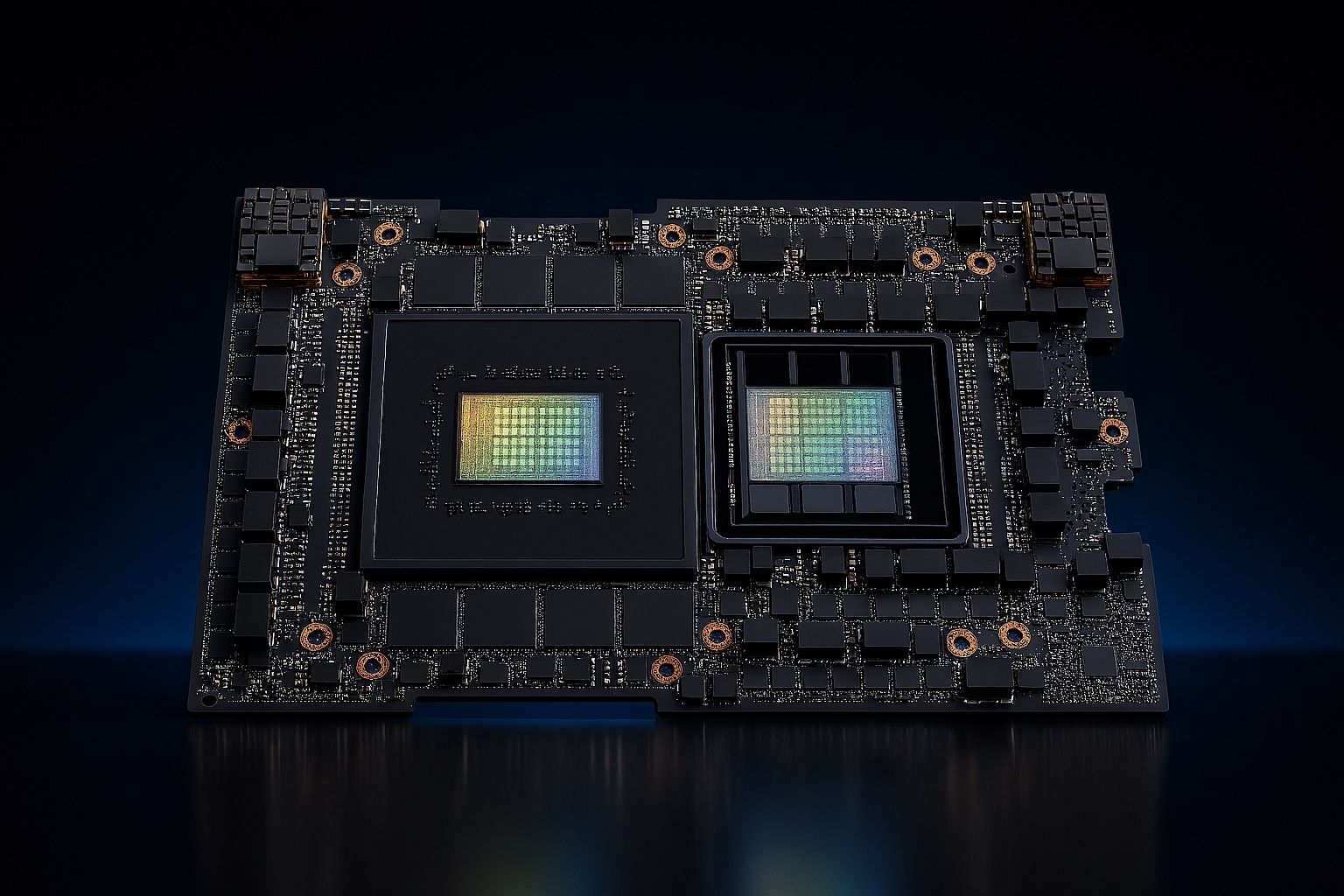
Reuters reported Nvidia is considering expanding production of its H200 AI chips amid unexpectedly strong demand from Chinese firms, following a decision by U.S. President Donald Trump to allow H200 exports to China with a 25% fee; Reuters said Chinese companies including Alibaba and ByteDance are seeking significant orders. The report also highlighted potential regulatory friction and capacity constraints at advanced manufacturers.
Despite that seemingly bullish demand signal, Nvidia is still trading down around 2.4% near midday, reflecting the broader de-risking in AI hardware.
Magnificent Seven check-in: Midday prices and what’s moving each name
As of about 12:30 p.m. ET, the “Magnificent Seven” are mostly red, with Tesla the notable exception:
- Apple (AAPL): about $277.86, down 0.06%
- Microsoft (MSFT): about $477.68, down 1.20%
- Alphabet (GOOGL): about $308.40, down 1.29%
- Amazon (AMZN): about $226.26, down 1.75%
- Meta (META): about $642.92, down 1.50%
- Nvidia (NVDA): about $176.51, down 2.44%
- Tesla (TSLA): about $448.23, up 0.30%
Apple: A legal headline that could shape App Store economics
Apple is trading relatively steady, but there’s meaningful legal news in the background. Reuters reported Apple won a partial reversal of sanctions tied to its Epic Games dispute: the appeals court modified parts of a lower-court order, while still upholding much of the earlier injunction. The ruling gives Apple an opening to argue for a “reasonable commission” on certain purchases that occur outside Apple’s platform—relevant to ongoing debates over App Store fees and competition. Reuters+1
Alphabet: EU antitrust risk re-enters the chat
Alphabet is down modestly as investors weigh a fresh regulatory overhang. Reuters reported Google is expected to face an EU antitrust fine next year over concerns it hasn’t done enough to comply with the Digital Markets Act rules against self-preferencing in search; Reuters noted potential fines can reach up to 10% of global annual turnover for DMA violations.
Tesla: Stock resilience despite a U.S. demand hit
Tesla is bucking the mega-cap trend on price, but the news flow is mixed. Reuters reported Tesla’s U.S. sales fell nearly 23% in November to 39,800 vehicles (from 51,513 a year earlier), with the report tying some of the demand pressure to the end of $7,500 federal EV tax credits and noting questions about whether cheaper “Standard” variants are cannibalizing higher-trim demand. Reuters
Barron’s similarly highlighted the tension: weak sales data vs. the market’s continued willingness to value Tesla as an AI and autonomy story.
The under-the-surface theme: AI capex is colliding with debt and credit markets
One reason “AI bubble” language keeps returning is that the AI buildout is increasingly colliding with the plumbing of markets: debt issuance, project finance, and long-duration capex cycles.
Reuters reported a UBS view that AI data center and project financing surged to $125 billion so far in 2025, up from $15 billion in the same period of 2024. Reuters also cited the Bank of England warning that the growing role of debt in AI infrastructure could heighten financial stability risks if valuations correct.
Crucially, Reuters added that mega tech debt issuance has been rising (including mega deals cited for Oracle and Meta), and that AI-linked companies now account for 14% of JPMorgan’s investment-grade index, surpassing U.S. banks as the dominant sector in that benchmark.
This doesn’t mean the AI buildout is “over.” But it helps explain why the market is suddenly less tolerant of “spend now, monetize later” narratives—especially after earnings and guidance disappointments.
What analysts are saying: Bubble fears vs. “company-specific” issues
Reuters’ analysis framing today is a tug-of-war:
- Some investors see Oracle as a special case—trying to become a hyperscaler without the same cash-flow cushion as the largest cloud players.
- Others argue the market is simply getting more selective: the correlation between aggressive AI capex and higher stock prices has weakened “beneath the surface,” according to one strategist quoted by Reuters. Reuters
- Data on short positioning suggests skepticism is showing up more in targeted trades than in a broad “AI crash” bet against the biggest names, per Reuters. Reuters+1
Investopedia also captured the mood shift: Broadcom’s drop—despite strong results—signals investors are demanding clearer evidence that AI-driven revenue growth will come with durable profitability, even as many Wall Street analysts remain broadly constructive on the longer-term AI cycle.
What to watch into the close and beyond
For the rest of today and into year-end positioning, traders and long-term investors are likely to stay focused on a few swing factors:
- Profitability vs. growth in AI hardware: Guidance that implies margin dilution (even with strong revenue) can hit the entire chip and AI-infrastructure complex.
- OpenAI infrastructure timelines: Any additional confirmation of delays, cost overruns, or supply constraints could keep pressure on Oracle and sentiment around AI capex more broadly.
- Rates and yields: The market is still digesting this week’s Fed move; higher yields can compress multiples for long-duration growth stocks.
- Regulatory headlines: Apple’s App Store ruling and Google’s EU antitrust risk show that “policy risk” remains a live variable for mega caps even when earnings are solid. Reuters+1
Note: Market prices move quickly. The quotes in this update reflect trading around 12:30 p.m. ET on Dec. 12, 2025. This is news and analysis, not investment advice.