
Gold prices are consolidating near record territory on Thursday, December 18, 2025, as traders juggle two powerful forces pulling in opposite directions: a still-resilient U.S. dollar and the renewed case for lower U.S. interest rates after a cooler-than-expected inflation reading.
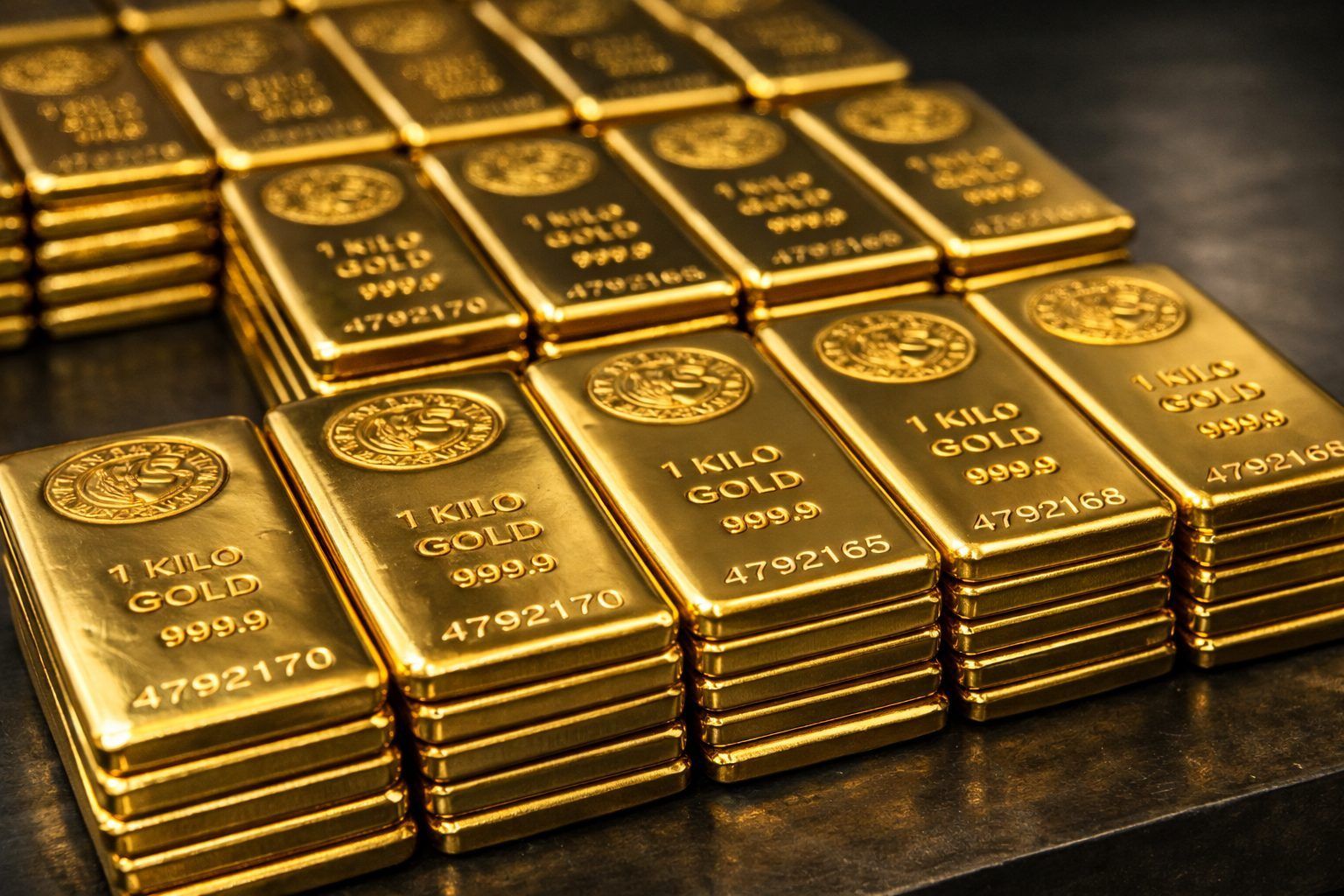
In early trading, spot gold was around the $4,330-per-ounce area, modestly lower on the day after a strong prior-session move, while U.S. gold futures were also fractionally softer.
But the bigger story for bullion today is macro: U.S. CPI cooled to 2.7% year-on-year in November, under the 3.1% consensus forecast in a Reuters poll—fuel for the “rates can fall further” narrative that has helped propel gold’s historic 2025 rally. Reuters+1
Gold price snapshot around today’s 09:55 update
Gold’s headline price action on Dec. 18 is best described as steady-to-soft, not a collapse—more like a market taking a breath near all-time highs after an extraordinary year.
- Spot gold: roughly $4,330/oz (slightly down on the session) Reuters+1
- U.S. gold futures: roughly $4,360/oz (also slightly lower) Reuters+1
A later read from Reuters showed spot gold down 0.4% to $4,323.57/oz (as of 12:10 GMT) with U.S. futures down 0.4% to $4,356.10, underscoring the day’s “small dip” tone rather than any trend break. Reuters
Investing.com, meanwhile, cited spot gold at $4,336.54/oz at 09:15 ET (14:15 GMT), with February gold futures at $4,370.30/oz—again consistent with a narrow, high-level range.
What’s driving gold today: dollar strength vs. rate-cut optimism
1) The U.S. dollar was a near-term headwind—until CPI hit
One of the simplest relationships in commodities is also one of the most reliable: a stronger dollar can pressure gold, because it makes dollar-priced bullion more expensive for overseas buyers.
Reuters noted the dollar index edged up after touching a near one-week high the prior session, a factor weighing on gold as traders positioned cautiously ahead of inflation data.
But CPI shifted the balance.
After the data, Reuters reported the dollar index weakened (down 0.12% to 98.25 in that update) and Treasury yields fell, an environment that typically improves gold’s appeal.
2) U.S. inflation surprised lower: CPI 2.7% vs. 3.1% expected
The headline macro catalyst today is the CPI undershoot:
- Headline CPI:+2.7% YoY in November
- Core CPI (ex food & energy):+2.6% YoY
- Consensus forecast:+3.1% YoY for headline CPI (Reuters poll) Reuters
There’s an important nuance: Reuters reported the CPI release was affected by a 43-day government shutdown, and the Bureau of Labor Statistics did not publish month-to-month CPI changes because October data collection was disrupted. That “data quality caveat” is a big reason why markets may be hesitant to chase gold aggressively higher on a single print. Reuters
Even so, softer inflation tends to push investors toward the view that real yields can fall, which is a structural positive for non-yielding assets like gold.
The Fed narrative: rate cuts, politics, and the next chair question
Gold’s 2025 surge has been tightly linked to the belief that the U.S. is in, or nearing, a lower-rate regime. Today’s flow of Fed-related headlines reinforced that debate.
Reuters highlighted that:
- Markets were pricing two additional 25-basis-point rate cuts next year in the update it cited.
- Fed Governor Christopher Waller said the central bank still has room to cut amid rising job market weakness.
- U.S. President Donald Trump said the next Fed chair will be someone who believes in lower interest rates “by a lot,” and that a successor to Fed Chair Jerome Powell would be announced early next year. Reuters
For bullion investors, this mix matters because gold can react to two things at once:
- Actual policy expectations (rate cuts = supportive), and
- Perceived institutional risk (concerns about independence or political pressure can support safe-haven demand).
Reuters’ broader gold-forecast reporting this week explicitly included worries about Fed independence among the factors analysts see supporting bullion into 2026.
Central bank day in Europe adds context: BoE cuts, ECB holds, BoJ next
Dec. 18 isn’t only about the Fed. It’s also a heavyweight central-bank week globally, and those decisions feed into FX and bond-market moves that spill over into gold.
Investing.com reported:
- The Bank of England cut rates by 25 bps
- The European Central Bank held rates steady
- The Bank of Japan decision is due Friday, with markets widely pricing a 25 bps hike Investing.com Nigeria
That mix matters for gold in two ways:
- Currency channels: The more global central banks diverge, the more volatile FX can become—often boosting demand for hard assets as portfolio stabilizers.
- Global real-rate expectations: If major central banks lean easier (or if easing cycles broaden), it can reinforce the long-run case for holding gold.
Silver, platinum, palladium: the broader precious-metals complex is still “hot”
Gold isn’t moving in isolation. On Dec. 18, Reuters and Investing.com both highlighted unusual strength across precious metals:
- Silver hovered close to its record highs after a huge year-to-date surge, supported by industrial demand and a supply deficit.
- Reuters cited silver’s record high at $66.88/oz in the prior session and noted the metal had risen ~129% year-to-date in that report.
- Platinum and palladium also pushed to multi-year highs in Reuters’ update, reflecting a broad “metals bid,” not just a gold-only trade. Reuters+1
Why this matters for gold: when the whole complex runs together, positioning risk rises—profit-taking in one metal can spill into others, even if gold’s fundamentals remain bullish.
Regional news that matters: Thailand targets gold-trade flows, Australia posts a “gold bonanza”
Thailand: central bank calls for tighter gold-trade controls
One of today’s most striking region-specific stories comes from Thailand, where policymakers are explicitly linking gold trading to currency-market stress.
Reuters reported the Thai central bank is urging the finance ministry to regulate gold trading after a surge in transactions helped push the baht higher, with the governor saying that on days of sharp baht strength, gold transactions can account for about half of the flows driving the move.
For global gold readers, the takeaway is bigger than Thailand: it’s a real-time example of how active gold trading and cross-border flows can become macro-relevant, affecting currencies, policy debates, and potentially even local market access and liquidity.
Australia: higher export earnings, gold becomes a top-tier export
Australia’s government-linked commodity outlook also underscored how gold’s high price level is reshaping the real economy.
Reuters reported Australia revised expected resource export earnings up 4% to A$383 billion for the current financial year, pointing to record gold prices as a key contributor. It also said gold is set to become Australia’s second most valuable resource export (after iron ore) in the 2025–26 financial year.
Notably, that report included a forward-looking anchor: it said gold prices are likely to remain strong at around $4,000/oz over 2026 before falling in 2027 (in that outlook).
That matters for the “forecast” question investors keep asking: even more cautious government-linked assumptions are now using $4,000 gold as a baseline for next year—a remarkable reset compared with the pre-2024 era.
Gold forecast 2026: why $5,000 is on the table—and why the rally could cool
A day before today’s CPI-driven headlines, Reuters published one of the most comprehensive roundups of the market’s 2026 gold forecasts—and the range is wide.
Key points from that Reuters analysis:
- Gold is up ~64% in 2025 and hit a record $4,381/oz in October.
- Analysts at JPMorgan, Bank of America, and Metals Focus see bullion reaching $5,000/oz in 2026.
- Morgan Stanley forecast gold at $4,500/oz by mid-2026, while JPMorgan projected averages above $4,600 in Q2 and more than $5,000 in Q4, and Metals Focus saw $5,000 by end-2026.
- More conservative, Macquarie projected an average of $4,225 in 2026, describing a world that may “stabilise a bit,” with growth improving and real rates staying relatively high. Reuters
The structural pillars bulls keep citing
The same Reuters report laid out why strategists believe this cycle has different “supports” than older gold booms:
- Central-bank reserve diversification is expected (for a fifth consecutive year) to underpin demand.
- JPMorgan’s metals strategy team estimated that to keep prices flat, quarterly central bank + investment demand of about 350 metric tons is needed—and forecast buying could average 585 tons per quarter in 2026.
- Investor gold holdings as a share of total assets under management rose to 2.8% from pre-2022 levels of 1.5% (per JPMorgan’s commentary in that report), indicating a bigger strategic allocation pool than in prior cycles.
The risks: corrections, forced selling, and “bubble” talk
Even in a bullish framework, the risks are real:
- Reuters reported the BIS warned this month that gold and share prices soaring together is a phenomenon not seen in at least half a century, raising questions about potential bubbles.
- Analysts noted that sharp equity drawdowns can sometimes force liquidation of even safe-haven holdings—meaning gold can dip in a broader de-risking event.
- The same Reuters piece flagged that jewelry demand fell 23% in Q3, and that central bank purchases and ETF inflows could slow in 2026—implying the rally may persist, but with less explosive momentum.
Analysis: why gold is “pausing” today, not reversing
Thursday’s price action fits a common late-cycle pattern in strong bull markets:
- Macro news turns favorable (cooler CPI, more rate-cut odds)
- Gold does not instantly surge because traders had already positioned for the theme—or because they’re waiting for confirmation amid data noise
- The market consolidates at a high level, letting other metals (silver/platinum) absorb more of the speculative heat
Investing.com explicitly described profit-taking after a sharp rally over the past week, while still pointing to “structural support” from central-bank buying and de-dollarisation themes. Investing.com Nigeria
And Reuters captured the same cautious tone ahead of CPI, quoting UBS strategist Giovanni Staunovo on investors preferring not to head into the inflation report with open risk.
What to watch next for the gold price
Gold’s next decisive move is likely to come from a combination of policy confirmation and liquidity:
- December inflation data (released mid-January): Reuters noted some strategists see the November CPI as unusually noisy because of shutdown-related collection issues—making the next CPI prints critical for rate-cut conviction.
- Fed January meeting expectations: The market is already debating how soon cuts resume, and CPI has nudged that conversation.
- Bank of Japan decision Friday: If the BoJ surprises, it can drive yen moves and global bond-market repricing, with knock-on effects for gold.
- Whether the dollar trend breaks: Today’s post-CPI dip in the dollar index matters if it becomes persistent rather than a one-session reaction.
Bottom line: Gold’s 2025 bull market remains intact—and the 2026 debate is now about “how high,” not “whether”
As of today’s 09:55 update on December 18, 2025, gold remains firmly parked near the $4,330/oz region, reflecting a market that is digesting softer U.S. inflation while still respecting short-term dollar strength and profit-taking near records.
The most important shift in today’s news flow is not the day’s small price dip. It’s the macro narrative reset: with CPI at 2.7% YoY versus 3.1% expected, the case for further easing in 2026 looks stronger—exactly the environment where gold has historically done well.
And with major banks now openly discussing $4,500 to $5,000 gold scenarios in 2026—alongside more conservative forecasts that still sit above $4,200—the metal enters year-end not as a fringe hedge, but as a core macro asset class that’s forcing governments, central banks, and investors to adapt.
Related articles: Gold Price