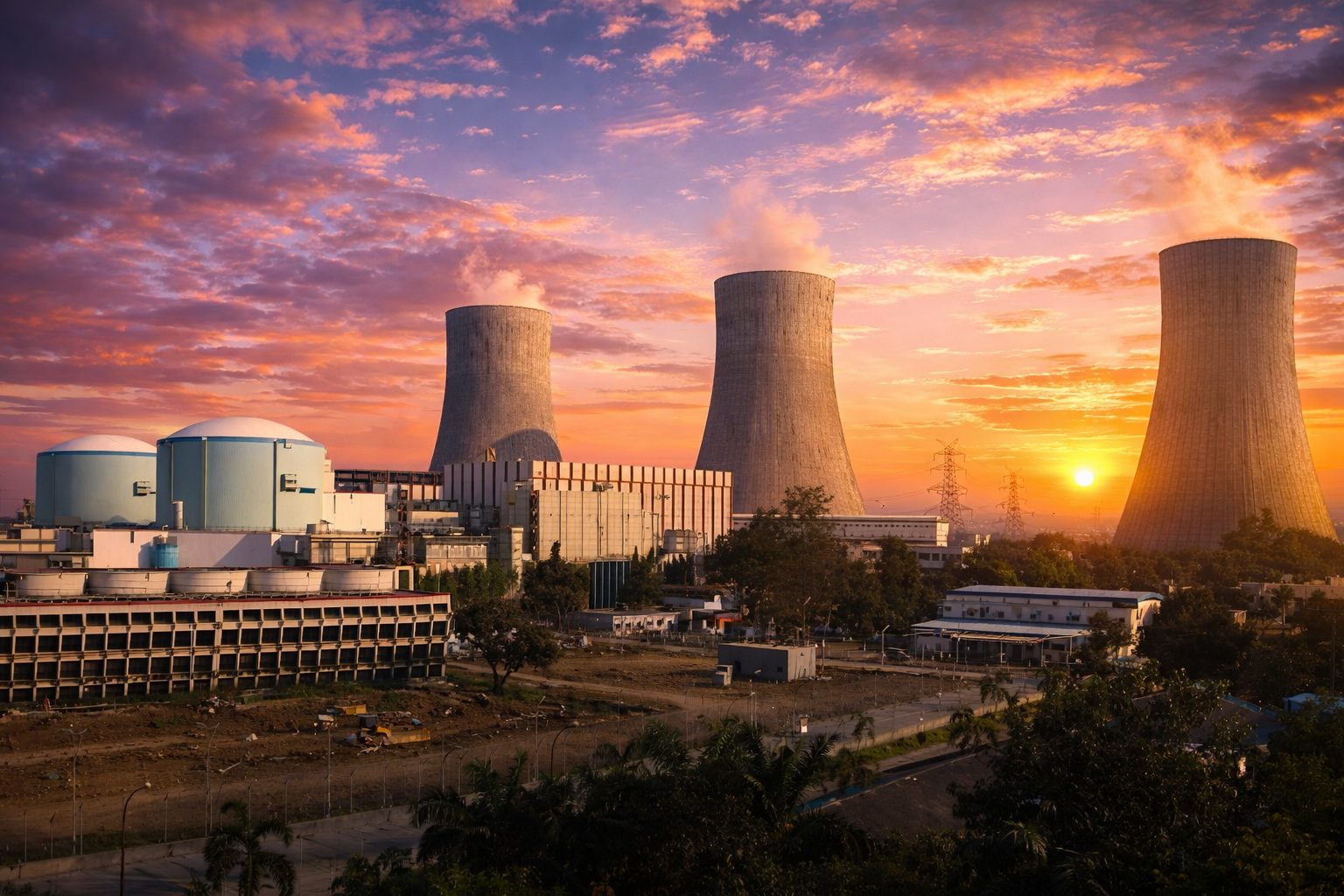
New Delhi witnessed a watershed moment in India’s clean-energy debate on December 18, 2025, as Parliament cleared the Sustainable Harnessing and Advancement of Nuclear Energy for Transforming India (SHANTI) Bill, 2025—legislation the government says will unlock investment and accelerate nuclear expansion, and critics say weakens accountability in one of the country’s most sensitive sectors.
The bill’s passage immediately triggered a political and social backlash: opposition parties raised alarms in the Rajya Sabha over safety, regulation, and liability, while power engineers, central trade unions and farmers’ groups announced nationwide protests from December 23, demanding the bill’s withdrawal.
Prime Minister Narendra Modi, welcoming the bill’s passage, framed it as a turning point for India’s technology and clean-energy trajectory, saying it will “safely power” emerging needs such as AI and green manufacturing—and called it an opportunity moment for private investment and innovation. PM India
What is the SHANTI Bill—and why it’s being called a landmark shift?
The SHANTI Bill is designed to replace two cornerstone laws that have long defined India’s civilian nuclear framework: the Atomic Energy Act, 1962 and the Civil Liability for Nuclear Damage (CLND) Act, 2010. The government’s stated aim is to consolidate and modernise nuclear governance under a single, updated law aligned with today’s energy and technology landscape.
The biggest headline change is structural: the law opens the tightly controlled civil nuclear power sector—historically dominated by state entities—so that non-government players can be licensed for specified activities, including building, owning, or operating nuclear plants/reactors, and handling nuclear fuel-related operations under defined rules and authorisations.
International outlets described the move as a major policy shift aimed at scaling nuclear power dramatically, as India targets a tenfold jump to 100 gigawatts (GW) of nuclear capacity by 2047—up from today’s single-digit GW fleet.
The private-sector opening: who can get licences and what foreign firms can (and can’t) do
According to PRS Legislative Research’s bill track summary, the new framework allows the central government to grant licences to:
- Indian companies (explicitly excluding “a company incorporated outside India” for specified licensing provisions),
- joint ventures between government entities and private companies, and
- other persons expressly permitted by the central government (for specified activities).
In practice, this means foreign participation is expected to come through partnerships with Indian companies, rather than through direct licensing of an overseas-incorporated company. Reuters reported that foreign firms can participate via such partnerships under the new legal regime.
Why this matters: India’s nuclear build-out has historically faced capital constraints and project risks. Reuters noted that India has explored attracting large domestic groups—naming Tata Power, Adani Power, and Reliance Industries—and that investment needs could run into tens of billions of dollars.
Nuclear safety and regulation: AERB gets statutory status
A central government argument in Parliament has been that opening the sector does not mean weakening oversight. One of the bill’s widely reported changes is to give the Atomic Energy Regulatory Board (AERB) statutory recognition (putting it under the parent law).
The SHANTI Bill’s text (as published on PRS) includes provisions for the constitution and functioning of AERB, including appointments by the central government and an institutional structure for the regulator.
Government-backed coverage of the Rajya Sabha debate said the minister underscored that “nuclear safety, national sovereignty and public accountability remain non-negotiable,” and described AERB’s statutory status as strengthening oversight in line with global best practices. DD News
The flashpoint: nuclear liability, “right of recourse,” and who pays when things go wrong
If there’s one issue uniting critics—from opposition lawmakers to power engineers and activists—it’s liability.
1) The overall cap: 300 million SDR
The bill text states that the maximum amount of liability for each nuclear incident shall be the rupee equivalent of 300 million Special Drawing Rights (SDR) (with scope for the central government to specify a higher amount by notification).
2) Tiered operator liability: from ₹100 crore to ₹3,000 crore
The law creates a tiered structure for an operator’s liability based on the category/capacity of the nuclear installation. PRS summarises this as ranging from ₹100 crore to ₹3,000 crore.
The Second Schedule (bill text) shows examples of these tiers—such as ₹3,000 crore for the largest category listed, and lower caps for smaller categories.
3) The operator’s “right of recourse” is narrowed—removing defective-supply grounds
The bill’s Section 16 states that an operator has a right of recourse only where:
- the right is expressly provided in a contract in writing, or
- the incident results from an individual’s intentional act to cause nuclear damage.
PRS highlights what critics are focusing on: the 2010 law allowed recourse on an additional ground—supply of defective equipment or materials—and the SHANTI Bill removes that ground.
Supporters argue this aligns India’s liability approach more closely with international norms that typically place primary liability on the operator, while critics argue it reduces deterrence for suppliers and dilutes accountability.
Parliament passage on December 18: what happened in the Rajya Sabha
NDTV’s PTI-fed report said the Rajya Sabha passed the bill by voice vote on Thursday (December 18), a day after Lok Sabha clearance, completing parliamentary approval before it goes for presidential assent (generally seen as procedural).
In the House, Minister of State for Atomic Energy Jitendra Singh emphasised the reliability of nuclear power as a 24×7 source and insisted safeguards would not be compromised. The same report quotes him saying there has been no report of radiation-related hazards to the public so far, while he sought to allay fears around radiation exposure.
Opposition’s critique: safety, oversight, and “who benefits?”
During the Rajya Sabha debate, opposition leaders flagged concerns that private entry could raise risks of irregularities and undermine safety unless regulation is genuinely independent. The Economic Times reported that Congress leader Jairam Ramesh questioned why the government was shifting positions compared to earlier BJP arguments during the 2010 liability debate, and alleged the bill could be influenced by external pressure while primarily benefitting private companies.
AP’s coverage captured the broader opposition/activist critique: that the bill could dilute safety and liability safeguards and may leave communities near nuclear plants with insufficient protections and limited remedies. It also quoted an energy-policy expert describing the bill as a milestone for private-sector participation, while activists called it risky.
Trade unions and farmers groups: why protests are being planned for December 23
The sharpest immediate street-level response came from organised labour and farmer platforms.
A PTI report carried by ETEnergyworld said the All India Power Engineers Federation (AIPEF), alongside central trade unions and the Samyukt Kisan Morcha (SKM), will hold nationwide protests on December 23, with demonstrations planned across districts, cities and towns.
Their stated demands include:
- withdrawal of the SHANTI Bill,
- restoration of stringent liability provisions (including the operator’s right of recourse),
- creation of a “truly independent” nuclear regulator,
- stronger environmental and labour protections, and
- clear parliamentary control over foreign involvement and strategic aspects of nuclear activities.
AIPEF’s chairman is quoted in PTI coverage arguing the bill creates a “profit-driven” licensing regime and shifts accident burdens toward the state and victims by weakening supplier-accountability pathways—an argument that directly tracks the bill’s narrowing of the “right of recourse.” ETEnergyworld.com+2PRS Legislative Researc…
Why the government is pushing the SHANTI Bill now: 100 GW by 2047 and clean baseload power
The Modi government’s overarching argument is that India cannot meet its long-term energy demand and decarbonisation ambitions without expanding clean, firm power.
A Department of Atomic Energy PIB release on the bill’s introduction tied it to India’s:
- decarbonisation roadmap to 2070, and
- a target of 100 GW nuclear capacity by 2047, alongside the need for reliable power for data centres and “future-ready” applications. Press Information Bureau
Reuters similarly framed the legislation as part of an effort to scale nuclear capacity tenfold by 2047 and described it as a major shift for a sector previously controlled by state entities—while noting the role of licensing for private operators and partnership routes for foreign firms.
PM Modi’s message: AI, green manufacturing, and a private investment push
In a statement posted on the Prime Minister’s official website, Narendra Modi welcomed the bill’s passage as “a transformational moment” and said it would “deliver a decisive boost to a clean-energy future,” while opening opportunities for the private sector and youth. PM India
The framing is clear: SHANTI is being positioned not only as an energy law but as a strategic industrial and technology enabler, linking nuclear power to round-the-clock electricity for high-growth sectors.
What happens next: presidential assent, rule-making, and the first test of private nuclear licensing
With both Houses having passed the bill, it now heads to the President for assent (widely expected as a formality, per AP), after which detailed implementation—rules, licensing procedures, and regulatory readiness—will determine how quickly private participation actually materialises.
Key near-term watchpoints include:
- How licensing is sequenced for private/joint venture entities and what qualifying standards apply.
- How liability and insurance mechanisms are operationalised in contracts—especially given that recourse now depends heavily on contract terms.
- Investor appetite and project pipelines, as India attempts to move from a tightly state-run model toward one that can absorb private capital without compromising safety.
- Public and political resistance, beginning with the announced December 23 protests and potentially extending into court challenges or demands for parliamentary review.
Bottom line: a clean-energy accelerant—or a liability gamble?
The SHANTI Bill is now the centrepiece of India’s bid to make nuclear power a core pillar of its clean-energy future—backed by a 2047 capacity target, an explicit push for private involvement, and promises of stronger statutory regulation through AERB.
But the intensity of the backlash—especially around the revised liability architecture and the removal of defective-supply grounds for recourse—suggests the next phase will be as much about social legitimacy and legal resilience as it is about financing reactors. How the government addresses these concerns, and how private players structure contracts under the new regime, will define whether SHANTI becomes a blueprint for rapid clean baseload growth—or a prolonged political fault line.