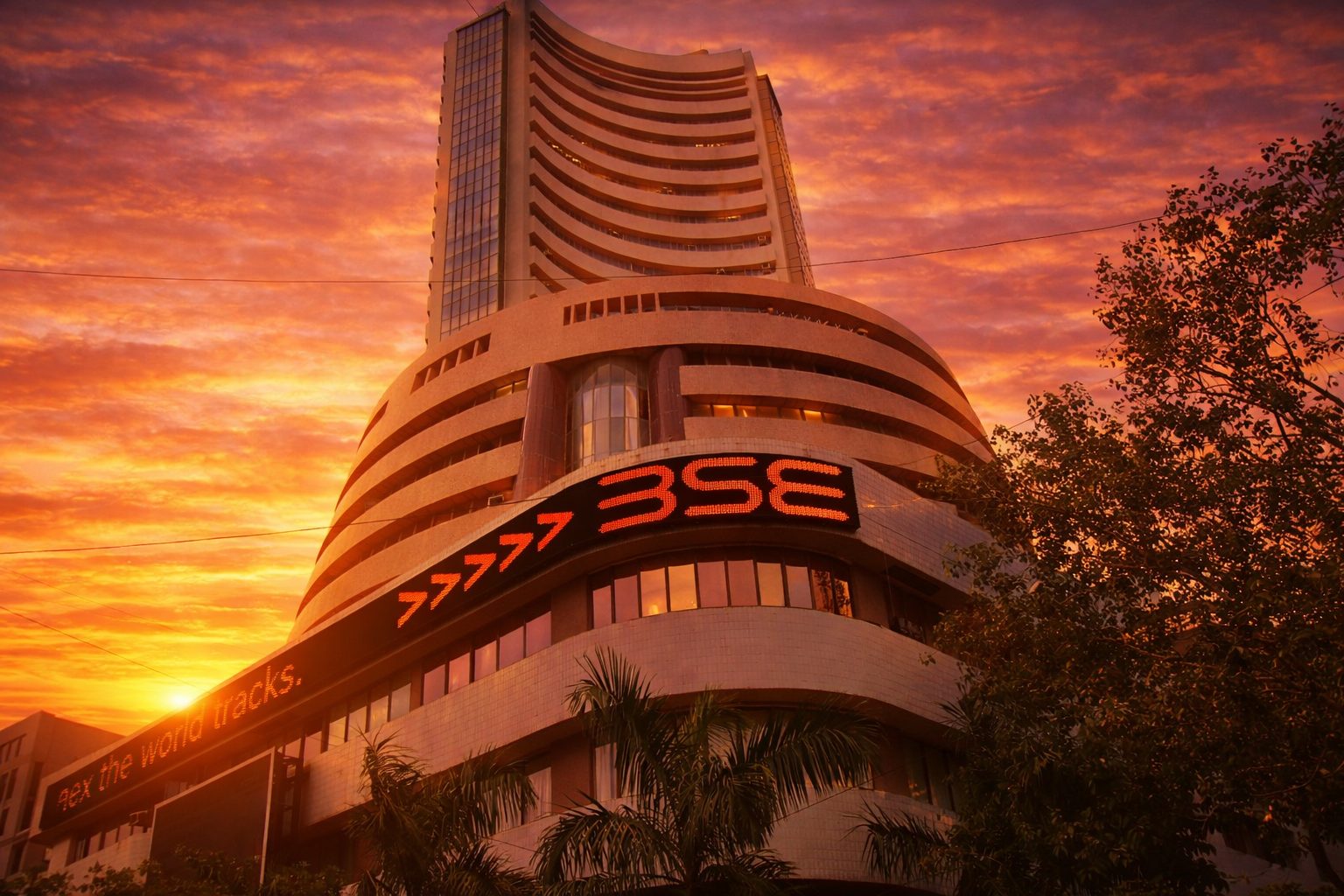
Mumbai | 21 December 2025 — The Bombay Stock Exchange (BSE) heads into a holiday-thinned, event-heavy week with a familiar cocktail: a late rebound in benchmarks, a looming BSE index reshuffle that can force passive-fund flows, and a fresh exchange-level proposal aimed at curbing “too many orders, not enough trades” behavior in the cash market.
Since Sunday is a non-trading day, the freshest price signals come from Friday’s close (19 December 2025)—and the message there was cautiously upbeat: the BSE Sensex rose 0.53% to 84,929.36, while the Nifty 50 gained 0.58% to 25,966.40, snapping a four-day losing streak.
But one strong session doesn’t erase the bigger mood: weekly performance stayed soft, and the coming week’s reduced global participation for Christmas can make markets feel oddly “quiet,” until they suddenly aren’t. Economic Times+1
Where the BSE Sensex stands going into Monday
Friday’s rally mattered less for the points and more for the tone shift: investors leaned into risk after supportive global cues, pushing Indian benchmarks higher to end the week.
Yet several signals say the market is still in “decide later” mode:
- The Nifty’s weekly structure was described by technicians as an “inside bar” / indecision setup, suggesting a consolidation rather than a clean trend. NDTV Profit+1
- India VIX (volatility gauge) has been hovering near multi-month lows, which typically supports grind-higher price action—but can also mask fragility if a surprise hits thin liquidity.
That sets up a week where mechanical events (index rebalancing, IPO calendar, corporate actions) may compete with macro drivers (FX moves, global risk appetite) for control of the tape.
The biggest BSE-specific catalyst: Sensex and BSE 500 reshuffle goes live on 22 December
The headline BSE event for Monday is the BSE indices reconstitution:
- InterGlobe Aviation (IndiGo) is set to trade as the newest Sensex constituent.
- Tata Motors Passenger Vehicles is slated for removal following its demerger, reflecting the post-corporate-action market standing.
- The BSE 500 is also scheduled for a major reshuffle with 32 additions and 32 deletions, effective 22 December 2025.
Why this matters (even if you never buy an index fund): modern markets run on rules. When a stock enters or exits a major index, passive funds and index-linked strategies may have to rebalance, creating time-bound demand/supply that can move prices around the effective date.
It’s not only a list change; it’s a liquidity event.
A quiet but important backdrop: BSE tightened index “entry barriers” this year
Separate from the one-time reshuffle, BSE’s index methodology has been evolving. One widely discussed change is the BSE 500 moving from fixed thresholds to a ranking-based approach, effective 22 December 2025, which can increase competition for inclusion and potentially raise churn near cutoff ranks.
For investors, that’s a reminder that “index inclusion” is not destiny—but it does influence visibility, liquidity, and sometimes near-term price behavior.
BSE proposes order-message fees beyond 10 crore per broker per day: what it means
In exchange-operator news, BSE has proposed a framework aimed at order-flow discipline in the equity cash segment:
- A free daily threshold of 10 crore order messages per broker (adds/modifies/deletes counted; settlement auction orders excluded).
- Charges beyond the threshold at ₹0.0025 per message.
- A relief clause: the first breach in a calendar month would be exempt, with fees applying to subsequent breaches.
- An implementation path where BSE would begin sharing daily files from 1 January 2026, and start including applicable charges from 15 January 2026, with recovery via the monthly billing cycle.
This is classic market plumbing—but it can matter. Order-message explosions are often associated with high-frequency and algorithmic strategies that generate huge “message-to-trade” ratios, which can load exchange systems and potentially degrade market quality. The proposal signals BSE’s intent to price that infrastructure burden more explicitly.
Calm markets, tricky options: the volatility story hovering over Indian equities
A separate thread in today’s market narrative is the unusual quiet. Bloomberg reports India has become among the world’s “calmest” equity markets recently—so calm that it’s forcing derivatives players to rethink strategies. It points to the Nifty’s limited movement for months, domestic flows outweighing foreign flows, and curbs in derivatives trading contributing to compressed volatility, with India’s volatility index ending Friday at an all-time low. Bloomberg
For BSE and the broader ecosystem, low volatility can be a double-edged sword:
- It often supports steadier risk appetite for long-only investors.
- But it can also reduce trading urgency, and it can complicate options pricing and hedging, especially when liquidity is thinner due to holidays.
In other words: the market feels tranquil—yet it’s a holiday week with multiple “mechanical” catalysts. Those two things don’t always coexist peacefully.
Monday and the Christmas week: the main triggers for BSE watchers
Economic Times’ weekend setup for the coming week highlights several drivers that investors are actively tracking:
1) Global holiday liquidity (and why it matters even in India)
Trading is expected to be subdued globally due to the extended Christmas holiday period, with several major markets operating shorter sessions or closures around 24–26 December. India’s equity market holiday is Christmas Day (25 December), but global liquidity conditions can still affect risk sentiment.
2) FX is back in the spotlight: rupee at 89.27 after a sharp rebound
The rupee’s move has become a real-time sentiment gauge. The rupee strengthened sharply to 89.27 per USD, a jump of 97 paise on Friday, with commentary pointing to likely RBI intervention late in the session.
3) FII and DII flows: domestic money still carrying weight
Foreign and domestic institutional flows remain central, but year-end and holiday conditions can shift who sets the marginal price. On Friday, FIIs were net buyers (~₹1,830.89 crore) and DIIs bought (~₹5,722.89 crore), according to the same weekend roundup.
4) IPO and listing calendar: a crowded primary market week
Primary market action is another attention magnet. The coming week includes 11 issues targeting about ₹750 crore in aggregate fundraising (including one mainboard IPO and several SME issues), plus multiple listings.
Technical levels to watch: where analysts see the “line in the sand”
With the market consolidating, traders are mapping the next week around well-defined levels:
- NDTV Profit’s trade setup notes the Nifty’s broader consolidation range roughly between 25,700 (downside) and 26,220 (upside), with a breakout zone near 26,050–26,100.
- The same analysis highlights 25,700 as a key support area that has been holding in recent weeks.
- For banks, NDTV Profit flags Bank Nifty at 59,069, with supports around 58,700 / ~58,470 and resistance around 59,700–60,000.
Technical levels don’t predict the future, but they do describe where traders are likely to change their minds in a hurry.
Forecasts and big-picture calls: what 2026 targets imply for the Sensex
Even as short-term trading remains range-bound, the medium-term sell-side narrative is still constructive:
- HSBC has projected the BSE Sensex at 94,000 by end-2026, driven by expectations of earnings recovery and cooling valuations.
- J.P. Morgan has pegged the Nifty 50 at 30,000 by end-2026, citing rate cuts and policy support among drivers.
- Morgan Stanley has published a scenario framework with a base case around 95,000 and a bull case of 107,000 for the Sensex by December 2026 (per Moneycontrol’s report of the note).
These are not guarantees—just structured opinions. But they help explain why dips have repeatedly attracted domestic buying: the market is still trading on a “2026 rebound” storyline, even while it argues with itself week to week.
BSE Ltd (the exchange company): price, expectations, and what the headlines mean for the business
It’s easy to talk about BSE as a place. It’s also a listed company.
As of 21 December 2025, Investing.com shows BSE Ltd around ₹2,684.80, with a 52-week range roughly 1,226–3,030, and an analyst average price target near current levels. Investing.com
Economic Times’ stock page likewise reflects the latest traded price around ₹2,684.80 (as of the latest available close) and provides additional context on market cap and ratios.
What could matter next for BSE Ltd, based on this week’s narrative:
- Index rebalancing is a reminder that BSE’s index business is influential—especially as passive strategies grow.
- Order-message fees (if implemented) would be a direct attempt to price infrastructure intensity in the cash segment.
- Low volatility and holiday liquidity can affect trading behavior across the ecosystem, with knock-on implications for transaction-linked revenues.
Bottom line: a “quiet” week with loud mechanical events
The Bombay Stock Exchange enters the week of 22–26 December with the Sensex stabilizing after a choppy stretch, but the agenda is packed: a high-impact BSE index rejig, a busy IPO pipeline, FX sensitivity, and exchange-level microstructure proposals that speak to how modern markets actually function under the hood.
For investors and traders, the key paradox is this: Christmas week tends to dampen volume—yet it also concentrates the impact of scheduled events. In markets, “quiet” is often just another form of tension.