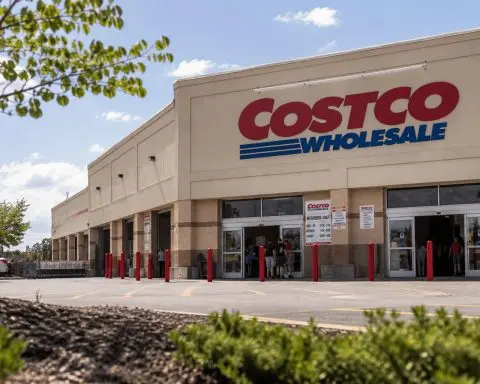

Costco Wholesale Corporation NASDAQ:COST is ending 2025 with investors debating a familiar tension: the company’s unusually consistent growth and membership economics versus a valuation that gives the stock less room for error. On Dec. 22, Costco shares were trading around $851, down roughly 0.5% on the session—keeping the stock near the middle of a December pullback that has been closely watched by both bulls and skeptics.
Below is a deep dive into the latest news, forecasts, and market analysis shaping Costco stock right now—covering the company’s most recent sales and earnings, membership trends, tariff-related risks, and where analysts’ price targets cluster heading into 2026.
Costco stock today: why investors are focused on membership, margins, and valuation
Costco’s latest quarterly report reinforced that demand remains healthy—especially online and in higher-frequency categories—while also surfacing a few pressure points that can matter more when a stock trades at a premium multiple. The market conversation in late December has centered on three themes:
- Strong Q1 fiscal 2026 results (ended Nov. 23, 2025), including a beat on profit expectations and solid comparable sales.
- A rare “Sell” call from Roth Capital that put membership renewal trends and competitive intensity back in the spotlight. MarketWatch+1
- Tariff uncertainty—including Costco’s lawsuit to preserve potential refund rights and the company’s behind-the-scenes assortment changes aimed at protecting its value perception.
The latest numbers: Costco’s Q1 fiscal 2026 earnings, explained
Costco’s fiscal year is a 52/53-week calendar, and fiscal 2026 is a 52-week year ending Aug. 30, 2026.
For the first quarter of fiscal 2026 (12 weeks ended Nov. 23, 2025), Costco reported:
- Net sales:$65.98 billion, up about 8% year over year Q4 Capital Development+1
- Membership fees:$1.329 billion (also up year over year) Q4 Capital Development+1
- Total revenue (sales + membership fees):$67.307 billion Q4 Capital Development
- Net income:$2.001 billion Q4 Capital Development+1
- Diluted EPS:$4.50, versus $4.04 a year earlier Q4 Capital Development+1
On the Wall Street expectations front, Reuters reported that Costco’s EPS of $4.50 topped estimates of $4.27, and quarterly revenue of $67.31 billion edged above estimates of $67.14 billion.
Comparable sales and digital momentum stood out
Costco’s core operating story remains comp sales plus membership retention. In Q1 fiscal 2026:
- Total company comparable sales:+6.4% Q4 Capital Development+1
- Digitally-enabled comparable sales:+20.5% Q4 Capital Development+1
Management and analysts have also pointed to strong performance in same-day delivery partnerships (including Instacart in the U.S. and Uber Eats/DoorDash internationally) as part of the digital mix.
November sales update: a key “pulse check” for Costco stock
Costco’s monthly sales releases often move sentiment because they offer a near-real-time view of traffic and ticket trends.
For November 2025 (four weeks ended Nov. 30, 2025), Costco reported:
- Net sales:$23.64 billion, up 8.1% year over year Costco Investor Relations
- Total company comparable sales (4-week retail month):+6.9% Costco Investor Relations
- Digitally-enabled comparable sales (4 weeks):+16.6% Costco Investor Relations
That same update reiterated Q1 trends (12-week period ended Nov. 23, 2025) and provided a year-to-date view (13 weeks), keeping Costco’s growth narrative intact heading into the holiday season.
Membership engine: renewal rates, fee growth, and what “digital sign-ups” mean
If you’re trying to understand Costco stock, start here: membership fees are a high-margin profit driver, and renewal rates are a key indicator of brand strength.
In its Q1 fiscal 2026 filing, Costco reported:
- Renewal rates:92.2% in the U.S. and Canada; 89.7% worldwide (end of quarter) Securities and Exchange Commission
- Costco noted renewal rates were negatively impacted by a higher number of memberships sold online, including via digital promotions, which tend to renew at a slightly lower rate on average.
- Total paid members:81.4 million; total cardholders:145.9 million Securities and Exchange Commission
A separate Nasdaq.com analysis framed the same data as renewal rates remaining near historical highs—even as the enrollment mix shifts more digital.
Why the market cares about a “small” renewal-rate change
In most businesses, a fraction-of-a-point swing wouldn’t matter. In Costco’s case, it can matter because:
- Membership economics are central to how Costco keeps prices low and drives traffic.
- Even modest renewal-rate moves can influence long-term membership fee growth assumptions.
- When valuation is elevated, investors can become less forgiving of incremental softness.
That dynamic is one reason a single cautious analyst note can create an outsized reaction in COST—especially in a market environment that’s more “risk-on” and less focused on defensive retail. Investing.com
Margins, cash flow, and capital spending: what the 10-Q reveals
Costco is not a “high margin” retailer in the traditional sense, but it is a highly efficient one—so small basis-point changes attract attention.
From Costco’s Q1 fiscal 2026 filing:
- Gross margin:11.32% of net sales (up slightly year over year) Securities and Exchange Commission
- SG&A rate: about 9.60% of net sales Securities and Exchange Commission
- Net cash provided by operating activities:$4.688 billion in Q1 fiscal 2026 Securities and Exchange Commission+1
Expansion pace remains a core part of the Costco thesis
Costco continues to invest heavily in new warehouses and infrastructure:
- It opened eight new warehouses (including one relocation) in the first quarter.
- It plans to open 25 additional new warehouses (including four relocations) in the remainder of fiscal 2026, per its 10-Q.
- Capital spending: Costco said it spent $1.526 billion on capex in Q1 and intends to spend about $6.5 billion in fiscal 2026.
The company also disclosed ongoing buybacks, repurchasing 225,000 shares in Q1 at an average price of $932.02, with remaining authorization still available under its board-approved plan.
Tariffs and the lawsuit: the “wild card” risk investors are pricing in
Costco has been in the news this month not only for earnings, but also for trade policy and legal strategy.
Costco joins the tariff refund legal scramble
A notable development: large companies, including Costco, have filed lawsuits in the U.S. Court of International Trade as part of a broader effort to preserve potential claims for tariff refunds—amid uncertainty tied to court deadlines and ongoing litigation over tariffs.
How tariffs are showing up in the warehouse experience
Separate reporting has described Costco adjusting its holiday assortment—reducing exposure to some tariff-impacted items and leaning on other categories and its private label to maintain value perception.
For investors, the key point is not whether a single product category is trimmed. It’s whether Costco can continue to do what it historically does well:
- negotiate with suppliers,
- shift sourcing when possible,
- protect sharp pricing on “known value items,” and
- keep member trust high—even when input costs become volatile.
That’s also why the tariff story has become intertwined with the membership narrative: shoppers will tolerate a lot if they believe the membership “pays for itself.”
Analyst action: rare bearish calls versus still-bullish price targets
The most market-moving analyst storyline in December has been the divergence between:
- a rare Sell rating that argues Costco’s metrics are softening and competition is heating up, and
- a broader Street view that still sees Costco as a high-quality compounder worthy of a premium.
The downgrade that grabbed headlines
Roth Capital issued a downgrade to Sell and cut its price target to $769, citing concerns that include weakening membership metrics, slower paid member growth, and competitive pressure from Sam’s Club and BJ’s.
Guggenheim’s “Neutral” stance: valuation is the issue
On Dec. 22, Investing.com reported that Guggenheim reiterated a Neutral rating, emphasizing valuation risk and arguing Costco is no longer getting a “pass” for routine quarterly fluctuations as investor attention shifts back to renewal rates and competitive intensity. Investing.com
Where consensus price targets sit
Depending on the dataset and the number of analysts included, consensus targets vary—but they generally imply a meaningful premium to current levels.
- MarketBeat listed an average target of $987.58 (with a wide range of targets in its compilation).
- Investing.com’s consensus estimates page cited an average 12‑month target around $1,031 (high estimate around $1,205, low around $640) based on its analyst set.
- StockAnalysis’ tracker showed an average target around $1,051.38 from a larger analyst sample, with a stated high of $1,225 and low of $640.
Taken together, these snapshots suggest that most analysts still model upside into 2026, but there’s an unusually wide dispersion in views—often a signal that the debate has shifted from “is Costco good?” to “how much should investors pay for Costco?”
The “special dividend” question and shareholder returns
Costco’s shareholder-return profile is another topic that regularly surfaces in December.
Investors have been primed to watch for special dividend headlines because Costco has paid them in the past, and some analysts have publicly discussed the possibility again this year. Market commentary following earnings noted investor disappointment that no special dividend was announced alongside the quarterly results.
Costco’s regular quarterly dividend remains in place. In its Q1 filing, the company disclosed a $1.30 per share quarterly dividend declared in October and paid in November 2025.
What matters next for Costco stock in early 2026
Costco’s story into 2026 is likely to be shaped less by a single quarter and more by a set of repeatable indicators. Here are the key ones investors are watching now:
1) Monthly sales updates and post-holiday demand
Costco’s November sales were strong overall, with digital growth still far outpacing the base business. The next releases will help investors gauge whether discretionary categories keep pace and whether traffic remains resilient after the holiday rush.
2) Renewal rates and membership mix
Even if renewal rates remain historically high, the market is signaling it will scrutinize:
- whether digitally acquired members renew at improving rates over time, and
- whether Executive membership penetration continues to rise (a key profitability driver).
3) Margin discipline while absorbing cost shocks
Tariffs, wage costs, and healthcare costs can all influence operating leverage. Costco’s model is built to pass value to members; the question for investors is how smoothly it can protect profitability while doing so.
4) Warehouse productivity and expansion execution
Costco’s plan to open more warehouses in fiscal 2026—and its broader investments in systems and distribution—remain central to the long-term bull case.
5) Valuation: the swing factor
If Costco executes well, the stock can still struggle if investors decide the multiple is too high for the macro backdrop. That’s the crux of the “Neutral” arguments: Costco can be great, but great doesn’t always mean underpriced. Investing.com+1
Bottom line: Costco’s fundamentals look durable, but 2026 may hinge on expectations
As of Dec. 22, 2025, the freshest data points on Costco stock are clear:
- Sales and comps remain solid, with digital growth a standout.
- Membership fee income and renewal rates remain strong—but the mix shift toward online sign-ups is now a real part of the debate.
- Analysts are still broadly constructive on the long-term outlook, yet a handful of prominent notes (Roth’s Sell, Guggenheim’s Neutral) underscore that valuation sensitivity is rising.
- Tariffs and legal uncertainty add noise—and could influence assortment, pricing strategy, and investor sentiment more than the direct dollar impact suggests.
For readers tracking COST into 2026, the most useful framework may be simple: watch renewals, comps, and margins—and compare each update to the expectations embedded in the stock’s premium valuation.
Related articles: NASDAQ:COST