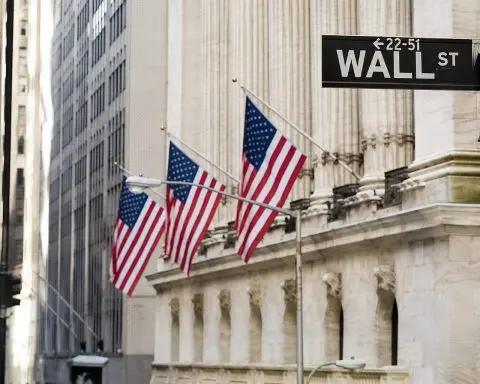
U.S. stocks started the holiday-shortened week on a firmer footing Monday, December 22, with the S&P 500 finishing higher as investors leaned back into technology and the AI trade while bracing for thin year-end liquidity and a packed slate of late-week economic data. The S&P 500 (SPX) ended the session at 6,857.30, up 0.33% on the day, after trading between 6,855.93 and 6,873.37.
That “green close” mattered beyond the tape. A Polymarket contract tracking whether the S&P 500 would finish up or down on December 22 priced a strong bias toward an up day, while a pair of ElliottWaveTrader updates from mid-December framed the same stretch of price action as a high-stakes technical inflection: either a bounce that could carry toward new highs, or a failure that would reopen downside targets. Polymarket+2Elliott Wave Trader+2
S&P 500 closes higher to open the holiday week — and stays within striking distance of record territory
Monday’s advance added to the market’s late-December rebound and kept the index close to the early-month record area. Just 11 days earlier, the S&P 500 closed at 6,901.00 (Dec. 11), a milestone that has served as the most visible near-term reference point for bulls and bears heading into year-end.
Much of the day’s constructive tone was consistent with the narrative that powered markets into the close last week: a renewed bid in AI-linked technology, supported by company-specific catalysts and a calmer inflation backdrop. In early trading, Reuters reported a continuation of the tech rebound and a pullback in market volatility, with the CBOE’s “fear gauge” (VIX) sliding to its lowest level since September. Reuters
While holiday weeks can produce choppy, headline-driven swings, Monday’s pattern leaned more toward “steady risk-on.” Reuters noted eight of the 11 S&P sectors were higher in the morning session, with materials and energy among the leaders as commodity prices jumped. Reuters
The catalysts: AI optimism, big single-stock movers, and deal headlines
Several of Monday’s biggest talking points sat at the intersection of mega-cap tech leadership and year-end positioning:
- Semiconductors and AI remained a focal point. Reuters linked the broader tech tone to late-week momentum sparked by upbeat AI-related developments, including Micron’s strong outlook and the market’s perception of a “benign” inflation report. Reuters
- Nvidia was higher in early trading after Reuters reported it aimed to begin shipping its second-most powerful AI chips to China ahead of the Lunar New Year period.
- Tesla surged intraday after the Delaware Supreme Court restored CEO Elon Musk’s 2018 pay package, according to Reuters, pushing the stock to an all-time high at the time of the report.
Outside tech, merger-and-acquisition headlines helped set the tone that risk appetite and dealmaking were still alive into year-end. Reuters highlighted Clearwater Analytics’ jump after an $8.4 billion go-private deal and pointed to a broader set of “movers” tied to corporate actions. Reuters
A separate Reuters report added another high-profile deal wrinkle: Oracle co-founder Larry Ellison provided a $40.4 billion personal guarantee to support Paramount Skydance’s effort to acquire Warner Bros Discovery, a move designed to strengthen financing confidence as the bidding contest intensifies.
Holiday mechanics: lighter volume, early close, and key data that could still move markets
The calendar matters this week. U.S. markets are operating with a holiday schedule, and Reuters flagged that volume is expected to be lighter than usual, with U.S. markets closing early on Wednesday and shuttered Thursday for Christmas.
Thin liquidity can amplify moves that might otherwise be muted—especially if new data surprises. Reuters cited a lineup that includes a preliminary reading of third-quarter GDP, December consumer confidence, and weekly jobless claims.
Polymarket’s “SPX up or down on Dec. 22” bet leaned bullish — and the close backed it up
One of the more unusual side-views into Monday’s session came from Polymarket, a prediction-market platform that lists event-style contracts tied to discrete outcomes. A contract titled “S&P 500 (SPX) Up or Down on December 22?” spelled out a simple rule: it resolves “Up” if Monday’s official SPX close is higher than the most recent prior trading day’s close (typically the previous Friday). The market’s listed resolution source is The Wall Street Journal’s historical “Close” values. Polymarket
By the time the contract appeared as “Past,” it showed $7,153 in volume and an implied probability heavily favoring an up day (displayed as roughly 87% in the interface at the time of capture). Polymarket
The market’s close aligned with that direction. The S&P 500 finished at 6,857.30 on Dec. 22 versus 6,834.50 on Dec. 19—higher on the day—meaning the contract’s stated rules would point to an “Up” resolution once the official closing reference is applied. Investing.com+1
What this does—and doesn’t—say about forecasting
Prediction-market odds can be useful as a real-time measure of crowd positioning and confidence, but they’re not guarantees—and single-day directional contracts can be especially sensitive to timing, liquidity, and hedging behavior. In this specific case, the total traded volume was modest, so it should be read as a sentiment snapshot rather than a definitive “smart money” signal. Polymarket
Elliott WaveTrader’s read: from “support box” risk to a “bullish set-up” aimed toward ~6,950
The two ElliottWaveTrader posts linked in your brief (both by Avi Gilburt) provide a technical narrative that helps explain why traders were laser-focused on specific S&P 500 zones in mid-December—and why Monday’s steady finish matters for the next step.
Dec. 15: “Setting Up To Test The Support Box Below”
In the Dec. 15 update, Gilburt argued the S&P 500 had likely completed a consolidation structure and could be setting up for a decline to test a “support box.” He outlined conditions that would make that downside path more likely—most notably, a breakdown below the 6,800 region—while projecting a potential target area “just north of” 6,700 (described as a .500 retracement region). Elliott Wave Trader
Crucially, the post framed the next move as a “tell” for what would follow: a rally off the decline that develops as a 5-wave structure could imply a larger advance, while a 3-wave bounce could raise the odds of another leg down to complete a broader corrective structure. Elliott Wave Trader
Dec. 18: “Bullish Set Up In Place”
Three days later, the tone shifted toward a more explicitly bullish risk/reward setup. In the Dec. 18 update, Gilburt wrote that SPX had bottomed around a .500 retracement area and rallied in what he counted as a 5-wave move off the low, followed by a pullback he treated as a “wave 2.” He then described a developing “1-2, i-ii” pattern that could support a push higher—as long as the wave 2 low held. Elliott Wave Trader
He also put a marker on potential upside: the “standard extension” he referenced suggested a region around 6,950 on the S&P 500 as a working target for the structure at that time, while warning that a breakdown below the wave 2 low would change the interpretation and could re-open a more aggressive downside scenario. Elliott Wave Trader
How Monday’s close fits the technical storyline
From a pure “levels and behavior” perspective, Monday’s session did a few things that matter in the context of those Elliott Wave scenarios:
- The S&P 500 remained well above 6,800, the area flagged on Dec. 15 as an important breakdown threshold for a more convincing trip toward the 6,700 zone.
- The index stayed below the early-month record close near 6,901, keeping the market in a tight range where “breakout vs. rejection” remains the key question into year-end. Investing.com
- The existence of a nearby “bullish target” zone around 6,950 (from the Dec. 18 framework) places extra importance on whether rallies can hold key pullbacks as support—particularly in thin holiday liquidity where false breaks are common. Elliott Wave Trader
None of this “confirms” an Elliott Wave count on its own, but it does explain why traders often talk about year-end price action in terms of defined invalidation levels: below one threshold the story shifts bearish; above another the path opens toward new highs.
The cross-asset backdrop on Dec. 22: record metals, higher oil, a struggling yen, and a soft-dollar narrative
Even as equities pushed higher, other markets told a more complicated story—one where risk-taking and hedging demand can coexist.
Gold and silver surge to records
Reuters reported that gold jumped more than 2% to an all-time high (spot high $4,428.92/oz) while silver hit a record (high $69.44/oz), citing safe-haven flows and expectations tied to rate policy and geopolitics.
In the same report, Reuters tied some of the safe-haven bid to rising U.S.-Venezuela tensions, including a Trump-announced “blockade” focused on sanctioned oil tankers. Reuters
Oil jumps on Venezuela-related headlines
That geopolitical thread also appeared in global market coverage. Reuters noted oil prices moved higher after the U.S. intercepted a Venezuelan oil tanker and pursued another, helping lift Brent and U.S. crude in holiday-thinned trading.
Yen weakness and Japan rate dynamics ripple globally
On currencies and rates, Reuters highlighted the yen’s weakness and pressure on Japanese government debt after the Bank of Japan raised rates to 0.75%, with Japanese 10-year yields reaching levels not seen in decades (as reported in the same global markets dispatch).
The dollar’s bigger-picture problem: investors see more downside risk in 2026
A separate Reuters analysis framed 2025 as a difficult year for the U.S. dollar, with the dollar index down about 9% year-to-date and investors debating whether stabilization is temporary as the Fed continues easing and global growth dynamics shift.
For U.S. equities, that matters because currency trends can affect multinational earnings translation, cross-border flows, and relative attractiveness of U.S. assets versus international alternatives.
What to watch next: data catalysts, year-end positioning, and the “Santa Claus rally” window
With the S&P 500 closing higher on Dec. 22 and staying near record territory, the near-term outlook increasingly hinges on a familiar trio: data, positioning, and liquidity.
- Data: Reuters pointed to key releases still ahead this week, including GDP, consumer confidence, and jobless claims—any of which could reshape rate-cut expectations quickly in a thin market.
- Positioning and sentiment: Reuters’ global markets piece cited a Bank of America sentiment measure moving into “extreme bullish” territory, a condition that can sometimes precede reversals—particularly when markets are crowded and liquidity is light. Reuters
- Seasonality: Reuters also highlighted the classic “Santa Claus rally” window and the tendency for late-December trading to be constructive, while warning that this year’s moves are arriving amid a very specific AI-driven leadership cycle. Reuters
A practical framework traders are using now
Putting the day’s reporting and the linked technical commentary together, the market’s short-term debate can be summarized like this:
- Bullish case: Tech momentum holds, volatility stays suppressed, and the index works back toward the early-month highs—leaving open the possibility of a push toward the ~6,950 region referenced in ElliottWaveTrader’s Dec. 18 framework.
- Bearish/defensive case: A breakdown toward the 6,800 area (or below) would revive the Dec. 15 “support box” risk narrative and reintroduce downside targets nearer 6,700—especially if macro data or geopolitics triggers a risk-off impulse in thin conditions. Elliott Wave Trader+2Reuters+2
Bottom line
December 22 delivered a straightforward headline outcome—the S&P 500 closed higher—but the bigger story is how multiple market “lenses” pointed to the same thing: confidence that the path of least resistance was up for now, even amid a cross-asset backdrop that still includes record safe-haven demand, geopolitical risk, and major FX and rates moves overseas.
Polymarket’s day-direction contract leaned bullish and the close validated that direction under the contract’s rules, while ElliottWaveTrader’s recent updates underscore why traders are treating the 6,800–6,900 range as a decisive battleground into year-end.