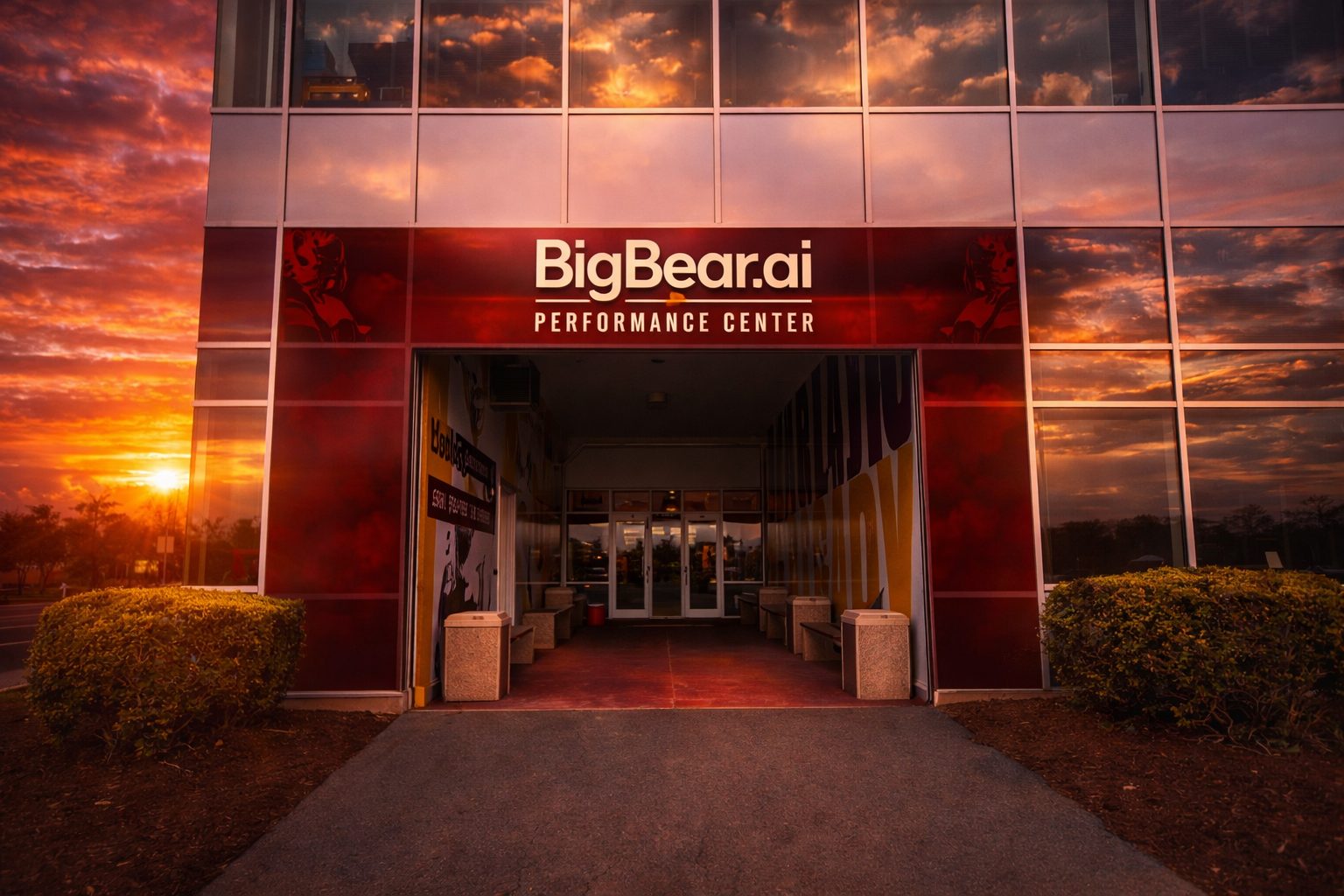
BigBear.ai Holdings, Inc. NYSE:BBAI is heading into the final week of 2025 with a familiar mix of ingredients that tends to supercharge small-cap AI stocks: a big strategic acquisition, fresh defense-adjacent partnerships, and a shareholder vote that could materially change the company’s capital flexibility.
As of Dec. 25, 2025, the most recent official market data shows BBAI last traded at $6.03, down $0.09 (-1.47%) on the latest session data available, with a market cap around $2.64 billion.
What follows is a detailed, publication-ready roundup of the most current news and analysis circulating on and around Dec. 25, 2025, plus what major forecasting dashboards and market commentary imply for BBAI stock in 2026.
What’s moving BigBear.ai stock right now
BBAI’s late-December narrative clusters around four themes:
- Ask Sage acquisition (generative AI + government customers)
- Defense and border-security partnership momentum (ConductorOS at the “edge”)
- International expansion (notably Abu Dhabi / UAE)
- A high-stakes shareholder vote to expand authorized shares (dilution risk vs. strategic flexibility)
Those themes are not abstract—they’re anchored to dated corporate releases and SEC materials from November and December 2025, plus the latest wave of market commentary landing on Christmas week.
The headline catalyst: BigBear.ai’s $250 million Ask Sage deal
On Nov. 10, 2025, BigBear.ai announced Q3 2025 results and, more importantly for many traders, a definitive agreement to acquire Ask Sage—positioned as a secure generative AI platform designed for defense, national security agencies, and other highly regulated environments. The company said Ask Sage is expected to generate about $25 million in 2025 annual recurring revenue (non‑GAAP), representing roughly a six-times increase vs. 2024 ARR, and that BigBear.ai expects to pay $250 million for the business (subject to customary adjustments).
BigBear.ai also indicated the Ask Sage acquisition is expected to close late in Q4 2025 or early in Q1 2026, meaning the deal sits right on the border between “2025 story” and “2026 execution test.” BigBear.ai Holdings, Inc.
Why this matters for BBAI stock in 2026
Investors aren’t just buying “AI” as a buzzword anymore—at least, not exclusively. They’re buying distribution and stickiness. Ask Sage is framed as a platform already operating at scale in sensitive environments (where procurement is slow, but switching can be even slower). In plain English: if BigBear.ai can integrate it cleanly, the deal has the potential to shift BBAI’s revenue mix toward more recurring software/platform economics.
The “if,” however, is doing real work here—especially because BigBear.ai’s own quarter showed pressure in core areas even before layering on integration complexity.
Q3 2025 numbers: revenue down, margins pressured, backlog still sizable
In the same Q3 release, BigBear.ai reported:
- Revenue fell 20% year-over-year to $33.1 million (from $41.5 million), tied primarily to lower volume on certain Army programs
- Gross margin was 22.4% vs. 25.9% in the year-ago quarter
- Non‑GAAP adjusted EBITDA was -$9.4 million vs. +$0.9 million a year earlier
- Backlog was $376 million as of Sept. 30, 2025
- The company continued to project full‑year 2025 revenue of $125 million to $140 million
The same release also highlighted a record cash balance of $456.6 million as of Sept. 30, 2025—important context for funding strategy, acquisition capacity, and (inevitably) the dilution debate.
New defense-adjacent momentum: the C Speed partnership (Dec. 18)
On Dec. 18, 2025, BigBear.ai announced a strategic partnership with C Speed, LLC to integrate BigBear.ai’s ConductorOS AI orchestration platform with C Speed’s software-defined LightWave Radar system. The stated goal: deliver “intelligent, autonomous, and real-time threat detection and decision support” for defense and homeland security use cases, including surveillance radar applications supporting air/missile defense and counter‑UAS. Bigbear
This partnership helped drive a burst of bullish trading attention in the days that followed; market commentary highlighted that the release described operational integration and mission scope, while leaving financial specifics largely unspecified—classic fuel for both hype and skepticism.
Middle East expansion: Abu Dhabi office (Dec. 8)
On Dec. 8, 2025, BigBear.ai announced the opening of its first Middle East office at the World Trade Center Abu Dhabi, describing it as part of a long-term regional investment and linking the move to travel-and-trade security themes.
The company later connected that geographic footprint back to defense/security commercialization, noting the C Speed partnership is expected to leverage BigBear.ai’s presence across geographic markets, including the Middle East.
The capital-structure storyline: the vote to increase authorized shares
While partnerships and acquisitions grab headlines, capital structure often decides what a stock can survive.
BigBear.ai is in the middle of a shareholder process to approve an amendment increasing authorized common shares from 500,000,000 to 1,000,000,000. In a December 2025 letter, CEO Kevin McAleenan framed it as authorization (not immediate issuance), intended to preserve flexibility for growth initiatives and future opportunities.
An SEC filing (DEFA14A) states the adjourned special meeting was further postponed and will reconvene on Dec. 30, 2025 at 3:00 p.m. ET, with electronic voting open until 11:59 p.m. ET on Dec. 29, 2025. The filing also notes the board recommends voting “FOR” the proposal and describes potential uses for additional equity, including financing activities and strategic/corporate opportunities. SEC
Why investors care (even if they hate thinking about it)
Authorized shares are not the same as issued shares—but expanding authorization can be a clear precursor to future issuance.
- Bull case: more flexibility for acquisitions (like Ask Sage), partnerships, retention incentives, and balance-sheet moves
- Bear case: more flexibility to dilute common shareholders if funding needs rise or operating performance doesn’t stabilize fast enough
Both interpretations can be rational. The market’s job is to decide which one dominates next.
What today’s commentary is saying (Dec. 25, 2025)
Even on a holiday news cycle, BBAI is getting ink—because it sits at the intersection of three high-attention themes: AI, defense, and speculative small-cap volatility.
“PLTR vs. BBAI” framing: upside debate for 2026
A TipRanks comparison article published Dec. 25, 2025 frames BigBear.ai as the “smaller and more speculative” defense-AI name versus Palantir, noting BBAI’s strong year-to-date performance and emphasizing that execution risk remains high due to size and contract concentration. The same piece reports TipRanks’ view of BBAI as a Moderate Buy with an average price target of $6.50 (about 8% upside from the reference level used in that comparison). TipRanks
Valuation-focused takes: can the premium be justified?
AInvest ran multiple BBAI items on Dec. 25, 2025 that revolve around a single question: whether BigBear.ai’s defense-AI positioning and strategic moves justify a premium valuation given revenue variability and profitability challenges. While AInvest content should be read as market commentary rather than official guidance, it reflects what many retail-focused “AI stock” discussions are circling: durable revenue vs. narrative-driven multiples. AInvest
The “what happened to the stock” coverage (Dec. 24, flowing into Dec. 25)
MarketBeat’s Dec. 24 piece noted BBAI trading down about 1.2% intraday around $6.05, and summarized a mixed analyst stance: a consensus “Hold” rating with an average price target around $6.33. It also reiterated that profitability metrics remain pressured and that the company’s recent quarter showed revenue down year-over-year. MarketBeat
Analyst forecasts for BBAI stock: what the dashboards show heading into 2026
Forecasts for small caps are never gospel, but they do tell you what the “market modeling layer” thinks is plausible.
Here’s what major forecast/ratings aggregators show as of the latest available updates:
- TradingView shows a price target of $6.67, with a max estimate of $8.00 and a min estimate of $5.00 (based on the analyst inputs it tracks).
- StockAnalysis lists a consensus price target of $7.00 (range $6.00–$8.00) and labels the consensus as Strong Buy (with targets last updated Nov. 11, 2025 on that page).
- MarketBeat describes a more cautious blend—mixed ratings producing a consensus Hold and an average target around $6.33.
- TipRanks (in the Dec. 25 comparison coverage) cites a Moderate Buy stance with a $6.50 average target in that context.
The “so what” hidden inside those numbers
Notice what’s weirdly consistent: most targets cluster near the current price zone. That typically means one of two things:
- Analysts see upside only if execution improves (integration, contract timing, margins), or
- Analysts don’t have high conviction visibility into near-term fundamentals, so targets stay tethered to the present.
For BBAI, that makes sense. The next re-rating likely requires a concrete “proof point” in 2026—such as smoother revenue conversion, clearer unit economics, or Ask Sage integration milestones that show real cross-sell and retention.
Bull case vs. bear case: the honest 2026 setup
The bull case for BigBear.ai stock
BBAI bulls are effectively underwriting these claims:
- Secure “mission AI” demand keeps rising, especially for defense, border security, and regulated deployments
- Ask Sage adds platform gravity—a recurring revenue engine that can be sold into the same buyer universe BigBear.ai already targets
- ConductorOS + radar partnerships push the company closer to “AI at the edge,” where switching costs can be higher and deployments can become embedded into operations Bigbear
- A large backlog figure provides a base of potential revenue conversion (timing still matters)
The bear case for BBAI stock
Bears have a clean line of attack too:
- Revenue has been volatile and recently down year-over-year, and margins have been under pressure
- Adjusted EBITDA remains negative, which limits how long the company can rely on narrative alone
- Acquisitions can disappoint—integration risk is real, especially when the acquired product category (generative AI platform) must be integrated into a broader “services + software” government contracting machine
- Dilution risk is not theoretical: the company is actively pursuing authorization to expand its share capacity, explicitly to preserve strategic flexibility
- Some bearish market commentary goes further, arguing that declining revenue trends plus acquisition dependence can turn a hot stock into a long-term capital destroyer if execution slips
Key dates and catalysts to watch next
If you’re tracking BigBear.ai stock into 2026, the near-term calendar has a few high-signal items:
- Dec. 29, 2025 (11:59 p.m. ET): stated deadline for electronic voting on the authorized-share proposal
- Dec. 30, 2025 (3:00 p.m. ET): reconvened special meeting focused solely on that proposal
- Late Q4 2025 / early Q1 2026: the stated window to close the Ask Sage acquisition
- 2026 execution milestones: contract conversions, backlog burn, margin direction, and whether partnerships translate into revenue (especially when releases omit financial terms)
Bottom line: what Dec. 25, 2025 tells us about BBAI into 2026
BigBear.ai ends 2025 in a classic “high-voltage” posture:
- It has real government and security-adjacent positioning, and it’s actively expanding that footprint (C Speed partnership; UAE office).
- It’s attempting a platform step-up via Ask Sage, priced at $250 million, with a clear goal of strengthening secure generative AI capabilities in regulated environments.
- It’s simultaneously asking shareholders for more capital flexibility, which can be strategic… or dilutive… or both, depending on what management does next.
- Wall Street and aggregator forecasts look cautiously constructive but not euphoric, with most targets hovering around the current price zone—suggesting the next major move is likely to be driven by execution evidence, not slogans.