NEW YORK, Dec. 27, 2025, 8:46 a.m. ET — Market closed (weekend)
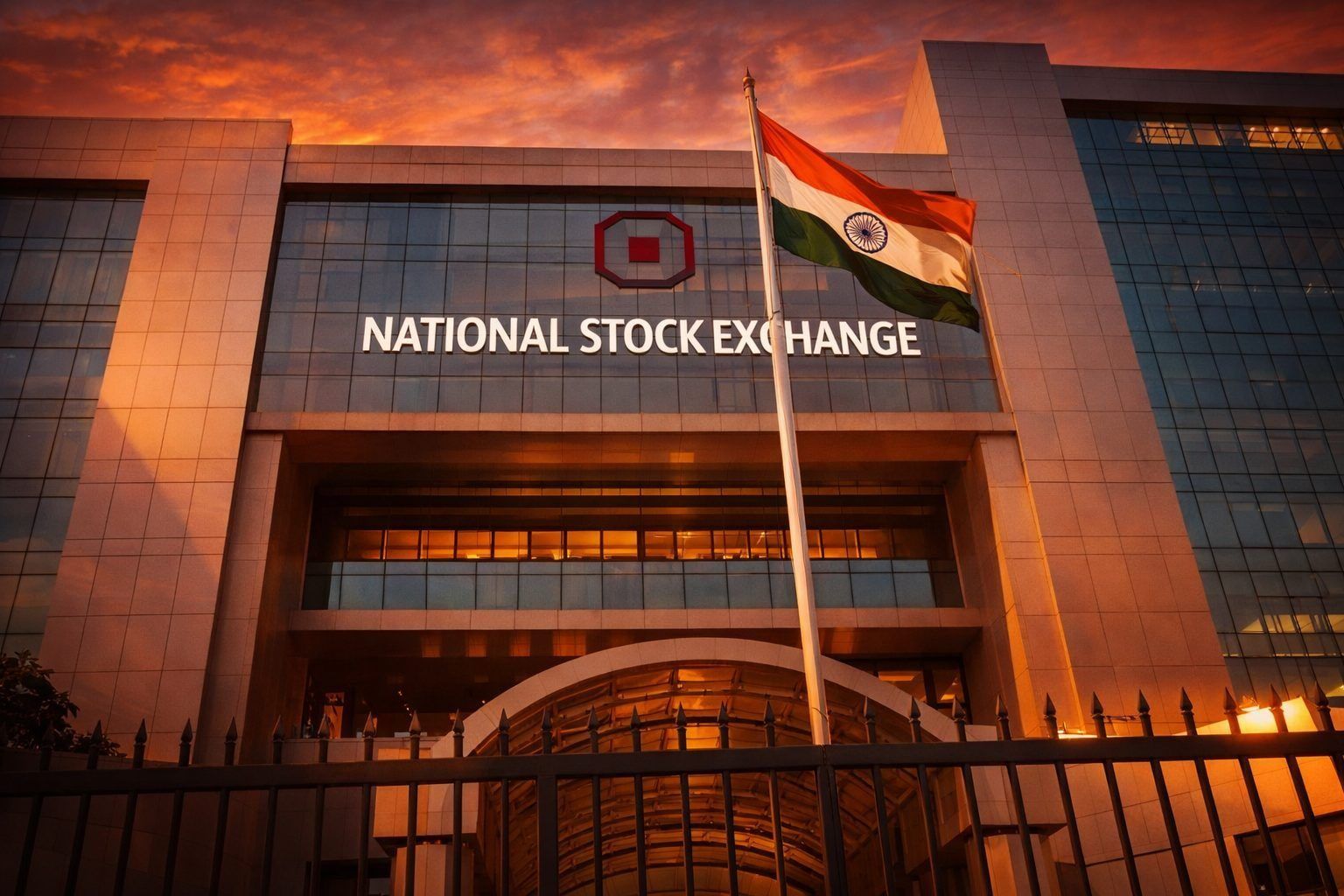
India’s National Stock Exchange of India (NSE) heads into the final trading sessions of 2025 with a familiar year-end cocktail: thin liquidity, cautious positioning, and investors trying to decide whether “quiet” means “stable” or “about to get weird.”
On Friday, the NSE’s benchmark Nifty 50 slipped 0.38% to close at 26,042.30, while the BSE Sensex fell 0.43% to 85,041.45 as traders booked profits near record highs amid subdued holiday-period activity. Weekly gains were trimmed to roughly 0.3% for the Nifty and 0.1% for the Sensex, even as the broader tone stayed constructive after a three-week losing streak.
With U.S. markets also closed now for the weekend, global investors are using the pause to re-check risk: foreign flows, rupee stability, and the unusual signal coming from India’s volatility gauge—low enough to look comforting, but potentially loud enough to be a warning siren.
What moved the NSE on Friday: profit-taking, thin volumes, and selective sector strength
The Friday dip wasn’t a dramatic “risk-off” event so much as a reminder that late-December price action can be dominated by position management rather than fresh conviction. Reuters noted that trading volumes have been lighter, averaging about 250 million Nifty 50 shares in December versus around 300 million in November—exactly the kind of environment where markets can drift until a catalyst shows up. Reuters
Sector performance also looked more “stock-pickers’ market” than broad stampede. Metals led weekly sector gainers (up about 2.7% on the week), with Reuters pointing to stronger demand expectations from China and rate-cut hopes in the U.S. as supportive factors. Small-caps outperformed (up about 1.8% on the week), while mid-caps were broadly flat. Reuters
Several single-stock headlines helped keep attention focused on pockets of momentum:
- Shriram Finance jumped after Mitsubishi’s reported $4.4 billion investment for a ~20% stake.
- Coal India gained after signaling plans to list subsidiaries.
- Ola Electric rose after receiving a government incentive under the PLI scheme.
The big pressure point: record FII outflows in 2025
The most consequential macro narrative hanging over Dalal Street right now is foreign selling.
The Economic Times reported that foreign institutional investors are on track for their largest-ever net exit from Indian equities in 2025, citing a net outflow of about ₹1.58 lakh crore as of Dec. 27. The same report pegged cumulative equity selling at ₹2,31,990 crore, with primary market investments of ₹73,583 crore, producing net outflows of ₹1,58,407 crore.
VK Vijayakumar, Chief Investment Strategist at Geojit Financial Services, told ET that 2025 is shaping up as “the worst selling by FIIs” since they began investing in India—language that captures the scale of the shift even if domestic participation has helped cushion the index. The Economic Times
ET also highlighted that on Friday alone, foreign portfolio investors were net sellers while domestic institutions were buyers—another snapshot of the push-pull dynamic under the hood.
Rupee watch: stability helps, but the “trade deal” theme keeps popping up
Currency markets are part of the same story because foreign flows and rupee expectations tend to feed each other.
Reuters reported the rupee was little changed on Friday at around 89.8325 per U.S. dollar in holiday-thinned trading, with traders citing routine corporate dollar demand alongside intermittent selling by state-run banks that helped blunt dollar bids.
One particularly market-relevant line: Reuters also cited analysts at ING saying that securing a trade agreement with the U.S. is “critical” for the rupee’s performance. That theme matters for equity investors because a steadier rupee can reduce the perceived currency risk for offshore allocators—especially at a time when the year’s FII tape has been heavy. Reuters
The calm that might not be calm: India VIX at record lows
If you want one indicator that captures the market’s odd mood, it’s volatility.
The Economic Times flagged that India VIX fell to about 9.15, described as its lowest level, as the Nifty stayed rangebound in the holiday-shortened week. ET’s Milan Vaishnav cautioned that ultra-low volatility can signal complacency and may leave the market vulnerable to sharp moves if an adverse trigger hits while positioning is crowded.
This matters heading into Monday because low volatility doesn’t predict direction—but it often tells you the market is underpricing the possibility of surprise.
Forecasts and technical levels: where analysts see the next inflection
With macro cues limited, near-term roadmaps are coming from technical levels and positioning.
Moneycontrol’s technical desk quoted Rajesh Bhosale (Angel One) saying traders should avoid reacting to short-term noise, stick with a buy-on-dips mindset, and watch 25,900 as immediate support (with 25,700 as a key near-term trend level). On the upside, he highlighted 26,250–26,350 as a major hurdle zone.
Moneycontrol also cited Rupak De (LKP Securities), who noted weakening momentum signals and framed 26,000 as an important line: holding it could allow a retrace toward 26,200+, while a sustained break below could deepen weakness.
ET’s market coverage echoed the “tight-range” thesis. UR Bhat (Alphaniti) said investors are hesitant to carry positions over the weekend amid global uncertainties, and Vipin Kumar (Globe Capital Market) mapped a short-term Nifty range roughly between 25,700 and 26,300, while noting the longer-term uptrend stays intact above lower support levels. The Economic Times
For a broader week-ahead framework, ET’s F&O feature quoted Sudeep Shah (SBI Securities) highlighting 26,200–26,250 as a crucial resistance band and 25,900–25,850 as important support, while pointing to potential catalysts including January earnings season, budget-related speculation, and a possible U.S.–India trade deal as “direction triggers.” The Economic Times+1
Global backdrop from New York: Wall Street’s last session was quiet, too
From the New York lens, the tone is similarly “low volume, limited catalysts.”
Reuters reported Wall Street ended Friday’s light post-Christmas session near flat, snapping a short rally but still logging weekly gains. Ryan Detrick, Chief Market Strategist at Carson Group, described the move as the market “catching our breath” after a strong run and noted the seasonal “Santa Claus rally” window remains in play. Reuters
For India-focused investors, the takeaway isn’t that Wall Street dictates Monday’s Nifty tick-by-tick—but that global risk appetite is not currently flashing an obvious red light. Instead, the risk is more subtle: thin liquidity plus complacent volatility pricing plus headline sensitivity.
If the NSE is closed: what investors should line up before the next session
Because it’s the weekend, the NSE cash market is shut—meaning the next real “price discovery” window comes when India reopens on Monday.
Here’s what matters most to have on your dashboard before that first trade prints:
- Key levels that traders are watching
- Support: 26,000 and 25,900–25,850 (multiple analysts flag these zones).
- Resistance: 26,200–26,250 first, then higher hurdles above that.
- Signals from futures and early indicators
- NSE’s own market page displayed GIFT Nifty levels (an early sentiment read) at the time of its update.
- Rupee and rates narrative
- With USD/INR near 89.83 and commentary focused on flows and potential trade-deal implications, currency stability remains part of the “foreign investor comfort” equation. Reuters
- Volatility: don’t confuse “low VIX” with “low risk”
- India VIX around record lows is a setup, not a guarantee—especially if any macro or geopolitical headline hits a thin market.
- Know the clock
- NSE’s standard equity session runs with a pre-open starting at 09:00 and the regular market open at 09:15, with normal market close at 15:30 (IST), according to NSE’s published market timings.
- Holiday effects are fading—but U.S. markets have another schedule wrinkle ahead
- U.S. markets are closed now for the weekend; the next notable closure is New Year’s Day. Investopedia reported that stocks have a full trading day on Dec. 31, with markets closed Jan. 1, 2026.
Bottom line
The National Stock Exchange of India is entering Monday with benchmarks still near highs, but with positioning and sentiment shaped by record foreign selling, a steady-but-watched rupee, and volatility priced as if nothing surprising can happen (which is historically when surprises get the most dramatic entrance).
The setup isn’t screaming “panic.” It’s whispering: watch the breakouts, respect the supports, and don’t let low volume lull you into sloppy risk management.