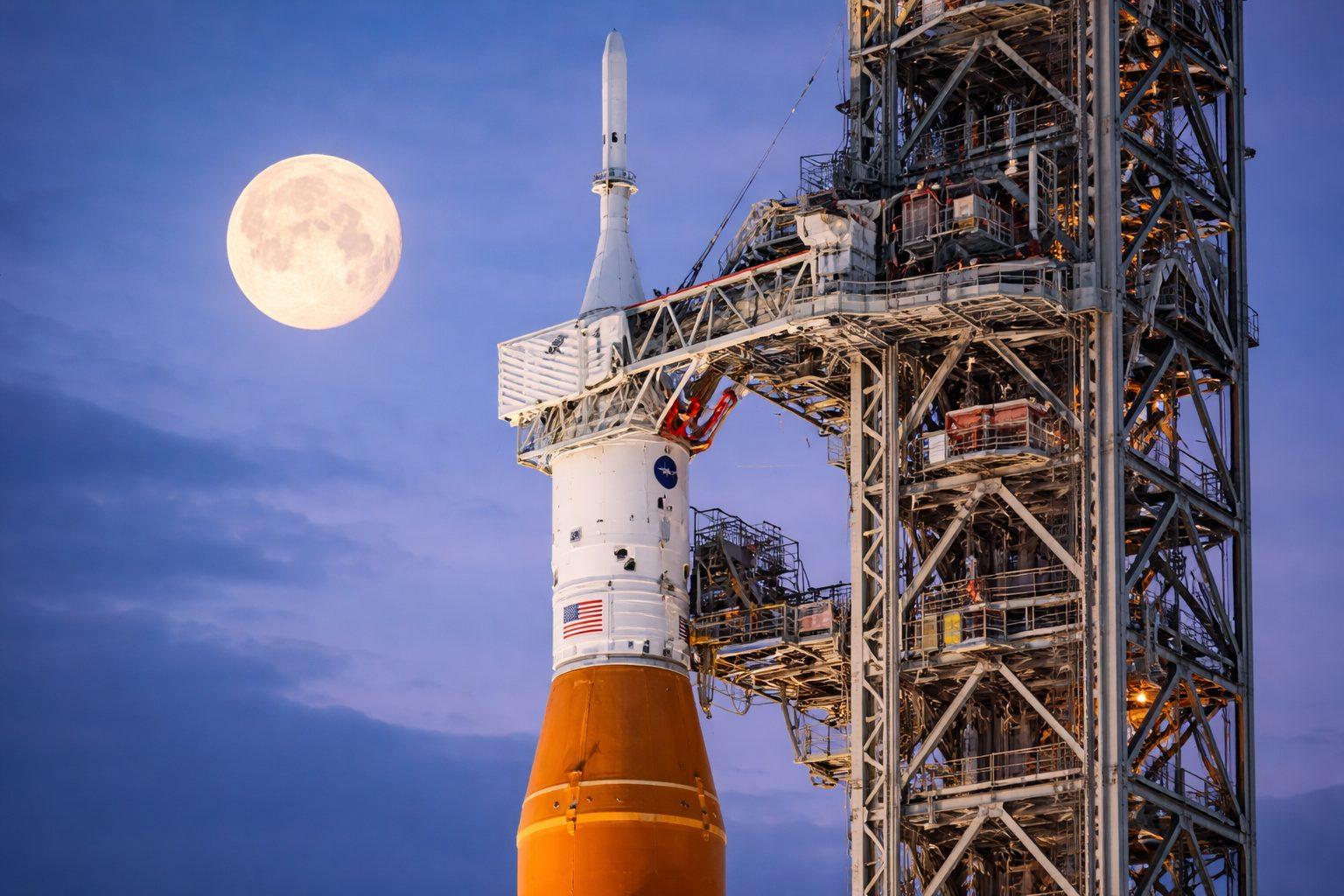
CAPE CANAVERAL, Florida, January 17, 2026, 07:21 EST
- Early Saturday, NASA started transporting its Space Launch System rocket along with the Orion crew capsule to Launch Pad 39B
- The agency sets the Artemis II launch window to open as soon as Feb. 6, pending a full fueling test and readiness review
- The crew of four features Canadian astronaut Jeremy Hansen, who will become the first Canadian to take part in a Moon exploration mission
NASA started moving its Artemis II Moon rocket and Orion spacecraft to the launch pad at Kennedy Space Center on Saturday. The slow, hours-long trek kicks off final tests ahead of the first crewed lunar mission in over 50 years.
The rollout is crucial as it kicks off the final phase of hands-on tasks NASA must complete at the pad. Here, crews hook the vehicle up to ground systems and run through countdown drills. NASA has set Feb. 6 as the earliest launch window for Artemis II.
Artemis II will mark NASA’s first crewed launch using the Space Launch System (SLS) rocket, sending astronauts aboard the Orion capsule on a roughly 10-day journey that loops around the Moon before heading back to Earth. The mission aims to put life support, guidance, and other critical systems through their paces ahead of a future Artemis flight that plans to land astronauts on the lunar surface.
The 11-million-pound rocket and capsule stack is mounted on a mobile launch platform, hauled by a crawler-transporter — a slow-moving, tracked vehicle that advances at roughly 1 mile per hour. NASA cautions that rollout timing could shift due to weather or technical issues, and it has set strict limits concerning lightning, wind, and temperature.
Canada’s space agency confirmed the crew includes NASA astronauts Reid Wiseman, Victor Glover, and Christina Koch, with Hansen joining as a mission specialist. Hansen is set to become the first Canadian involved in a Moon exploration mission.
At a Friday briefing, Artemis II mission management chair John Honeycutt emphasized that “crew safety is going to be our number 1 priority.” He also noted the timeline depends heavily on upcoming pad tests that must go smoothly. Space policy analysts pointed out the flight will follow a “free return” trajectory — a loop around the Moon designed to bring Orion back to Earth even if its main engine falters. https://spacepolicyonline.com/news/sls-ori…
NASA Administrator Jared Isaacman has zeroed in on reentry safety following heightened attention on Artemis I’s heat shield. “The heat shield has to do its job. There’s no Plan B capability,” Isaacman told WESH in an interview. https://www.wesh.com/article/nasa-administ…
“These are the kinds of days that we live for,” Honeycutt said Friday during a press briefing as rollout preparations finished, according to the Guardian. David Parker, formerly head of the UK Space Agency, described the mission as “a big deal,” marking progress toward sustained Moon exploration and eventually Mars. Artemis III targets a landing near the lunar south pole as soon as 2027, the Guardian reported. https://www.theguardian.com/science/2026/j…
Sky News says the rocket is roughly 98 metres tall. NASA is tackling last-minute snags, including swapping out a bent cable in the emergency abort system. The agency plans a “wet dress rehearsal”—a full countdown run with about 3.2 million litres of propellant loaded. Launch windows stretch from Feb. 6 through April, but just a few days each month line up with the Moon’s position. Sky also pointed out China aims to land astronauts on the Moon by 2030. https://news.sky.com/story/artemis-mission…
The schedule leaves little room for error. NASA can roll the stack back to the Vehicle Assembly Building if engineers need to make repairs, but even a fully prepped rocket might have its launch called off due to weather, technical problems, or range safety concerns.
The U.S. hasn’t sent astronauts to the Moon since Apollo 17 in 1972. NASA’s Artemis I mission, which flew Orion around the Moon unmanned in 2022, set the stage for Artemis II. This upcoming mission aims to move closer to crewed landings and eventually establish a lasting lunar outpost.