
New York, April 24, 2026, 17:03 (EDT)
- Applied Optoelectronics jumped 17.74% to finish at $162.17 on Nasdaq, after hitting an intraday high of $164.87.
- May 7 is circled for the company’s next test: first-quarter results and a second-quarter forecast are both due.
- Orders keep coming for 800G data-center transceivers, while a new capacity expansion near Houston spotlights ongoing demand for AI network infrastructure.
Shares of Applied Optoelectronics surged 17.7% Friday, as the optical networking name kept riding a hot AI-infrastructure wave ahead of its upcoming first-quarter earnings report. The stock finished the session at $162.17, with volume hitting roughly 13.9 million shares.
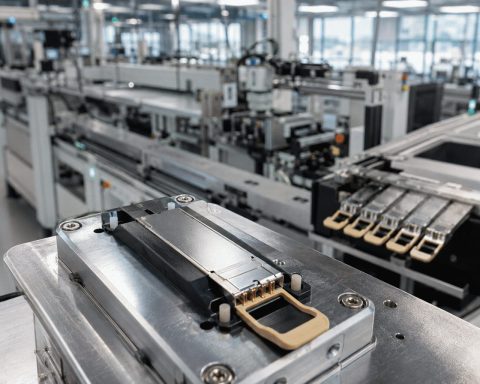
AAOI’s shift is notable—this stock now trades as a more focused play on the essential fiber hardware powering artificial intelligence. Its optical transceivers, the key gear shuttling data along fiber links, are what heavy AI computing relies on inside sprawling data centers, where speed and lower latency aren’t optional.
Applied Optoelectronics is set to release its March quarter results on May 7, with a call scheduled that day to talk through the second-quarter forecast. The rally now faces a concrete test, rather than getting swept up in the broader AI trade.
The order book has been drawing attention lately. On April 2, the company announced a fresh $71 million order for 800G single-mode data-center transceivers from a major hyperscale customer—industry shorthand for a big cloud or data-center operator. That pushes total business from this customer to $124 million since mid-March, more than doubling the backlog tied to that account. The 800G label flags gear built to handle 800 gigabits per second.
Chief Executive Thompson Lin pointed to the order as evidence of “growing demand for 800G optics.” Applied Optoelectronics expects shipments for both the original and expanded orders to start in the second quarter. The initial order wraps up in the third quarter, while fulfillment of the additional order should complete by year-end. Applied Optoelectronics, Inc.
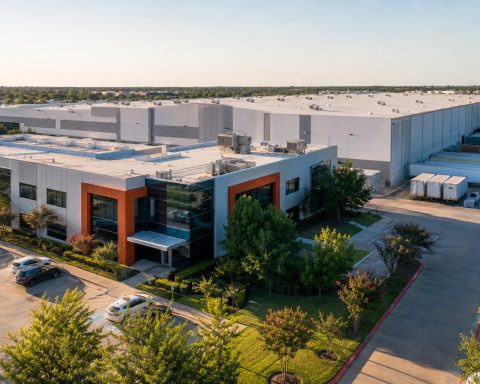
Just a week after its last announcement, AOI revealed plans to tack on two neighboring buildings in Pearland, Texas, bumping its Houston-area real estate to roughly 900,000 square feet. CEO Lin pointed to stronger-than-expected demand for optical connectivity. The expansion, the company said, should allow AOI to reach monthly output of up to 700,000 units for both 800G and 1.6T transceivers in Houston. For reference, 1.6T—1.6 terabits per second—doubles the data rate of 800G.
The competitive landscape looks different now. After Charter Communications posted first-quarter numbers, Raymond James flagged some ripple effects for Applied Optoelectronics, Ciena, Harmonic, and Nokia in a Friday note. Charter’s cable capex landed at $2.86 billion, topping both the Raymond James projection of $2.68 billion and consensus at $2.64 billion.
CMC Aureon flagged analyst Uttam Dey’s comments on a Seeking Alpha podcast: Dey says Applied Optoelectronics “own[s] the entire manufacturing ecosystem,” handling everything from laser chips to optical pluggables for hyperscale clients. In Friday’s note on optical AI trends, CMC pointed out Dey’s picks for the sector, naming both Lumentum and Applied Optoelectronics as key players in the optical AI expansion. CMC Markets
Financial conditions are looking better, though uncertainty lingers. AOI posted fourth-quarter revenue of $134.3 million, up from $100.3 million the previous year. Its GAAP net loss tightened sharply, coming in at $2.0 million versus the prior $119.7 million. Looking ahead to the first quarter, AOI expects revenue between $150 million and $165 million, and projects non-GAAP earnings ranging from a 9-cent loss per share to flat.
Still, this isn’t without risk. CMC points to heavy customer concentration, swings in demand, and patchy profits as key bear arguments. For its part, AOI itself flags weaker orders, shipment setbacks, price squeezes, tariffs, and the dangers of depending on just a handful of clients.
In a proxy filing on Friday, AOI scheduled its annual meeting for June 4 in Sugar Land, Texas. Investors are set to weigh in on a slate of proposals: two Class I director seats, auditor ratification, executive compensation, a charter amendment, plus the 2026 equity incentive plan.
Applied Optoelectronics is being viewed squarely as a play on capacity and delivery. Investors want to see if the company can actually convert those big hyperscale orders into real shipments—without sacrificing margin. After the stock’s run, plenty of good news looks priced in already.
Related articles: NASDAQ:AAOI



![US Stock Market Today 08/27/2026 [UPDATE: 00:01 EDT] [NVIDIA Leads AI Earnings Bid Across Midnight]](https://ts2.tech/wp-content/uploads/2026/08/US-market-dashboard-2026-08-27-0000-480x384.jpg "US Stock Market Today 08/27/2026 [UPDATE: 00:01 EDT] [NVIDIA Leads AI Earnings Bid Across Midnight]")

![Australia Stock Market Today 27/08/2026 [UPDATE: 13:40 AEST] [Spending Beat Pins ASX Near Session Low as MinRes Gains]](https://ts2.tech/wp-content/uploads/2026/08/AU-market-dashboard-2026-08-27-1340-480x384.jpg "Australia Stock Market Today 27/08/2026 [UPDATE: 13:40 AEST] [Spending Beat Pins ASX Near Session Low as MinRes Gains]")