
TORRANCE, California, April 28, 2026, 11:02 PDT
Navitas Semiconductor dropped roughly 17% by late morning Tuesday, snapping back after a strong rally that put the power-chip maker close to its 52-week peak. Shares were last seen at $15.11, having slipped to an intraday low of $14.84. Volume topped 26 million shares early on.
The slide is catching attention as investors look ahead to next week’s earnings, zeroing in on a single issue: can Navitas convert demand for its AI-related power systems into actual sales? First-quarter numbers land after the bell on May 5, with CEO Chris Allexandre and CFO Tonya Stevens set to take questions on the call.
Analysts are projecting Navitas will report a quarterly loss of 5 cents per share with revenue at $8.179 million, according to MarketBeat data. Last quarter, revenue landed at $7.3 million—a 59.4% slide from the same period last year—even as the company draws more focus for its work on high-power data-center projects.
The stock’s turned into a crowded trade. According to Benzinga, short interest hit 43.48 million shares, roughly 25.11% of the float as of Tuesday—numbers that can fuel sharper swings if traders scramble to cover shorts or exit momentum plays. When a short squeeze happens, investors who were betting against the stock are forced to buy.
Options activity cranked up the volume. According to The Fly, 22,053 Navitas call contracts traded Monday—roughly 1.5 times the usual tally—as implied volatility jumped over five points to 145.32%. Calls let traders lock in a purchase price, a setup that can supercharge speculation when earnings or product headlines break.
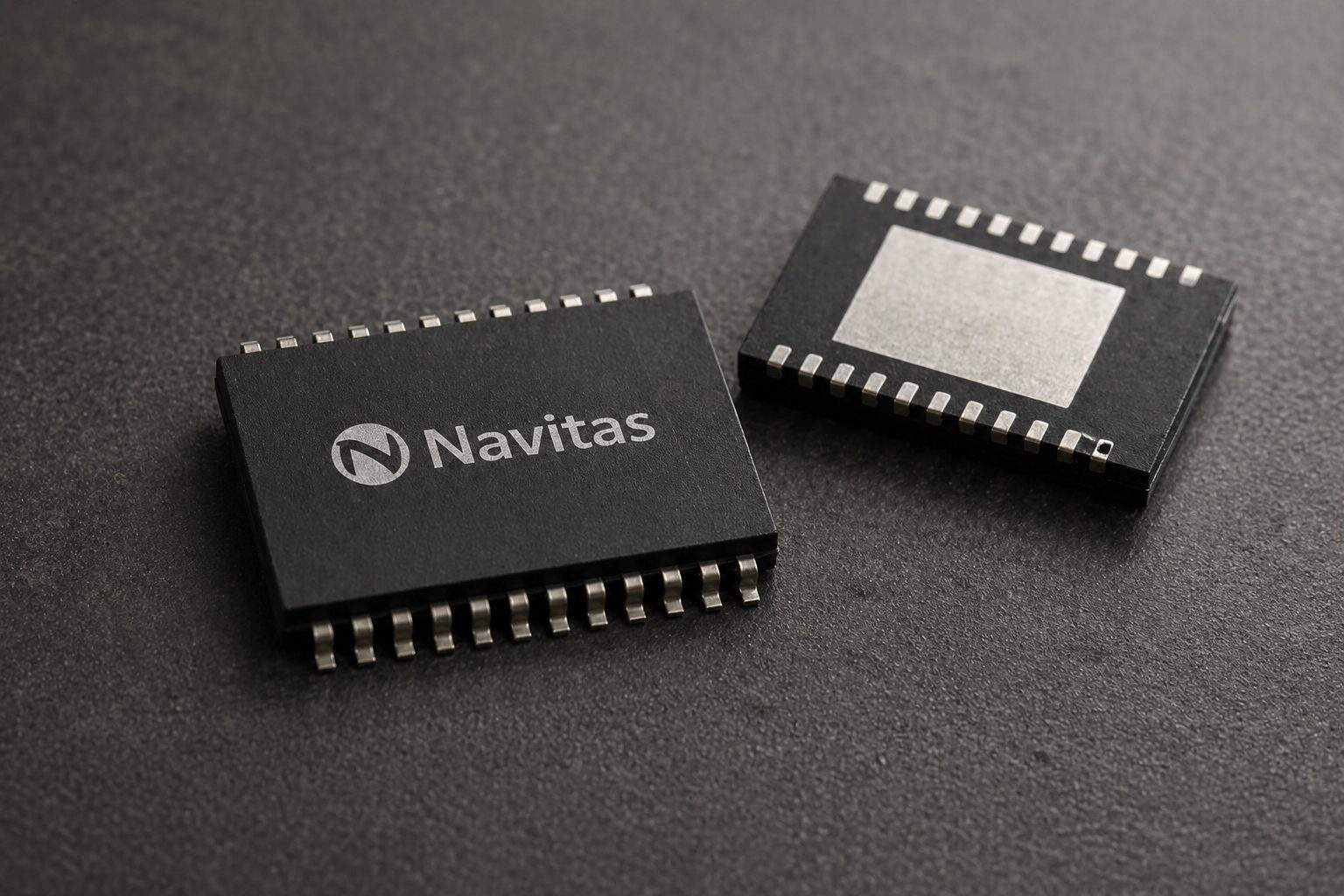
Navitas builds power semiconductors using gallium nitride (GaN) and silicon carbide (SiC)—materials that push electricity through hardware more efficiently than much of the legacy silicon tech. That efficiency is coming into sharper focus as AI servers ramp up power demands and hardware packing gets tighter.
AI’s role here isn’t brand new, but it’s moved closer to the heart of the narrative. Back in March, Navitas unveiled an 800-volt to 6-volt direct-current power board at Nvidia’s GTC conference, targeting the elimination of a conversion step inside server trays. According to Allexandre, this setup could “lower system cost and power losses” and open up more board space. Navitas Semiconductor
That’s the bullish argument. Right now, the market is putting it to the test.
Losses showed up in other power and semiconductor stocks as well—this wasn’t limited to Navitas. Shares of Power Integrations dropped roughly 7%, Monolithic Power Systems slipped about 6%, and Wolfspeed tumbled close to 13%, according to the latest market data.
Valuation’s in focus, too. According to MarketBeat, seven research outfits following Navitas landed on an average “Hold” rating. The consensus 12-month price target: $6.78—a fair bit under where shares traded on Tuesday. The breakdown: one analyst says sell, five are holding, just one’s at buy. MarketBeat
Governance remains a focus. Earlier this month, Navitas tapped Gregory M. Fischer—a former Broadcom executive—for a seat on the board as an independent director. He’s set to join both the compensation and executive steering committees. Chairman Richard Hendrix described the moment as a “pivotal time” for Navitas. Navitas Semiconductor
Still, execution is the big question mark here. Back in March, Navitas flagged its pivot to AI data centers, grid infrastructure, and other high-power applications as a work in progress, hinging on its ability to scale up, attract clients, fend off bigger rivals, and push 800-volt architectures into the mainstream. None of these are locked in yet.
Investors right now aren’t so much concerned with Navitas’s present sales figures—they’re watching to see if the company’s AI power pitch will actually drive orders. The May 5 report is shaping up as a test, not just for the numbers but for patience, too.