
BEIJING, May 14, 2026, 23:02 (China Standard Time)
- Elon Musk has turned up in Beijing as part of President Donald Trump’s business delegation, with Tesla pushing for broader approval of its Full Self-Driving system in China.
- Tesla shares barely budged in U.S. trading, with the company’s market cap steady around $1.57 trillion.
- Tesla has a green light from Belgium to run a supervised self-driving test with a single car. European regulators, though, aren’t done pressing on safety concerns.
Elon Musk showed up in Beijing this week, pushing Tesla’s Full Self-Driving system back into the spotlight as he looks to win over Chinese regulators. The U.S. automaker wants approval to expand the driver-assistance tech across China, the world’s biggest car market. Leaving the Great Hall of the People on Thursday, Musk told reporters he hoped to achieve “many good things” in the country. Reuters
Why does this matter now? Tesla’s valuation isn’t riding on plain-vanilla EV sales anymore—it’s whether Elon Musk can pull off big bets on autonomy, robotaxis, and software subscriptions, making those a bigger slice of the business. And China isn’t some side market, either. Tesla moved around 626,000 cars there last year, ranking as the country’s fifth-largest seller of electric and plug-in hybrids. That market contributed close to 20% of Tesla’s total revenue, according to company data and figures from the China Passenger Car Association, as reported by Reuters.
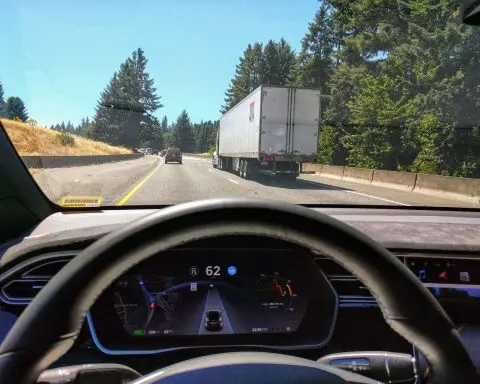
Tesla’s Full Self-Driving, or FSD, is a paid software add-on that can handle some driving tasks, but drivers still need to pay attention and be ready to intervene—it doesn’t make the car fully autonomous. The company is currently trying to secure regulatory approval in China to boost FSD’s rollout there. Meanwhile, a U.S. business delegation is banking on the Trump-Xi summit to help open the door for market access and necessary approvals for multiple firms, according to Reuters.
Tesla stock barely budged, closing at $445.13 in U.S. trading after touching $451.99 during the session. The company’s market cap sits around $1.57 trillion. Investors are still betting on Tesla’s autonomy story, even as demand for its core vehicles cools and rivals crowd the field.
Tesla’s influence in Beijing hasn’t faded. “Beijing’s priorities line up almost perfectly with Musk’s interests,” Kyle Chan, a fellow in Chinese technology at the Brookings Institution, told Reuters, highlighting electric vehicles, autonomous driving, AI, and humanoid robots. Felipe Munoz, a longtime auto analyst, called Tesla’s push on battery tech and software “one of the biggest inspirations” for China’s carmakers. Reuters
The China market isn’t straightforward for Tesla. Local EV brands are going after it on both price and tech, and Xiaomi CEO Lei Jun sharing a moment with Musk at the state banquet made clear: Chinese tech names are fighting for the spotlight, too. Chang Yan, who runs the EV-focused Weibo blog Supercharged, told Reuters that Musk’s star power in China could wane as domestic players close the gap or even outpace parts of his tech business.
Europe saw some action too. Tesla got the green light on Wednesday to run supervised self-driving tests with a single vehicle in Belgium’s Flanders, according to a spokesperson for regional minister Annick De Ridder. The pilot will span roughly 5,000 kilometres, aimed at gauging how Tesla’s software handles Belgian roads and traffic laws, after the Netherlands gave provisional approval last month.
The approval route isn’t without its hurdles. Internal emails reviewed by Reuters reveal that regulators across several European countries raised flags over FSD—questioning its handling of speed limits, performance on icy roads, and whether the “Full Self-Driving” branding could give drivers the wrong idea. For an EU-wide green light, the measure needs backing from nations making up at least 55% of member states and 65% of the bloc’s population. There was no vote on the docket this week. Reuters
Investors have fresh cause for pause as Tesla’s robotaxi launch in the U.S. stumbles. During tests in Dallas and Houston, Reuters reporters dealt with lengthy waits, few available cars, rides cancelled outright, and drop-offs that sometimes missed the mark by a wide margin. Right now, the service is restricted to Dallas, Houston and Austin. That’s a far cry from what Musk once promised: robotaxis serving half the country by the end of 2025.
Costs keep climbing. Tesla now expects to spend over $25 billion on capital projects through 2026—factories, chips, other big-ticket items—raising its target from the previous “above $20 billion.” CFO Vaibhav Taneja described the current period as a “very big capital-investment phase,” with negative free cash flow likely sticking around through the end of 2026. Reuters
Tesla isn’t backing away from legacy manufacturing either. This week, the company put nearly $250 million more into battery cell output at its Gruenheide site near Berlin, bumping up targeted yearly capacity to 18 gigawatt hours—more than double the previous 8 GWh. Labor demand for battery-cell work will also climb, topping 1,500 jobs.
Right now, Beijing’s just unlocked the door, not greenlit the deal. Musk is in, Tesla’s tech is under regulatory review, and the stock’s still reflecting big hopes for autonomy. What hasn’t shifted: Tesla still has to show its software can scale safely—both in China and beyond—before rivals and rulemakers close in.
Related articles: NASDAQ:TSLA