NEW YORK, July 15, 2026, 17:09 (EDT)
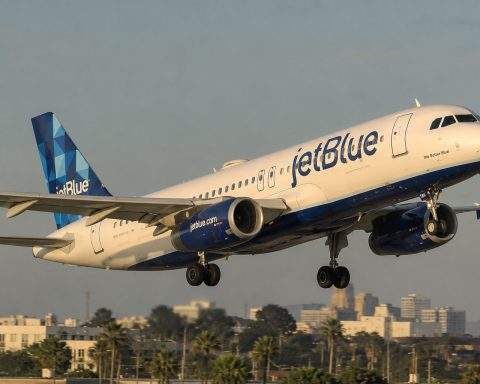
JetBlue Airways NASDAQ:JBLU rolled out installment payments for bookings on Wednesday. The carrier is trying to drive sales as a jump in fuel costs is on track to erase the gains it expected from higher fares. Based on its Q2 guidance, revenue lands around $185 million short of the combined fuel and core ex-fuel costs at the guidance midpoint, before factoring in other operating items.
JetBlue reports on July 28, a date that matters as investors look to see if higher prices have kept up with what could be an 85% jump in its fuel bill from last year. JetBlue shares closed up about 4.5% at $5.59 on Wednesday, regaining nearly all of Tuesday’s 4.8% drop after airlines rallied.
JetBlue’s new ClarityPay offer lets eligible customers break up payments from six weeks to 48 months. Annual percentage rates are from 0% to 36%. There’s a promo now—0% financing for up to 12 months, open until August 15. A $219.49 fare, the first-quarter average, would mean $18.29 monthly for a year with no interest, but eligibility and other charges may apply.
Ed Pouthier, vice president of loyalty and personalization at JetBlue, said the new ClarityPay deal will offer “more flexibility when planning and booking travel.” Tom Carter, ClarityPay’s commercial chief, said the rollout aims to “drive future purchases within the JetBlue ecosystem.” There were no details on merchant fees, customer adoption goals or revenue projections in the announcement. JetBlue Investor Relations
JetBlue’s June update guided for Q2 capacity to rise by 2% to 4%, RASM up 9% to 12%, and CASM ex-fuel climbing 3% to 5%. RASM, or revenue per available seat mile, tracks pricing, while CASM is cost per available seat mile. Taking those outlook ranges and applying them to last year’s numbers, assuming fuel use also moves with capacity, gets this range:
| Illustrative scenario | Revenue ($mln) | Fuel ($mln) | CASM ex-fuel cost ($mln) | Residual ($mln) |
|---|---|---|---|---|
| Q2 2025 base | 2,357 | 504 | 1,806 | +47 |
| Q2 2026 downside | 2,621 | 934 | 1,935 | -248 |
| Q2 2026 midpoint | 2,683 | 932 | 1,935 | -185 |
| Q2 2026 upside | 2,746 | 930 | 1,935 | -120 |
Residual here is revenue less estimated fuel and CASM ex-fuel. This model isn’t company guidance or a formal earnings outlook, and it doesn’t show operating income. It uses Q2 2025 fuel efficiency.
The model leans on the size of the imbalance, not the exact deficit number. In the upside case, revenue is up about $388 million from the year before, but estimated fuel outlays climb roughly $426 million along with higher labor, maintenance and other costs. JetBlue’s GAAP operating margin came in at just 0.3% in Q2 of 2025, so there’s not much cushion left for another cost hit.
United Airlines Holdings, Inc. NASDAQ:UAL set out a peer update after the close Wednesday. The airline posted 3.5% capacity growth and unit revenue up 12.1%. Fuel averaged $4.19 a gallon. United said fare and revenue moves helped offset about half its higher Q2 fuel bill. JetBlue is aiming to recover at least 40%.
| Investor measure | JetBlue Q2 2026 | United Q2 2026 |
|---|---|---|
| Capacity guidance at 2% to 4% | 2%–4% guidance | Capacity actually grew 3.5% |
| Guided revenue per unit up 9% to 12% | 9%–12% guidance | Unit revenue came in at 12.1% |
| Guided fuel cost per gallon in $4.26 to $4.36 range | $4.26–$4.36 guidance | Fuel cost hit $4.19 per gallon |
| Expected to recover at least 40% of added fuel cost | At least 40% expected | Recovered about 50% in practice |
| Sees full recovery in early 2027 | Early 2027 | Looking for full recovery in Q4 2026 |
JetBlue laid out its recovery timeline in its Q1 numbers, while United posted its results and guidance on Wednesday.
So JetBlue’s revenue goal looks doable compared to that, though it puts more pressure on their outlook. United said the recent jump in oil prices has boosted its fuel bill by roughly $575 million in two weeks. The airline now sees third-quarter adjusted earnings between $2.50 and $3.50 a share, with the midpoint under the $3.60 analysts expected. United shares fell around 5% after hours. CEO Scott Kirby said United was “built to thrive in every environment.”
The JetBlue approach could turn out to be too aggressive. The airline might beat its unit-revenue forecast, cut capacity, boost fuel efficiency, or bring in more loyalty and ancillary revenue than this model suggests. ClarityPay might lift conversion for expensive tickets. But risks cut both ways: standard loan rates can hit 36%, there are no adoption or transaction projections, and a jump in jet fuel would drive up costs.
JetBlue finished March with about $2.4 billion in liquidity and $8.44 billion in debt, making the risks clear. S&P Global Ratings, part of S&P Global Inc. NYSE:SPGI, downgraded JetBlue to CCC+ in June. The agency said, “we no longer expect positive free cash flow generation until 2028,” but kept its outlook stable and said it sees JetBlue’s liquidity covering needs through 2027. The checkout tool can ease up-front payments, but it doesn’t cut fuel costs. SEC