
NEW YORK, July 15, 2026, 18:05 EDT
- Intermodal accounted for $55.1 million of the $62.2 million year-on-year operating-profit gain at J.B. Hunt, or about 89%.
- The unit moved 10% more loads even as average tractors dropped 3% and containers and trailers were down 1% at the end of the quarter.
- Stock gained 6.9% to $295.20 in after-hours trading as both revenue and EPS came in ahead of estimates.
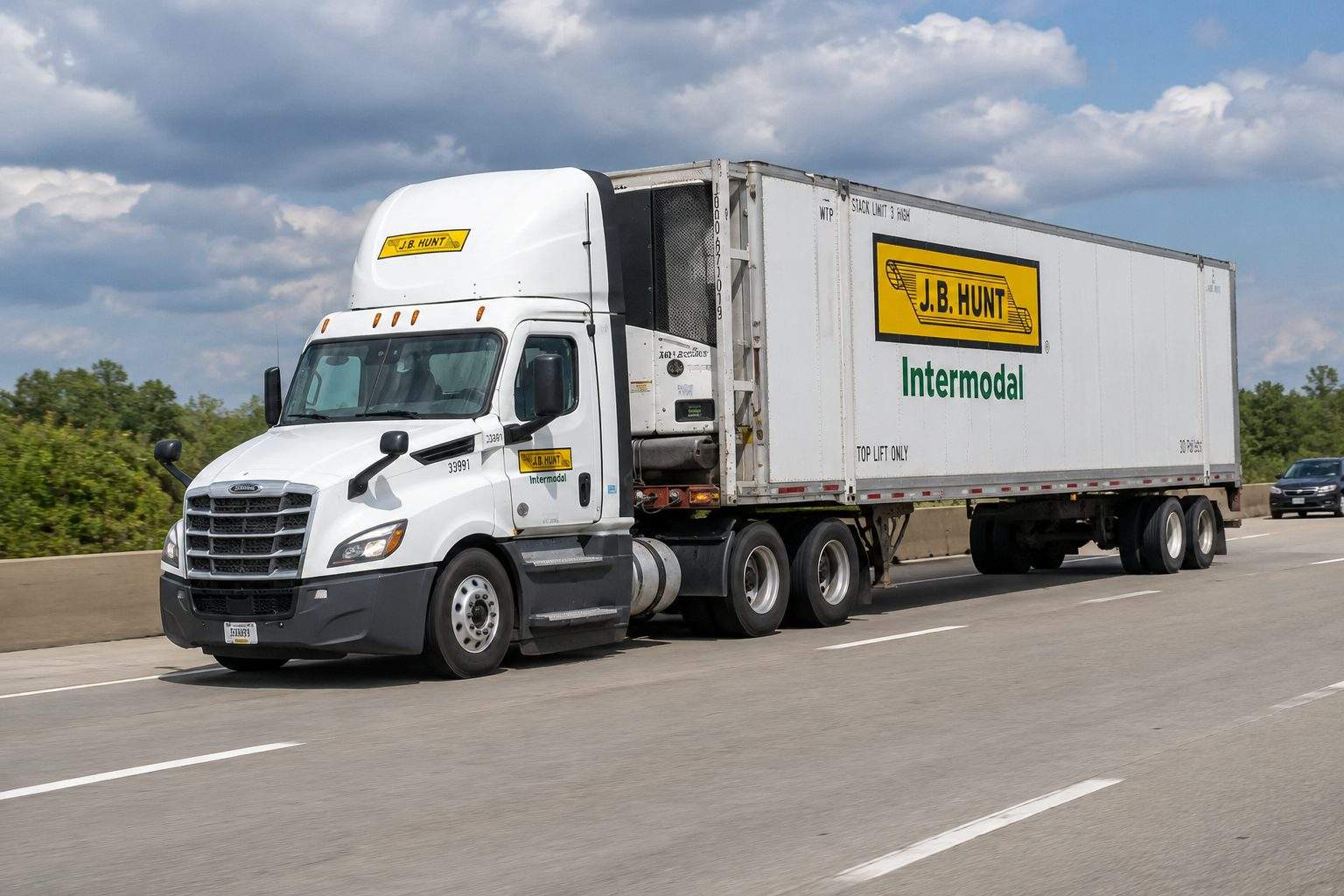
J.B. Hunt Transport Services, Inc. NASDAQ:JBHT got nearly 90% of its second-quarter operating profit gain from intermodal, according to its reported numbers. The carrier hauled more loads using about the same amount of equipment. Shares jumped 6.9% after hours.
The result is key since J.B. Hunt’s main business is boosting volume and efficiency together, not just getting more from fuel surcharges. Intermodal, its rail-truck business, posted a 10% gain in loads and revenue per load was up 1% without fuel. Loads on the eastern network jumped 16%. Transcontinental lanes saw a 5% rise.
Revenue climbed 19% to $3.50 billion. EPS jumped 45% to $1.91, ahead of analyst forecasts for $3.26 billion in revenue and $1.74 in EPS, according to FactSet NYSE:FDS. Shares were up 42% in 2026 through Wednesday’s close, setting high expectations for operating leverage, or profit growth as the company moves more freight on the same network. Operating income was up 32%.
| Q2 and market check | Reported or latest | Benchmark | Difference |
|---|---|---|---|
| Revenue | $3.50 billion | $3.26 billion estimate | +7.2% |
| Earnings per share | $1.91 | $1.74 estimate | +9.8% |
| After-hours share price | $295.20 | $276.28 regular close | +6.9% |
FactSet consensus numbers; share price shown is after-hours at dateline.
Segment profit wasn’t as spread out as sales growth made it look. Intermodal delivered 50% of segment sales, but pulled in 58% of the operating income and was behind $55.1 million of the $62.2 million increase. Dedicated and brokerage chipped in, while final mile and truckload lost ground.
| Segment | Q2 2026 operating income | Q2 2025 | Change | Share of total gain |
|---|---|---|---|---|
| Intermodal | $150.9 million | $95.7 million | +$55.1 million | 88.6% |
| Dedicated | $102.5 million | $93.7 million | +$8.8 million | 14.1% |
| Integrated Capacity Solutions | $1.7 million | $(3.6) million | +$5.2 million | 8.4% |
| Final Mile Services | $5.6 million | $8.0 million | $(2.4) million | (3.9)% |
| Truckload | $(1.3) million | $3.4 million | $(4.7) million | (7.6)% |
| Other | $0.2 million | $0.0 million | +$0.2 million | 0.3% |
| Total | $259.5 million | $197.3 million | +$62.2 million | 100% |
Totals are based on company numbers before rounding; rounding may cause minor differences.
Intermodal load count climbed to 578,072, even as average tractors dropped to 6,212 from 6,376. Containers and trailers at quarter’s end slipped 1% to 124,199. Still, average effective equipment usage moved up 9% to 112,301. Operating margin for the unit jumped to 8.6% from 6.7%. In short, more of the trucks ran.
President and CEO Shelley Simpson said, “Our second quarter results reflect the strength of executing our strategy,” and noted the company is keeping “discipline around returns on our capital.” J.B. Hunt pointed to fewer empty-container moves, a drop in storage costs, better productivity at local rail-terminal trucking, and structural cost cuts. Business Wire
But the tight truck market hit other segments. Truckload revenue jumped 35% and loads were up 14%, but the unit swung to a $1.3 million loss from a $3.4 million profit as outside-carrier costs climbed. Integrated Capacity Solutions saw revenue up 49% and moved back to profit, but gross margin dropped to 12.5% from 15.5%. Purchased transportation, capacity from outside carriers, rose 54%. Lower fuel prices or more truck capacity could slow the move to intermodal.
Cash flow was another bright spot. Operating cash flow for the first half dropped 10% to $723.3 million. Net capital spending declined more sharply, down 64% to $144.9 million. That pushed implied free cash flow up to $578.3 million from $407.2 million. Debt was cut to $1.15 billion from $1.72 billion a year ago. J.B. Hunt also bought back $98 million of stock in the quarter.
J.B. Hunt closed at $295.20 in after-hours trading, 2.7% over the $287.40 average 12-month analyst target from Google Finance. That gives the company less room if fleet use dips or revenue per load drops. The coming quarter has to prove that intermodal gains can hold up with the ongoing truck capacity squeeze.
Related articles: Stock Market