
NEW YORK, August 4, 2026, 18:59 EDT
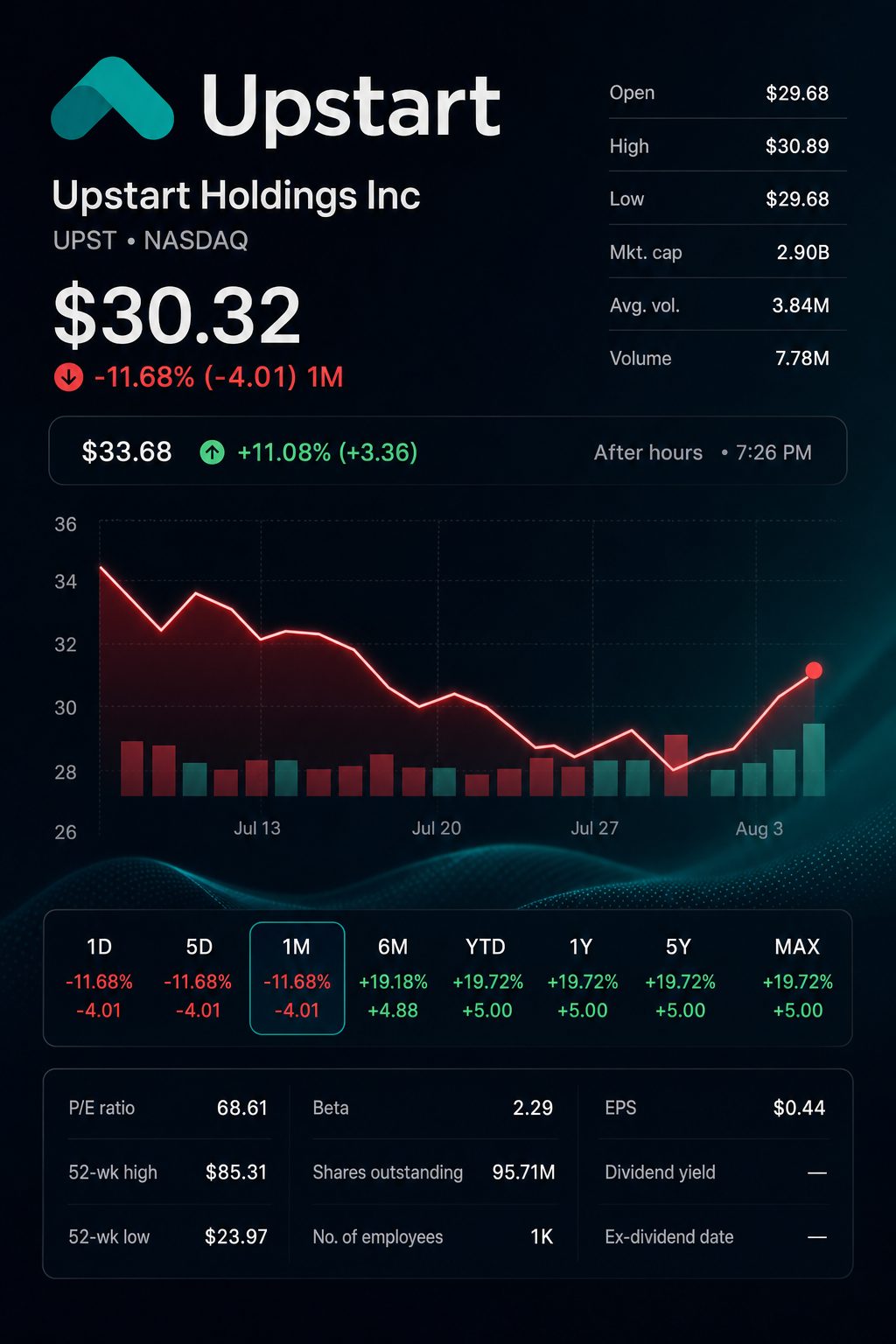
- Upstart shares gained 10.2% to $33.42 in after-hours trading. During the regular session, the stock rose 3.0% to close at $30.32.
- Originations rose by $782 million from the previous period. Loans held grew by approximately $50 million.
- The maintained $1.4 billion revenue forecast suggests that second-half quarterly revenue will average approximately $363.5 million, which is about the same as the second quarter.
Upstart Holdings Inc. NASDAQ:UPST surged approximately 10% in after-hours trading on Tuesday, following stronger-than-expected second-quarter revenue and adjusted EBITDA. The move came after the end of regular U.S. trading, with the after-hours session still ongoing.
The key signal for investors was growth quality. Upstart increased its loan volume at a significantly quicker pace than the growth of its own balance sheet.
Originations climbed $782 million quarter-over-quarter. Loans on the balance sheet grew by approximately $50 million. As a result, the growth in the balance sheet represented around 6.4% of the incremental originations for the quarter. This figure serves as an intensity metric rather than a measure of funding share.
The company surpassed the S&P Global Market Intelligence and Visible Alpha consensus estimates for revenue and adjusted EBITDA in the quarter. However, GAAP earnings per share came in below expectations.
| Q2 2026 metric | Actual | Consensus | Surprise |
|---|---|---|---|
| Revenue | $364.7 million | $356.7 million | +2.2% |
| Adjusted EBITDA | $76.9 million | $64.8 million | +18.7% |
| GAAP diluted EPS | $0.16 | $0.19 | -15.8% |
Revenue increased by 42% compared to the same period last year. Net income totaled $16.5 million, and contribution profit set a new high at $193 million. CEO Paul Gu described core personal loans as “our superpower” and stated that the expansion was financed “without adding equity capital.” Upstart Holdings, Inc.
The comparison of balance sheets helps explain the positive investor reaction. Marketplace volume increased at a quicker pace than retained credit exposure.
| Capital-efficiency measure | Q2 2026 | Sequential comparison |
|---|---|---|
| Originations | $4.227 billion | Up $782 million, or 23% |
| Loans held | $1.064 billion | Increase of about $50 million, or 5% |
| Held-loan share of outstanding principal | 5.9% | At its lowest point in nearly two years |
| Derived balance-sheet intensity | 6.4% | $50 million as a share of $782 million |
In the first half, institutional investors acquired 61% of the originated principal, while lending partners kept or acquired an additional 31%. Upstart retained 8% on its own balance sheet. The company secured capital agreements providing as much as $10.8 billion in additional capacity.
Platform product economics strengthened overall. The majority of profit came from unsecured lending, as losses in auto and home lending narrowed.
| Q2 product group | Originations, quarter-on-quarter | Fee revenue | Contribution margin |
|---|---|---|---|
| Unsecured lending | +20% | $326 million, +23% | 62%, up 6 points |
| Secured products | +45% | $22 million, +86% | -35%, rise of 61 points |
The secured business continues to operate at a loss on a contribution basis. Executives anticipate it will achieve break-even in the fourth quarter. CFO Andrea Blankmeyer stated Upstart was “no longer a single-product company.” Upstart Holdings, Inc.
The company’s unaltered annual outlook signals increased caution. Upstart kept its revenue guidance at about $1.4 billion and adjusted EBITDA at $294 million.
| 2026 revenue bridge | Amount |
|---|---|
| Guidance for full year | About $1.400 billion |
| Revenue reported for first half | $672.9 million |
| Revenue implied for second half | About $727.1 million |
| Average per quarter implied | About $363.5 million |
| Q2 reported revenue | $364.7 million |
| Difference between implied H2 quarterly average and Q2 | -0.3% |
The rally appears to hinge on funding durability and rebound in margins, rather than expectations of stronger sales in the second half.
Upstart maintained its guidance as the company’s macro-risk index climbed to 1.50, up 9% from the beginning of the quarter and hitting the upper end of the range anticipated in February. An index reading of 1.50 implies about 50% greater risk of repayment compared to Upstart’s typical baseline.
Upstart reported preliminary, unaudited originations for July at $1.397 billion, equating to $51 million per origination day. The UMI measurement marked its strongest result since January but still trailed its 2024 high.
Upstart secured conditional authorization from the Office of the Comptroller of the Currency to form Upstart Bank. The company still awaits approval from the Federal Deposit Insurance Corp. Leadership is targeting a launch in early 2027.
Risks persist. Secured products continue to produce negative contribution margins. Upstart retains over $1 billion in loans, leaving earnings vulnerable to defaults and adjustments in fair value. Elevated UMI readings may reduce demand, harm credit performance, or affect third-party funding.
The next challenge is execution. Upstart needs to maintain a low balance-sheet share, bring secured lending to break-even, and sustain quarterly revenue close to the implied $364 million level.
Related articles: Fintech