Gossamer Bio shares surge after FDA filing update; cash concerns and dilution still loom

Gossamer Bio shares surge after FDA filing update; cash concerns and dilution still loom

NEW YORK, July 27, 2026, 3:02 p.m. EDT. Gossamer Bio shares rose sharply after the company outlined its FDA filing strategy, but lingering questions over cash reserves and potential shareholder dilution persist.

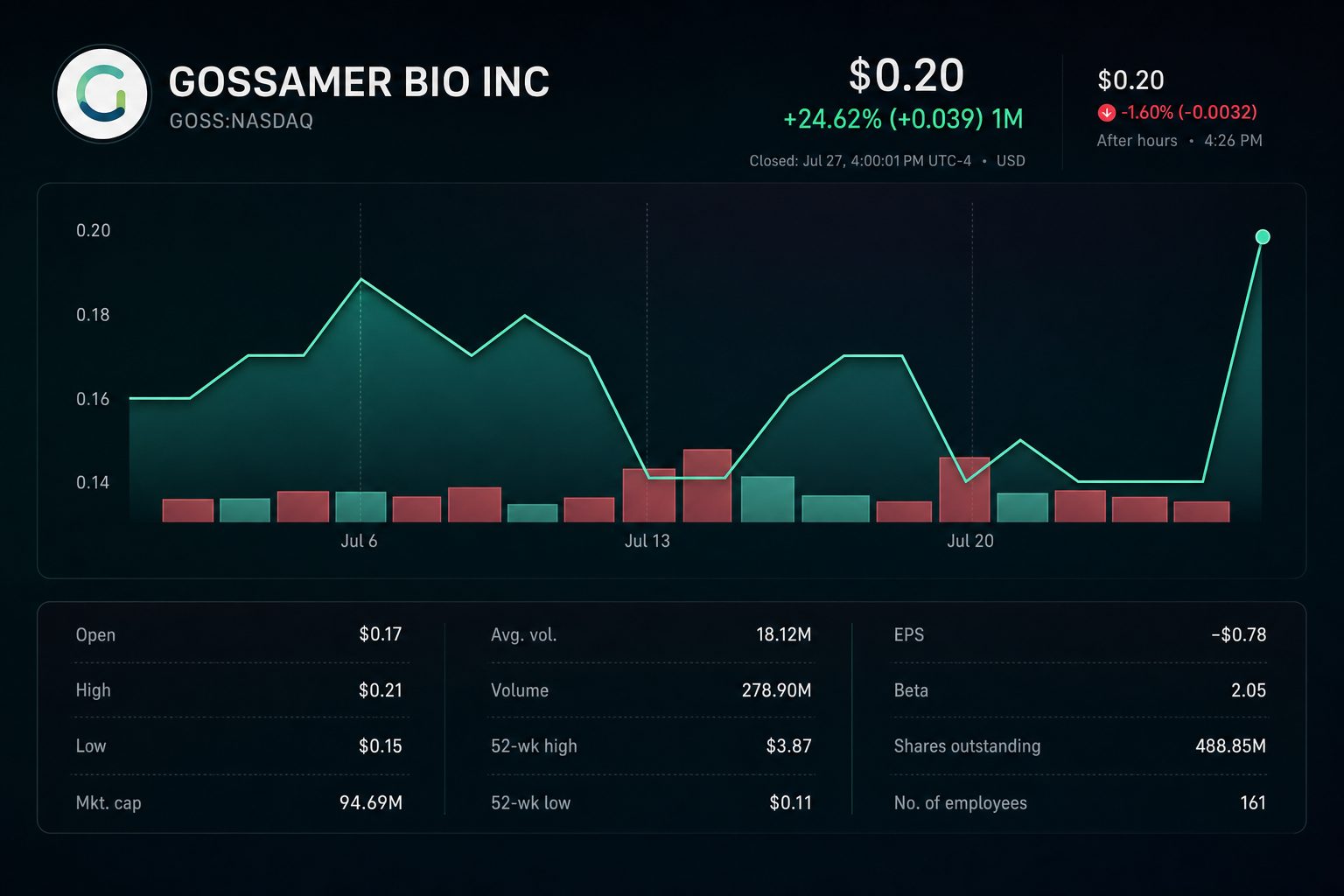
  • Shares of Gossamer Bio increased by 41% to $0.1917. The SPDR S&P Biotech ETF (NYSEARCA:XBI) was up 0.8%.
  • Minutes from an FDA meeting back the filing of a seralutinib application in September. An outcome may be reached in the third quarter of 2027.
  • Gossamer Bio reported preliminary cash of $57 million at the end of June, down from $99.2 million as of March 31.

Gossamer Bio Inc. shares jumped 41% to $0.1917 as of 2:46 p.m. EDT on Monday. Earlier in the day, the stock reached a session high of $0.2134. U.S. stock markets were still trading.

The action came after receiving updated feedback from the U.S. Food and Drug Administration, which reduced the short-term risk of the filing being denied. However, it did not resolve the issue of whether approval would be granted.
Gossamer Bio shares surge after FDA filing update; cash concerns and dilution still loom

The FDA has classified the statistical result and treatment effect of seralutinib as matters for review, not as obstacles to filing. Gossamer intends to file its application in September.

The filing is set to be based on data from the Phase 3 PROSERA trial. Gossamer intends to supplement it with results from the Phase 2 TORREY study and additional supportive analyses. Pending acceptance, the submission may result in an FDA decision in the third quarter of 2027.

The capital changes were more involved. Gossamer has concluded its partnership with privately owned Chiesi Group, reacquiring global rights to seralutinib. Chiesi is set to pay Gossamer $5 million. Gossamer is not required to make any upfront payments.

Chiesi maintains global royalty and milestone entitlements up to a capped amount. Gossamer will preserve the majority of downstream economic interests and continue to oversee pricing, manufacturing, and commercialization activities. The previous arrangement for development cost-sharing will terminate.

Investors are considering regulatory developments while also factoring in a slimmer balance sheet:

MeasureLatest readingComparison
Gossamer share move$0.1917, gains 41.0%XBI rises 0.8%
Trading volume255.5 million sharesRoughly 13.3 times the weekly average of 19.2 million
Cash and securitiesPreliminary $57 million as of June 30$99.2 million at March 31; down 42.5%
Convertible-note principalRoughly $84.1 million after exchange$200 million pre-exchange; drop of 57.9%
New-note conversion priceRoughly $0.187 per shareNear Monday’s closing price

The cash balance declined by about $42.2 million over the quarter. Gossamer spent $38.7 million on operations in the first quarter. The numbers are not directly comparable due to differences in payment timings and one-off expenses.

Debt relief offers some flexibility. The swap reduced principal by roughly $115.9 million, leaving $65.2 million in secured notes maturing in 2030 and $18.9 million in outstanding older notes.

Dilution acts as the counterbalance. At the starting conversion rate, the new notes account for approximately 348.7 million shares, representing 71% of the 488.8 million common shares listed as outstanding as of June 5. All conversions are still governed by the terms of the notes.

Gossamer Chairman and CEO Faheem Hasnain stated the company is “moving forward with a planned NDA submission” in September. The firm noted that final approval is subject to the FDA’s full review. Gossamer Bio Investor Relations

Seralutinib continues to have a challenging track record in clinical trials. PROSERA boosted six-minute walking distance by 13.3 metres compared with placebo. The p-value reached 0.0320, not meeting the prespecified threshold of 0.025.

Approved therapies are already available in the PAH market, such as Winrevair by Merck & Co. Inc. and Tracleer by Johnson & Johnson . Seralutinib will be required to demonstrate a positive overall benefit-risk balance during the assessment process.

Risks are still elevated. The FDA may turn down the filing or reject the approval. Gossamer had already cautioned there is significant doubt regarding its ability to remain a going concern. The company estimated that funding as of the end of March would support operations through early 2027. Shareholders have also approved a reverse stock split, with implementation anticipated in or just after the third quarter.

The next major catalyst will be the September submission. Following Monday’s rally, both financing terms and the risk of dilution could be just as significant as acceptance of the filing.
What is driving today’s surge in GOSS shares, and is the rally sustainable?

Gossamer Bio (GOSS) was up about 41.3% at $0.1921 as of 2:47 p.m. ET Monday. Trading volume reached 255.6 million shares. The stock moved between $0.1343 and $0.2134 through the session amid sharp intraday swings. The surge followed FDA feedback backing Gossamer’s planned NDA submission in September. A second catalyst was the company’s reacquisition of global rights to seralutinib from Chiesi. The sustainability of the move hinges on filing acceptance, financing, and the impact of dilution. Gossamer Bio Investor Relations

Has the FDA enabled an NDA submission for seralutinib?

The route ahead has fewer obstacles, but approval remains uncertain. The FDA described PROSERA’s concerns with statistical significance and treatment magnitude as review matters, not as barriers to filing. That language indicates that an NDA submission is supported, without guaranteeing approval. Gossamer expects to file in September 2026, presenting data from both PROSERA and TORREY. The FDA could still reject the application or find the benefit-risk assessment unsatisfactory. Any approval decision will be made after the agency completes a full review of the application. Gossamer Bio Investor Relations

What was the significance of PROSERA’s missed statistic in Phase 3?

The PROSERA trial enrolled 390 patients, with 197 allocated to the seralutinib group. The increase in walking distance, adjusted for placebo, was 13.3 meters at 24 weeks. The resulting p-value stood at 0.0320, which surpassed the pre-established primary threshold of 0.025. For the 234 patients categorized as intermediate- and high-risk, the improvement rose to 20.0 meters, and this subgroup reported a p-value of 0.0207. Three of the four main secondary endpoints had nominal p-values under 0.0125. Since the primary threshold was not met, secondary findings are considered supportive, not confirmatory. Gossamer Bio Investor Relations

Could PROSERA’s safety profile represent an extra hurdle for approval?

In the PROSERA study, 86.5% of patients given seralutinib experienced treatment-emergent adverse events, compared with 80.5% for those on placebo. Serious adverse events were recorded in 16.0% of the seralutinib arm and 18.9% in the placebo group. Cough was reported in 37.0% of seralutinib patients. Elevated transaminase levels, at least three times the normal value, occurred in 13% of those on seralutinib versus 1% on placebo. The FDA review will consider these safety data alongside the unclear degree of efficacy of seralutinib. Gossamer Bio Investor Relations

What benefits did Gossamer achieve from terminating the partnership with Chiesi?

Gossamer has taken back full global development and commercial rights to seralutinib from Chiesi. Under their previous arrangement, both firms evenly shared U.S. profits. Chiesi will make a $5 million payment to Gossamer soon after termination of the deal. Gossamer will not pay any upfront cash to reclaim these international rights. Chiesi will keep a worldwide royalty, subject to a cap, and be eligible for regulatory and commercial milestone payments. Exact figures for the royalty ceiling and milestones remain undisclosed. Gossamer Bio Investor Relations

Is Gossamer’s current cash position sufficient to last until an FDA verdict?

Gossamer Bio reported preliminary cash and marketable securities of approximately $57 million as of June 30, down $42.2 million from the balance of $99.2 million on March 31. The terms of the new notes stipulate a minimum liquidity threshold of $40 million, assessed monthly. An incoming $5 million payment from Chiesi is expected to improve short-term liquidity. Earlier forecasts indicated funding would last into the first quarter of 2027, though management did not provide an update on Monday. A further capital raise remains possible, but no announcement has been made. Gossamer Bio Investor Relations

Was Gossamer’s 2027 debt issue resolved by the note exchange?

Gossamer swapped $181.1 million of 2027 notes for $65.2 million in secured 2030 notes, trimming its principal debt by about $115.9 million. Roughly $18.9 million of the old notes are still outstanding. The new notes revert to March 2, 2027, maturity if more than $4 million is left at that time. The coupon on the new notes increases to 7.5% from 5.0%. While the balance sheet position improved, short-term refinancing risks remain. Gossamer Bio Investor Relations

What is the extent of the dilution risk?

Dilution has already reached a significant level. Filings listed 488.85 million common shares outstanding as of June 5. Based on Monday’s price, that total corresponded to about $93.9 million in equity value. The exchange distributed 33.40 million prefunded warrants and 135.79 million purchase warrants. The purchase warrants feature a $0.34 exercise price. New notes are convertible at first into approximately 348.52 million shares at nearly $0.19. If all were converted and exercised, the total share count would surpass one billion, though the precise amount of dilution is still unclear. SEC

Is a reverse stock split probable at this point?

Shareholders approved a reverse split at the July 14 special meeting. Management anticipates carrying out the move during or soon after the third quarter of 2026. The proposal aims to help the company meet Nasdaq’s minimum bid requirement. The board has yet to determine the exact reverse split ratio. A reverse split adjusts the stock price and outstanding shares in equal measure. It does not remove dilution or ensure ongoing Nasdaq compliance. Gossamer Bio Investor Relations

What key upcoming events should investors monitor?

Gossamer’s next planned catalyst is the NDA submission scheduled for September 2026. The subsequent key regulatory milestone would be FDA filing acceptance. According to Gossamer, the FDA could issue a decision in the third quarter of 2027. That schedule depends on both the prompt NDA submission and acceptance by the FDA. Full second-quarter results are expected to confirm the preliminary $57 million cash figure. Monday’s announcement did not specify the second-quarter reporting date. Gossamer Bio Investor Relations

Iwona Majkowska is a financial markets journalist at TS2.tech, specializing in stocks, artificial intelligence and technology. A graduate of the Warsaw School of Economics, she previously worked in equity research and financial analysis before focusing on market reporting. Her daily coverage helps investors follow major developments across U.S. and global markets. Follow Iwona Majkowska on Google News.

Stock Market Today

  • AI-linked bonds under strain as Meta, Microsoft results approach
    July 27, 2026, 5:40 PM EDT. AI-linked bonds are facing added stress with a wave of debt issuance weighing on the market. Bryce Doty at Sit notes that 'the money has to come from somewhere,' pointing to the difficulty in absorbing fresh AI-related debt ahead of upcoming earnings from Meta and Microsoft.
Palantir shares rally 7% with investors weighing earnings risk at 44x sales value
Previous Story

Palantir shares rally 7% with investors weighing earnings risk at 44x sales value

U.S. stocks climb as Dow gains, outweighing AI chip sector losses
Next Story

U.S. stocks climb as Dow gains, outweighing AI chip sector losses