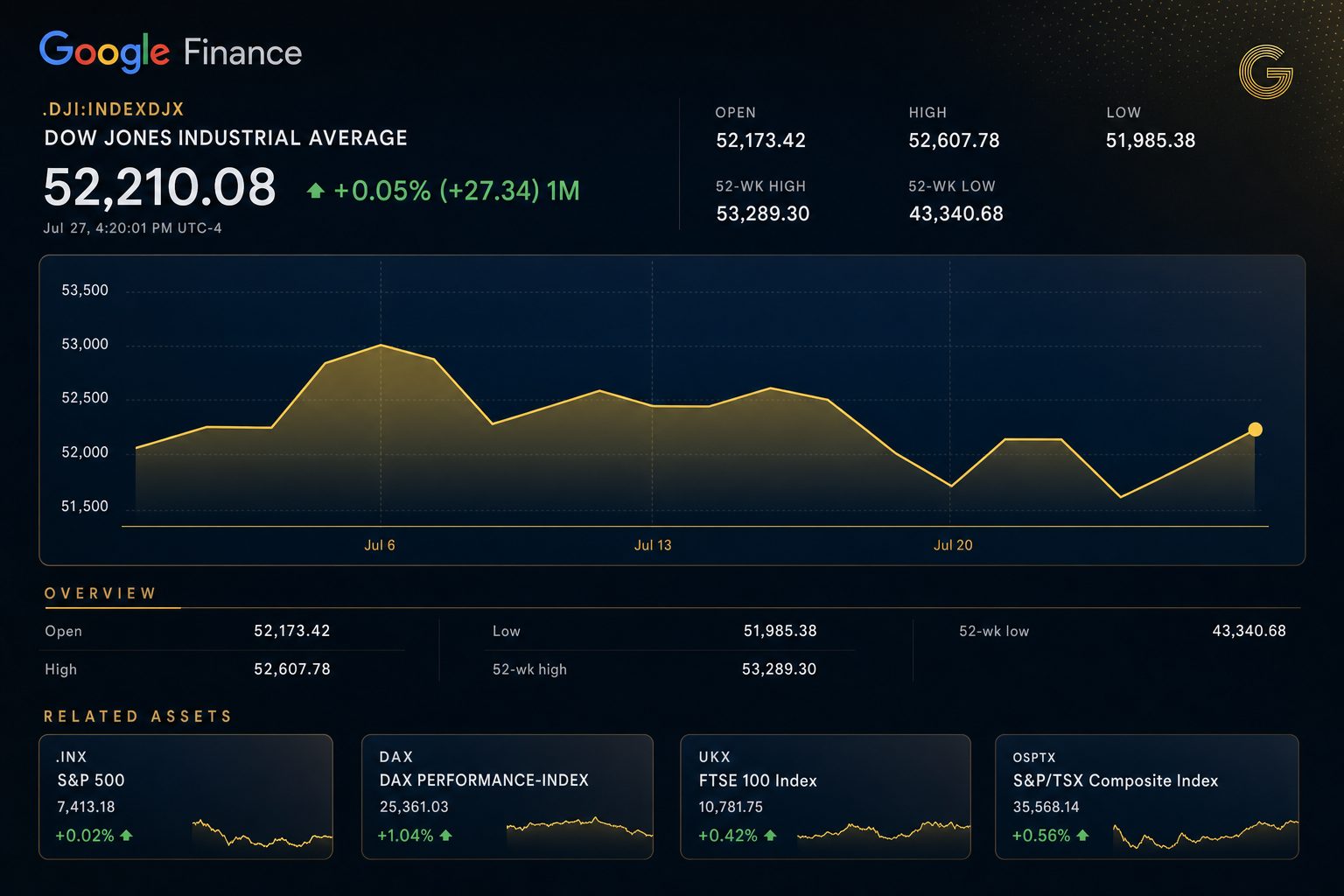
The Dow finished at 52,209.69, gaining 262.44 points, or 0.51%.
The S&P 500 rose by 0.02%, as the Nasdaq Composite slipped 0.18%.
An early component estimate indicated that five decliners accounted for a 57% reduction in gross gains.
The Dow Jones Industrial Average gained 262.44 points on Monday, finishing the day at 52,209.69, an increase of 0.51%. Trading in the regular session wrapped up at 4 p.m. EDT.
A preliminary estimate based on delayed moves of components showed that twenty-five rising stocks contributed approximately 571 Dow points. Meanwhile, five falling stocks subtracted 327 points, offsetting 57% of the total gain.
The split is significant due to the Dow’s price-weighted structure. Each $1 shift in a component adjusts the average by approximately 5.94 points.
The postponed data resulted in the following initial breakdown:
Initial Dow impact assessment
Projected index point change
Top five gainers
+287.3
Remaining 20 stocks rising
+283.3
Five stocks losing ground
-326.8
Overall figure from delayed data
+243.7
Five top performers accounted for 50.3% of total positive points, while the other 20 contributed 49.7%. This resulted in a widespread advance among Dow constituents on Monday. The data was compiled just before the closing auction.
Caterpillar NYSE:CAT, Goldman Sachs NYSE:GS and Nvidia NASDAQ:NVDA were the main contributors to the Dow’s decline, collectively responsible for roughly 88% of the index’s negative points.
Broader markets showed mixed moves. The S&P 500 was up 0.02%, while the Nasdaq Composite slipped 0.18%.
Semiconductors continued to drag on the market. The PHLX chip index deepened its recent losses, trading around 20% under its June 22 peak, even after climbing 63% so far this year.
The majority of S&P 500 firms continued to climb. Healthcare and consumer staples also posted gains. The data underscored a move away from dominance by chip-focused stocks.
“Today is another example of the rotational market we have witnessed,” said Bill Merz, who leads capital-markets research and portfolio construction at U.S. Bank Asset Management Group. Reuters
The drop in oil prices helped lower a key inflation concern. Brent crude fell by 8% to roughly $89 per barrel. Traders put the likelihood of a 25-basis-point Federal Reserve hike on Wednesday at 38%.
The Dow opened Monday following three straight weeks in negative territory, declining 0.4% last week. The S&P 500 slipped 0.6% over the same period, and the Nasdaq retreated 2%.
The Federal Reserve holds its meeting on July 28-29, announcing its decision on Wednesday. Microsoft will release its report that day as well. Amazon.com NASDAQ:AMZN and Apple NASDAQ:AAPL are scheduled to report on Thursday.
The advance estimate for second-quarter GDP is due on Thursday. June figures for personal income and spending are scheduled for release at 8:30 a.m. EDT, with the report set to include PCE inflation.
Analysts project a 39% increase in S&P 500 earnings for the second quarter, with a significant portion of the anticipated growth driven by companies tied to AI. These expectations set a high standard for this week’s earnings reports.
Risks still center on rates and AI-related outlooks. A Fed rate increase, stronger-than-expected PCE data, or disappointing megacap projections could stall the recent shift. The Dow’s price-weighted structure may magnify changes in its priciest stocks.
At Monday's close, where did the Dow finish, and how did it perform relative to other indexes?
The Dow ended Monday, July 27, at 52,170.18, up 222.93 points, or 0.43%, compared to Friday’s close at 51,947.25, after a volatile trading day. The S&P 500 dropped roughly 0.22% in the same session. The Nasdaq Composite closed almost unchanged, up just 0.02%. The Dow outperformed other major U.S. indexes.
Is the Dow Jones still near its all-time peak?
Monday’s close was 885.73 points short of the record closing level of 53,055.91, a difference of about 1.67% from the closing peak on July 6. The highest intraday level was 53,289.30 on July 7. The most recent close is approximately 2.10% below that intraday record. The Dow is trading near its all-time highs but has yet to surpass them.
Did Monday’s Dow gain reflect a wide rally or a focus on certain stocks?
By 3:53 p.m. ET, 23 of the 30 Dow components traded higher. Salesforce posted the strongest performance, climbing 5.98%. Shares of American Express gained 2.94%, and 3M saw a 2.77% increase. Nvidia slid 4.74%, recording the steepest drop among index members. Chevron retreated 2.64%, while Caterpillar declined 1.92%. While the majority of stocks advanced, notable losses weighed on overall gains.
What action is the Federal Reserve anticipated to take this week?
The Federal Open Market Committee will hold meetings on Tuesday and Wednesday, July 28–29, with its rate decision expected at 2:00 p.m. ET on Wednesday. The existing federal-funds target range stands at 3.50% to 3.75%. As of late Monday, futures indicated a 38% likelihood of a quarter-point hike. That reflects a 62% chance that policymakers will maintain current rates. These probabilities are derived from market pricing, not from any statements by the Fed.
What economic data releases have the potential to impact the Dow over the coming week?
Consensus for consumer confidence on Tuesday is 92.5, compared to the previous 91.2. Second-quarter GDP data is due Thursday, with economists projecting annualized growth of 2.1%. Core PCE inflation is anticipated at 0.2% month-over-month and 3.3% year-over-year. Initial jobless claims are predicted to reach 203,000, rising from 187,000 previously. Friday’s estimate for the employment cost index sits at 0.8%, slightly lower than the prior 0.9%. All figures are projections until officially released.
Which Dow companies' earnings are most significant this week?
Boeing releases results on Tuesday morning, with Visa’s report coming after the market closes. Microsoft will announce earnings after the close on Wednesday, followed by Amazon on Thursday. Market schedules also list Apple’s quarterly results for Thursday. Boeing Investors The Dow’s price-weighted design means stocks with higher prices impact the index more. As of late Monday, Microsoft, Visa, and Apple traded at roughly $390, $362, and $337, respectively. A major earnings surprise could therefore trigger significant Dow moves.
What is the significance of oil prices and geopolitical risks?
U.S. crude last traded at $82.56, slipping 7.51% in the latest Reuters report. Brent crude posted an 8.14% drop for the day to $88.90. Chevron lost 2.64% in late trading on Monday, as energy stocks came under pressure. Weaker oil prices could help ease inflation concerns and benefit rate-sensitive equities. Still, any renewed disruption in the Strait of Hormuz could rapidly undo those moves. Geopolitical risk remains notably elevated.
What Dow price points should investors monitor going forward?
Monday’s session saw trading between 52,003.45 and 52,607.78, with the index finishing at 52,170.18, positioned in the lower half of the day’s range. Immediate resistance remains near Monday’s session peak of 52,608, while the record closing level stands at 53,055.91. A decisive move below 52,000 would undercut the recovery seen on Monday. Upcoming Fed and inflation reports may determine whether the index challenges resistance or support next.
Jerzy Lewandowski is a senior markets editor at TS2.tech. His coverage ranges from stocks and semiconductors to AI and the broader global markets. He studied economics at the University of Warsaw and worked in investment analysis before becoming a financial journalist. Follow Jerzy Lewandowski on Google News.