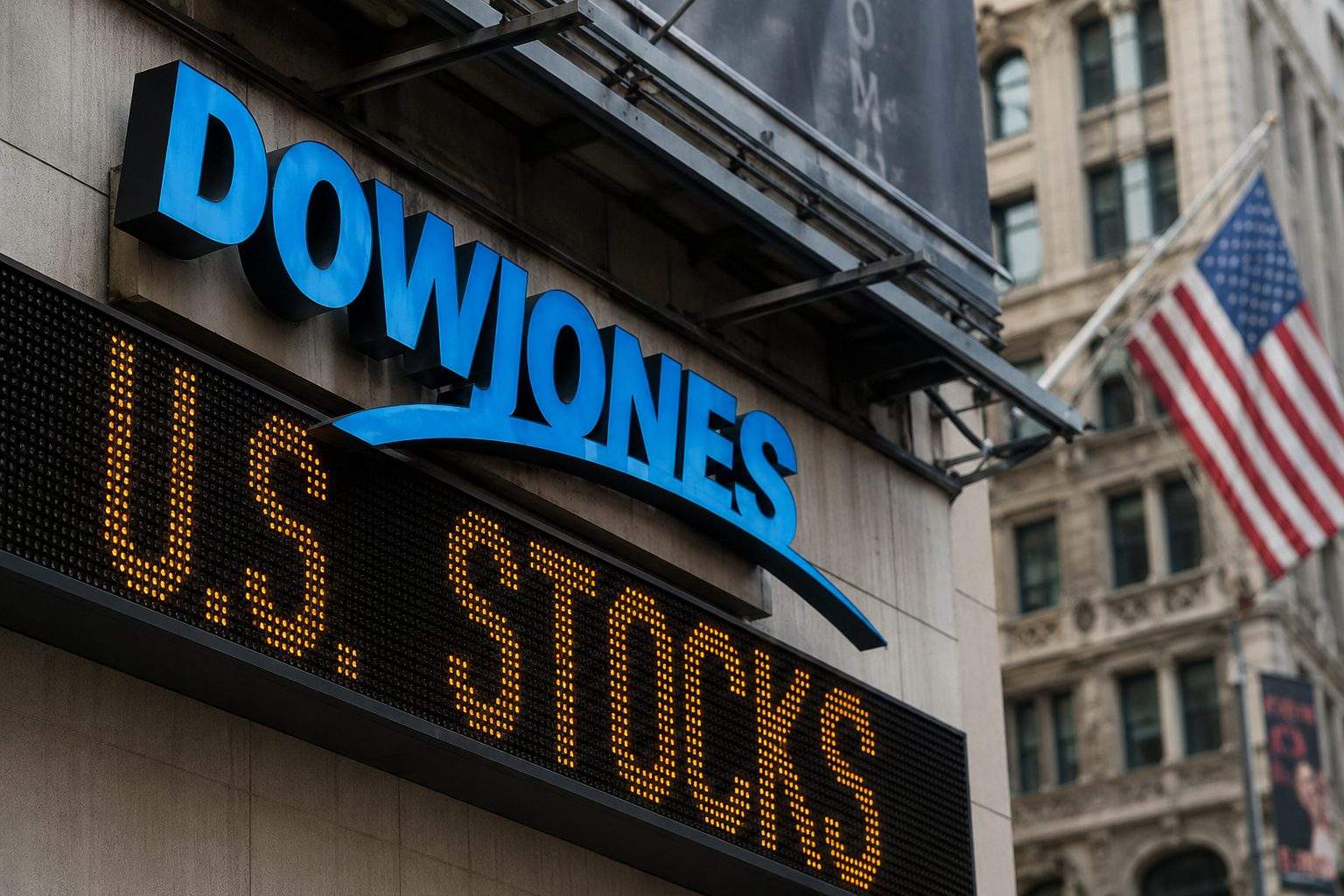
The Dow Jones Industrial Average dropped 305.32 points on Monday, with early figures at 4:01 p.m. showing it at 51,841.10. The cash market had just ended.
US stocks fell on Tuesday, with the Nasdaq and S&P 500 both closing at their lowest in more than a week after chip stocks tumbled. The moves ended the relative calm that followed last week’s Middle East de-escalation. According to MarketWatch, the Nasdaq Composite dropped 2.00%, the S&P 500 lost 1.31%, and the Dow Jones Industrial Average slipped 0.04%.
Dow flat near 51,700 as AI stocks drop hit Nasdaq, S&P 500 harder The Dow Jones Industrial Average was mostly steady late Tuesday morning, last at 51,703.51, down 9.20 points, according to Reuters. The Dow traded in a narrow band of 51,301.77 to 51,809.84, holding up better than the Nasdaq and S&P 500 as selling in technology names tied to artificial intelligence dragged on the broader market.
Dow Jones Industrial Average ticked up Thursday, with traders stepping in to buy after this week’s steep drop. Gains looked shaky, though, as wholesale inflation came in hot and energy prices plus Fed rate worries hung over the market.
Dow edges up as tech slump weighs on market The Dow Jones Industrial Average inched up 16 points on Tuesday, while a late-session tech slide pulled the market down. The Dow finished 15.98 points, or 0.03%, higher at 50,801.99. The S&P 500 gave up 39.47 points, or 0.53%, to 7,366.26. The Nasdaq Composite shed 314.38 points, or 1.21%, to 25,615.28.
Dow slips as S&P 500, Nasdaq recover on tech bounce The Dow Jones Industrial Average lost ground Monday, dipping 104.70 points, or 0.21%, to settle at 50,762.08. The index caught a range between 50,761.97 and 51,277.15. The S&P 500 and Nasdaq pushed higher as buyers moved back into tech and chip stocks after Friday’s selloff.
Dow drops as yields, oil push stocks down The Dow Jones Industrial Average lost ground Tuesday morning, down 249.36 points, or 0.5%, to 49,436.76 by 10:55 a.m. EDT. Treasury yields moved higher and concerns about oil-driven inflation grew, dragging Wall Street lower. S&P 500 declined 0.77%. Nasdaq Composite was off 1.28%, with selling pressure showing up outside of the Dow’s 30 stocks.
Jim Cramer pointed to Wednesday’s strong bounce in U.S. equities as a clear signal for investors: pay attention to which names lead on a relief rally. Among the standouts, the CNBC host mentioned Sherwin-Williams, Caterpillar, Home Depot, and Goldman Sachs—stocks that, he said, could see renewed institutional interest if Middle East tensions cool.
The Dow Jones Industrial Average pared back its initial drop Monday, though it lingered in the red as traders reacted to a spike in oil prices amid the Middle East conflict. By 12:25 p.m. EST, the index was off 0.14% at 48,907.26.
On Saturday, November 29, 2025, U.S. markets were closed, but The Sherwin-Williams Company stayed busy in the news cycle. A flurry of institutional ownership filings, fresh price-target roundups, and ongoing valuation debates gave investors new data points to digest as the paint-and-coatings giant heads into December.