HELSINKI, August 2, 2026, 18:02 EEST.
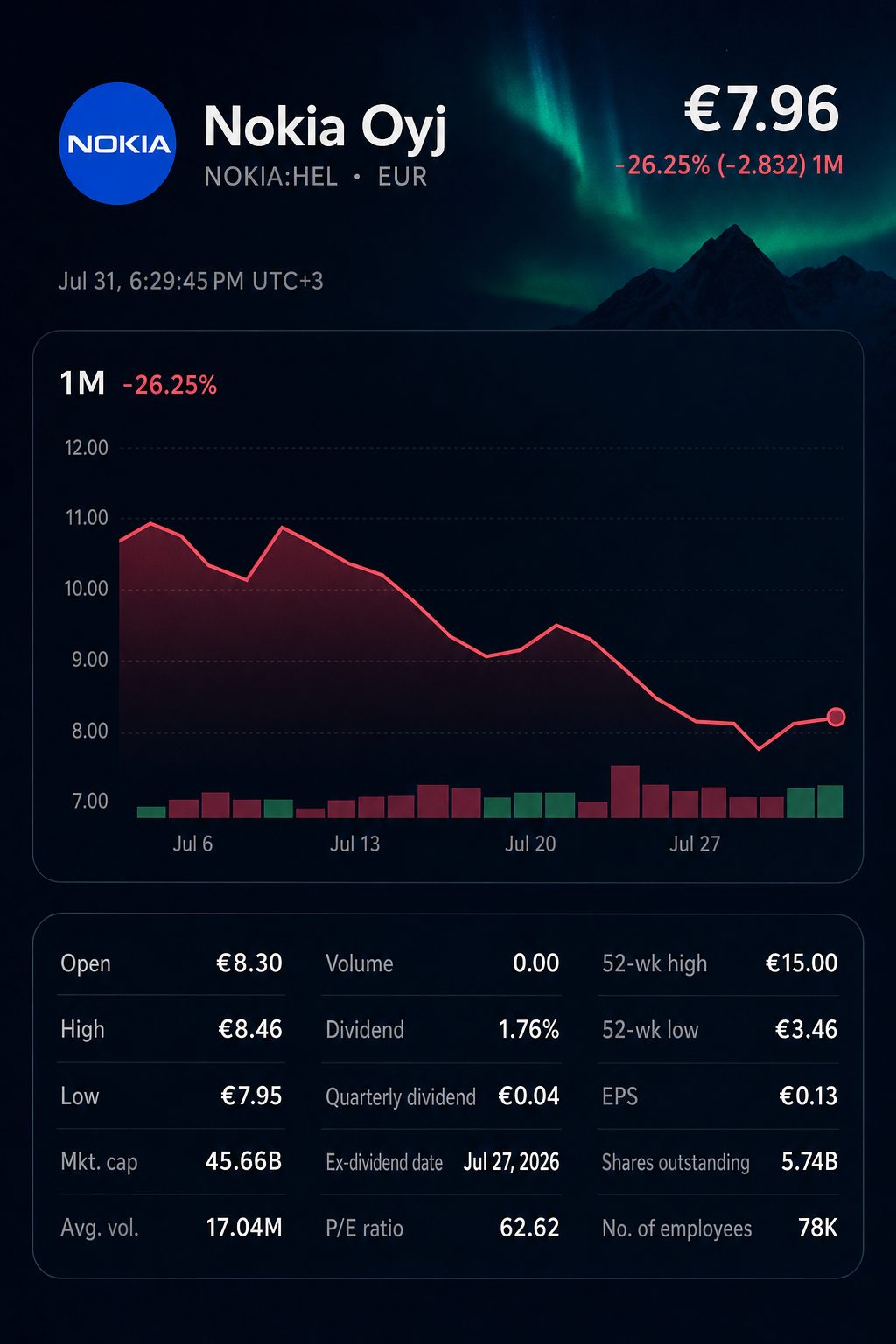
- Nokia closed Friday at €7.958, down 3.2% last week and 13.2% since July 22.
- AI and cloud sales rose 105% to €446 million, supplying an estimated 62% of Nokia’s sales increase.
- Nasdaq Helsinki reopens Monday. Nokia’s €0.04-per-share dividend is due Thursday.
Nokia Oyj closed Friday at €7.958, down 3.2% for the week. It has fallen 13.2% since July 22, before its second-quarter report.
The retreat came despite a clear earnings beat. Comparable operating profit rose 18% to €434 million. That topped the LSEG consensus by €52 million, or 13.6%.
The more revealing number sits inside revenue. AI and cloud sales rose 105% to €446 million. Group comparable sales increased by €367 million.
Calculated from company data, AI and cloud supplied about 62% of that increase.
| Q2 growth measure | 2026 | 2025 | Change |
|---|---|---|---|
| AI and cloud net sales | €446m | About €218m | €228m, or 105% |
| Group comparable net sales | €4.815bn | €4.448bn | €367m, or 8% |
| AI and cloud share of group sales | 9.3% | About 4.9% | 4.4 percentage points |
| Share of group sales increase | About 62% | — | — |
Calculated estimate from Nokia’s disclosed figures.
That concentration raises the bar for execution. Chief Executive Justin Hotard said about half of €2.8 billion in AI and cloud orders should convert within twelve months.
“Demand remains strong, while supply continues to be the main industry constraint,” Hotard said. Nokia Corporation | Nokia
The adjusted result was strong. The reported result was not. Faster restructuring pushed reported operating profit to a €50 million loss.
| Q2 measure | 2026 | 2025 | Change or benchmark |
|---|---|---|---|
| Comparable net sales | €4.815bn | €4.448bn | Up 8% |
| Comparable gross margin | 46.0% | 45.3% | Up 70 basis points |
| Comparable operating profit | €434m | €367m | Up 18%; LSEG estimate €382m |
| Comparable diluted EPS | €0.07 | €0.04 | Up 75% |
| Reported operating profit | -€50m | €147m | Down €197m |
| Reported profit for the period | €5m | €96m | Down 95% |
Nokia expects €800 million of restructuring charges this year. Related cash outflows should reach €700 million to €800 million. That burden helps explain the market’s focus on free cash flow.
The guidance headline also carried less upside than it appeared. Nokia lifted the range to €2.1 billion-€2.6 billion. Management called the €100 million increase a technical revision. The underlying operating outlook stayed unchanged.
| Outlook measure | Company statement | Comparison or calculated effect |
|---|---|---|
| Full-year comparable operating profit | €2.1bn-€2.6bn | Previously €2.0bn-€2.5bn; operationally unchanged |
| Q3 net sales | Up 3%-7% quarter-on-quarter | Implied €4.96bn-€5.15bn |
| Q3 comparable operating profit | Largely flat from Q2 | About €434m if flat |
| Q3 comparable operating margin | Not formally guided | About 8.4%-8.8% |
| 2026 free-cash-flow conversion | 55%-75% of comparable operating profit | Sensitive to customer payments |
| 2026 capital spending | €800m-€900m | Optical capacity investment continues |
*Preliminary calculation based on Q2 sales and management’s assumptions. “Largely flat” is not a formal €434 million forecast. Nokia Corporation | Nokia
On those assumptions, Q3 comparable margin could slip below 9%. That would reflect higher sales without a matching quarterly profit increase.
Relative performance sharpened the signal. Telefonaktiebolaget LM Ericsson STO:ERIC-B gained 2.5% last week. The OMX Helsinki 25 rose 0.3%. Nokia lost 3.2%.
| Market | July 24 close | July 31 close | Weekly move |
|---|---|---|---|
| Nokia | €8.222 | €7.958 | -3.2% |
| Ericsson | SEK91.52 | SEK93.82 | +2.5% |
| OMX Helsinki 25 | 6,200.36 | 6,220.08 | +0.3% |
Ericsson had already warned that AI demand was lifting memory costs. CFO Lars Sandström said the build-out was pressuring the wider industry.
Nasdaq Helsinki was closed Sunday. Regular equity trading resumes Monday at 10:00 EEST. Thursday brings Nokia’s €0.04-per-share dividend payment. The next scheduled results arrive October 22.
Risks remain concentrated. Supply delays could slow order conversion. Component inflation, tariffs and currency swings could squeeze margins. Restructuring may absorb more cash than planned.
The near-term test is simple. Nokia must turn orders into reported profit and cash. The 13% post-results fall shows investors still want that proof.
Further analysis
Is Nokia able to turn its increased AI orders into revenue?
Second-quarter AI and cloud revenue rose to €446 million, marking a 105% increase from a year earlier. Orders totaled €2.8 billion, with about 50% anticipated to be delivered within twelve months. Constraints are currently supply-driven rather than demand-related. Nokia Corporation | Nokia
How challenging is Nokia’s maintained 2026 guidance?
The updated outlook is €2.1–€2.6 billion, with the rise attributed to technical factors. Comparable operating profit for the first half totaled €735 million. To hit the €2.35 billion midpoint, the company needs €1.62 billion in H2. Following a Q3 figure of around €434 million, Q4 must deliver approximately €1.18 billion. Nokia Corporation | Nokia
Could AI expansion significantly impact Nokia by 2028?
AI and cloud services comprised just 9% of the group’s revenue in the second quarter. Mobile Infrastructure accounted for €2.68 billion in sales and €310 million in operating profit. Nokia aims for €2.7–€3.2 billion in comparable operating profit by 2028. AI expansion must not impact main mobile profits. Nokia Corporation | Nokia
Is Nokia appealing after the recent selloff?
The NYSE ADR ended the session at $9.14, down 48% from the $17.45 high in June. FactSet projects 2026 EPS at $0.39, putting the valuation near 23 times earnings. The consensus price target stands at $12.81, indicating potential gains of about 40%. Forecasts range from $6.30 to $20.47, reflecting an unusually wide degree of uncertainty. The Wall Street Journal
What are the key downside risks?
Nokia forecasts restructuring cash outflows between €700 million and €800 million in 2026. The company posted a reported Q2 operating margin of negative 1%, compared with a 9% margin on a comparable basis. Guidance for free-cash-flow conversion is still given as a wide range, from 55% to 75%. Ongoing supply constraints and increased memory-chip expenses continue to pose risks to margins. Nokia Corporation | Nokia