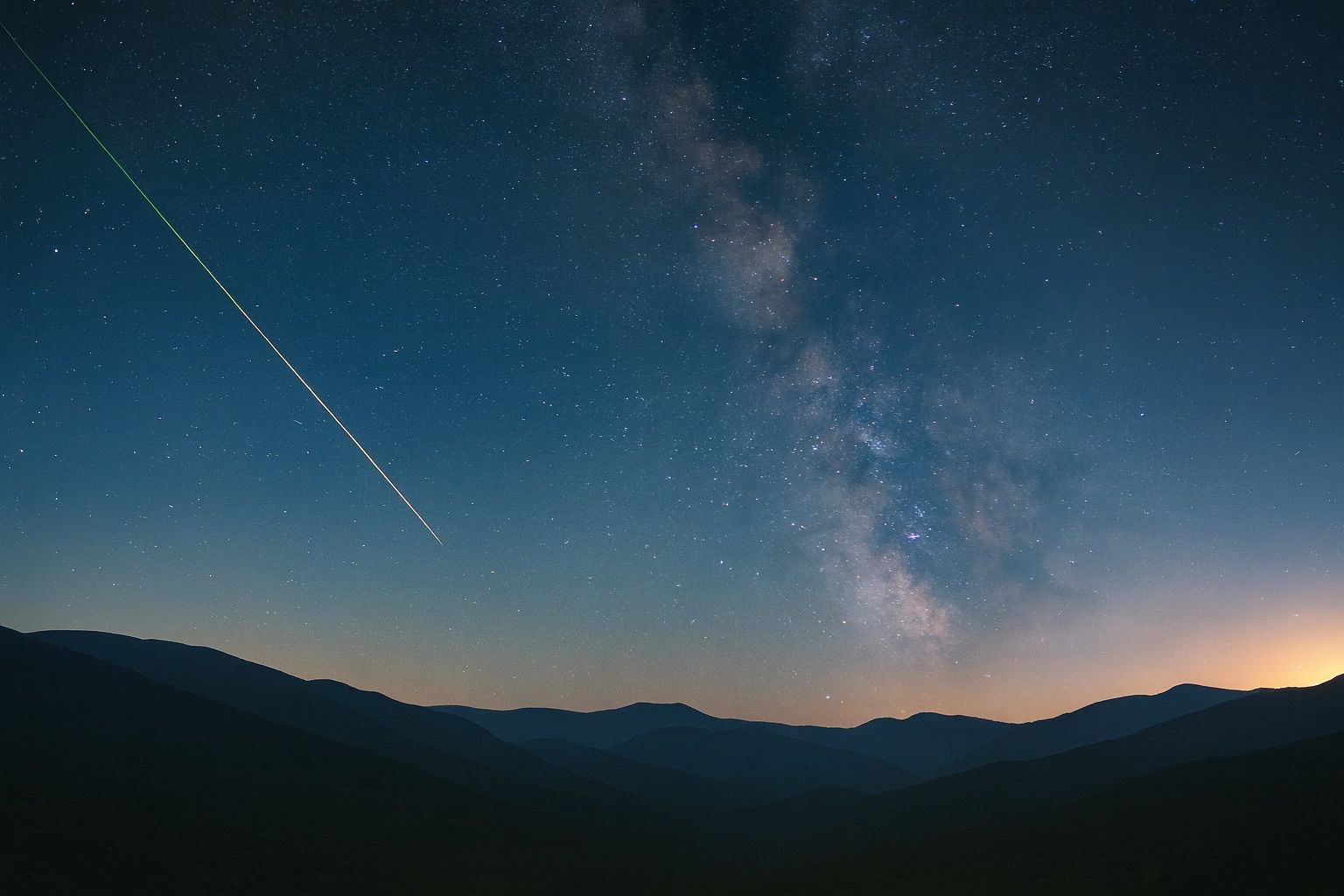

- Draconid meteor shower (Oct. 6–10) peaks around the evening of October 8, 2025, but a bright full “Harvest” supermoon that week will dramatically wash out the fainter meteors science.nasa.gov. This minor shower typically produces only a handful of slow meteors per hour earthsky.org, though in rare years “the Dragon” has awakened to unleash meteoric storms of hundreds per hour earthsky.org.
- Orionid meteor shower (active Sept. 26–Nov. 22) will peak on the night of October 21–22, 2025 under ideal moonless conditions as the new moon falls on Oct. 21 marthastewart.com. Skywatchers can expect up to 10–20 fast meteors per hour at the Orionid peak science.nasa.gov space.com, which occurs as Earth passes through debris left by Halley’s Comet.
- Viewing Tips: The Draconids are unusual – best viewed in the early evening (around nightfall on Oct. 8) when the constellation Draco is highest earthsky.org, whereas the Orionids are best after midnight on Oct. 21–22, when Orion rises high and the sky is at its darkest marthastewart.com science.nasa.gov. For both showers, find a dark location away from city lights, lie back to take in a wide sky view, and allow ~30 minutes for your eyes to adapt.
- Bonus Celestial Event: Two long-period comets are visiting this month. Comet C/2025 A6 (Lemmon) reaches its closest point to Earth around October 21 – the same time as the Orionid peak marthastewart.com – and could brighten enough by late October to be seen with binoculars or even faintly with the naked eye in very dark skies marthastewart.com. Similarly, newly discovered Comet C/2025 R2 (SWAN) makes its nearest pass on October 21 at about 25 million miles away space.com, and is expected to hover near the threshold of naked-eye visibility (around magnitude 6–7) under dark, clear conditions space.com.
Draconid Meteor Shower – October’s Early-Show “Dragon” Fireworks
The Draconid meteor shower – emanating from the northern constellation Draco (the Dragon) – kicks off the month’s skywatching excitement. In 2025 the Draconids are active from October 6 to 10, with peak activity predicted on the evening of October 8 (into the early hours of Oct. 9) earthsky.org. Unlike most meteor showers which are strongest after midnight, the Draconids are best viewed in the early evening after nightfall earthsky.org. That’s because Draco’s “head,” where the shower’s radiant lies, is highest in the sky in the evening and then sinks lower later at night earthsky.org. So, observers should start looking as soon as darkness falls on Oct. 8 – a rare case of a meteor display that favors prime time viewing.
However, this year the full Moon poses a big challenge. October 8, 2025 arrives just two days after a full “Harvest” supermoon on Oct. 6, meaning the Moon will be very bright and nearly full during the Draconid peak science.nasa.gov science.nasa.gov. That lunar glare will likely wash out all but the very brightest meteors. NASA’s skywatching advisory quips that if you don’t catch any Draconids this time, “you can always blame the bright supermoon” lighting up the sky science.nasa.gov. In short, expect very few visible meteors this year – perhaps only ~2–6 per hour under the moonlight, according to forecasts amsmeteors.org. If you do try to observe, consider positioning yourself in the Moon’s shadow (behind a building or hill) to block some of the light earthsky.org.
On typical years, the Draconids are a minor shower, often producing no more than 5–10 slow “shooting stars” per hour at best science.nasa.gov. These meteors tend to be relatively faint and slow-moving because they hit Earth’s atmosphere at a more languid pace than other showers. They are the burning remnants of Comet 21P/Giacobini–Zinner, a periodic comet that swings through the inner solar system every 6.6 years earthsky.org earthsky.org. Most years, as Earth passes through this comet’s sparse debris stream, only a few dusty bits hit our atmosphere, resulting in a sleepy display earthsky.org.
But watch out if the Dragon awakes! On rare occasions, when Earth intersects a dense clump of particles, the Draconids have erupted into meteor “storms”, astonishing skywatchers with hundreds or even thousands of meteors per hour earthsky.org. Historic Draconid outbursts occurred in 1933 and 1946, and more recently in 2011 (when observers in Europe saw an outburst of over 600 meteors per hour) earthsky.org. Those bursts happen when the comet’s fresh debris trail – often bunched near the comet itself – crosses Earth’s path. Notably, Comet 21P/Giacobini–Zinner made its latest close approach to the Sun in March 2025 earthsky.org. Some astronomers wondered if that could herald increased Draconid activity this fall earthsky.org earthsky.org. The consensus, however, is that no dragon storm is expected in 2025 – but with meteor showers, you “never know” earthsky.org. Even a modest uptick is possible, which is why dedicated meteor enthusiasts won’t completely write off the Draconids despite the unfavorable moon. If you’re in the Northern Hemisphere (where Draco is visible) on Oct. 8, it might still be worth a look – just keep expectations very low, and enjoy any meteor you do catch as a bonus.
Orionid Meteor Shower – Halley’s Comet Sparks a Late-October Light Show
The Orionid meteor shower arrives later in the month and is usually a more reliable spectacle. The Orionids are active from around October 2 to November 22 each year as Earth travels through a broad stream of particles shed by the famous Halley’s Comet marthastewart.com space.com. Every autumn, our planet’s orbit intersects the path Halley’s Comet took (most recently in 1986), and we plow into the dusty debris it left behind space.com earthsky.org. These particles hit Earth’s atmosphere at tremendous speeds – about 41 miles per second (66 km/s) marthastewart.com – which is why Orionid meteors are fast, bright, and often leave glowing trails (“trains”) that can persist for a few seconds or more marthastewart.com marthastewart.com. The shower is also known to produce the occasional fireball – an extra-bright meteor that can light up the sky marthastewart.com.
In 2025, the Orionids are predicted to peak on the night of October 21 into the early hours of October 22. NASA and the American Meteor Society note this timing is perfect because it coincides with the new Moon – meaning no moonlight will interfere at all marthastewart.com science.nasa.gov. Under ideal dark-sky conditions (far from city lights), stargazers at the peak could see roughly 10 to 20 meteors per hour science.nasa.gov space.com. NASA has said the Orionids are “set to put on a spectacular show” this year thanks to the Moon-free sky, with perhaps around 20 meteors per hour at peak times science.nasa.gov. Some variability exists in forecasts – for example, some astronomers peg the peak on the morning of Oct. 21, while others say Oct. 22; effectively, the shower should be strong on both those nights space.com. The best window to watch will be from late night into the pre-dawn hours on October 21/22, after the radiant in Orion has risen high and when the sky is at its darkest marthastewart.com marthastewart.com.
To find the Orionids, look for the constellation Orion (with its bright stars Betelgeuse and Rigel). The meteors will appear to radiate from a point just north of Orion’s red giant star Betelgeuse in the hunter’s shoulder marthastewart.com. However, you shouldn’t stare directly at Orion. For the best viewing, astronomers advise looking about 45 to 90 degrees away from the radiant point marthastewart.com. This way, you’ll catch the meteors in profile as they streak by, which makes them appear longer and more spectacular marthastewart.com. In practice, the meteors can flash anywhere across the sky – so it’s best to lie back and let your eyes sweep a broad area rather than fixating on one spot.
Viewing tips: Find a safe, dark viewing site (a countryside location or park away from streetlights is ideal). Plan to be outside for an extended period; meteor watching requires patience. Dress warmly, bring a blanket or reclining chair, and perhaps a hot drink – late October nights can be chilly. After midnight, get comfortable looking up toward the southeast (if you’re in the Northern Hemisphere; face northeast if in the Southern Hemisphere) science.nasa.gov. Give your eyes 20–30 minutes to adjust to darkness – avoiding looking at any phones or flashlights during that time. Once adapted, you’ll start to notice faint stars and hopefully catch those swift Orionid meteors zipping across the sky. At peak, you might see an average of one every few minutes, with bursts of activity possible. If you’re lucky, one of Halley’s cometary “shards” might flare into a bright fireball leaving a luminous trail in its wake.
Another perk of the Orionids: they have a broad peak, so you can watch for meteors a few nights before and after Oct. 21–22 and still catch some shooting stars. The shower remains active through early November, gradually tapering off space.com. So if your weather is cloudy on the peak night, try again on the next clear night. In fact, some astronomers note a second wind in Orionid activity can occur on Oct. 26–27 as Earth encounters another portion of Halley’s debris stream, though it’s usually smaller. Overall, with dark skies on our side in 2025, the Orionids should deliver a pleasing show of fast, bright meteors – one of the highlights of the fall stargazing calendar.
A Cosmic Bonus: Comets Lemmon and SWAN Accompany the Show
As if two meteor showers weren’t enough, October 2025 also treats skywatchers to two visiting comets – adding to the celestial excitement. Comet C/2025 A6, dubbed “Comet Lemmon,” and Comet C/2025 R2 (SWAN) are both making close approaches to Earth this month, something experts say is pure coincidence but fortuitous timing forbes.com space.com. These are long-period comets (with orbits on the order of a millennium or more marthastewart.com space.com), now trekking through the inner solar system and offering a chance for amateur astronomers to spot a fuzzy cometary visitor.
Comet Lemmon was discovered in January 2025 by observers at Mount Lemmon in Arizona marthastewart.com. It’s a rare “once-in-a-lifetime” comet with an estimated 1,350-year orbital period marthastewart.com. This month, Comet Lemmon is journeying under the Big Dipper and will reach its closest point to Earth on October 21, 2025 – right as the Orionid meteor shower hits its peak marthastewart.com. After that, it continues to brighten and is expected to reach maximum brilliance around Halloween (Oct. 31) marthastewart.com. How bright will it get? Predictions vary, but some astronomers think Comet Lemmon might just become visible to the naked eye in very dark, clear skies at the end of October marthastewart.com. Even if it doesn’t attain naked-eye brightness, you should be able to see it with binoculars or a small telescope, appearing as a faint smudge of light. Photographs already show the comet has a pretty greenish glow, caused by vaporizing diatomic carbon gas in its coma marthastewart.com. To spot Comet Lemmon in early October, try looking in the pre-dawn eastern sky with binoculars; by late October, if it brightens as hoped, it could be visible at night in the constellation around Ursa Major (check online star charts for its path).
Meanwhile, Comet C/2025 R2 (SWAN) is another new comet, discovered just last month (Sept 2025) via the SWAN camera on the SOHO spacecraft space.com space.com. Comet SWAN has been putting on a show for observers in the Southern Hemisphere and is now moving into northern skies. It will reach its perigee (closest to Earth) on October 21 as well, at a distance of about 25 million miles (40 million km) space.com. Comet SWAN’s orbital period is estimated at roughly 1,400 years space.com, meaning the last time it swung by, humanity was in the medieval era. Currently, Comet SWAN is just below naked-eye visibility – recent estimates have it around magnitude +6 to +7 space.com space.com. (For reference, lower magnitudes are brighter – +6 is about the dimmest star you can see without optics under dark skies.) That means you’ll likely need binoculars to spot Comet SWAN, unless it brightens a bit more. Experts like Japanese comet watcher Seiichi Yoshida and others predict SWAN might hover at the naked-eye threshold in mid-October space.com – so if you’re under a very dark sky, you might just glimpse it without aid as a faint hazy star. Comet SWAN has been described through telescopes as a small condensed head with a thin, faint tail a couple of degrees long space.com.
Both Comet Lemmon and Comet SWAN will be relatively low in the sky for Northern Hemisphere observers during much of October, so finding them can be a fun challenge. Astronomy websites and apps can provide up-to-date sky maps for their positions each night. While these comets are not expected to become spectacularly bright, they add a special bonus for dedicated skywatchers – how often do we get to see two comets during a meteor shower season? If you’re out meteor-hunting on those clear October nights, it’s worth also scanning the sky for a faint cometary glow. With a bit of luck, you might catch a Draconid fireball, a dozen Orionid shooting stars, and a ghostly comet all in one night – a truly rich autumn sky experience.
Bottom line: October 2025 is a fantastic month for astronomy enthusiasts and casual stargazers alike. From the fickle Draconids in early October (with their dragon lore and unpredictable bursts) to the dependable Orionids in late October (delivering pieces of Halley’s Comet blazing across the stars), there’s plenty to look up for. Plan ahead for the peak nights – and don’t forget to check out the visiting comets if you have binoculars handy. Even if light pollution or moonlight diminishes one event, another might steal the show. Embrace the crisp fall evenings, keep your eyes on the skies, and enjoy the cosmic fireworks courtesy of comets and meteors this month science.nasa.gov marthastewart.com.
Sources: NASA Science (What’s Up October 2025) science.nasa.gov science.nasa.gov; American Meteor Society amsmeteors.org; EarthSky.org (Deborah Byrd) earthsky.org earthsky.org; Space.com space.com space.com; MarthaStewart.com marthastewart.com marthastewart.com; Yahoo News (Kate Murphy) science.nasa.gov science.nasa.gov.