
NEW YORK, August 4, 2026, 09:11 EDT – GameStop NYSE:GME stock traded steadily after the company executed a $1.4 billion debt swap, as market participants turned their attention to the implications for share dilution.
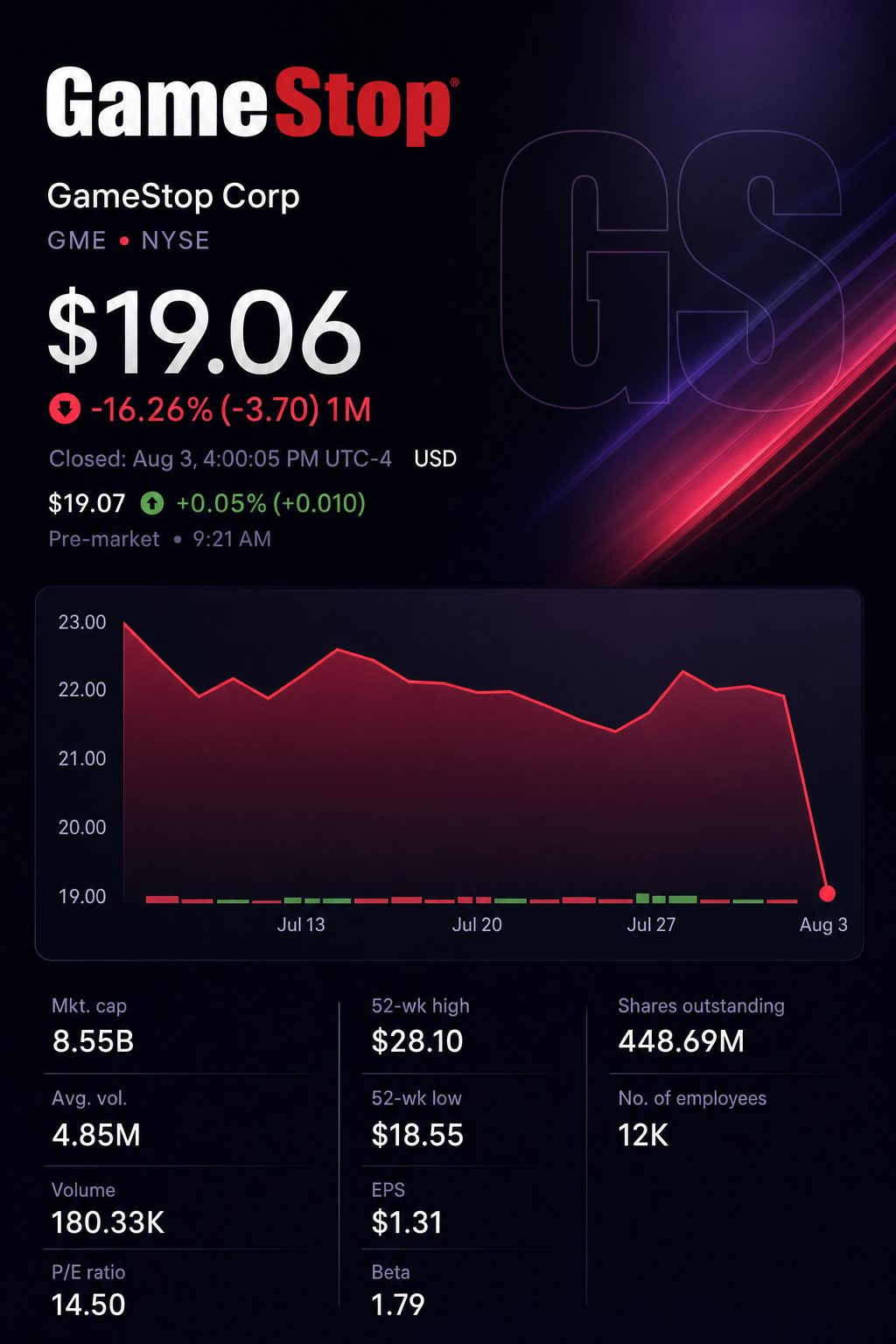
- GameStop finished Monday’s session at $19.06, falling 12.25%. Shares showed little movement in premarket trading, last at $19.07.
- The deal would eliminate 33.3% of $4.2 billion in note principal, with no cash required.
- Initial principal-equivalent calculations indicate 73.5 million shares at $19.06. The actual issuance may vary significantly.
GameStop Corp. NYSE:GME stock was steady around $19.07 ahead of the open on Tuesday. Shares dropped 12.25% during Monday’s session following the retailer’s announcement of a $1.4 billion debt-for-equity swap. The NYSE’s main trading session was scheduled to start at 09:30 EDT.
Investors largely view the deal as an adjustment to the share count. The two note series involved have 0.00% coupons. By eliminating them, the outstanding principal declines, though there is no immediate cash-interest benefit.
The difference is important. GameStop maintains its cash reserves and bolsters its balance sheet. However, once new shares are issued, current shareholders will hold a reduced stake.
GameStop plans to swap $400 million in 2030 notes and $1 billion in 2032 notes. The total number of shares involved will be based in part on an average price across 35 trading sessions starting August 3. A minimum share price is also in place. The deal is anticipated to close near September 23.
The company cautioned that noteholders taking part may buy or sell shares or derivatives as they rebalance hedges. Such trades have the potential to significantly impact GameStop’s market value, either higher or lower.
| Instrument | Monday close | Monday move | Tuesday premarket |
|---|---|---|---|
| GameStop Corp. NYSE:GME | $19.06 | -12.25% | $19.07, +0.05% |
| State Street SPDR S&P Retail ETF (NYSEARCA:XRT) | $91.46 | +1.87% | $91.81, +0.38% |
| State Street SPDR S&P 500 ETF Trust NYSEARCA:SPY | $757.67 | +1.40% | $760.11, +0.32% |
Monday’s numbers reflect close-to-close values. Premarket signals appeared at varying times before 09:11 EDT and were subject to delays.
The split indicates a repricing driven by company-specific factors. On Monday, GameStop saw 41.71 million shares change hands, representing 6.12 times its 65-day average. In contrast, the retail index rose nearly 2%.
| Note series | Principal prior | Converted | Principal left | Percentage retired |
|---|---|---|---|---|
| 2030 notes | $1.50 billion | $0.40 billion | $1.10 billion | 26.7% |
| 2032 notes | $2.70 billion | $1.00 billion | $1.70 billion | 37.0% |
| Total | $4.20 billion | $1.40 billion | $2.80 billion | 33.3% |
Data displays total principal amounts, not accounting carrying values.
The chief benefit to the balance sheet is conserving cash. As of May 2, GameStop reported $7.40 billion in cash and $970.5 million in marketable securities. If these levels are maintained, coverage of the note principal would increase to about three times from around two times.
| Illustrative coverage metric | Prior to exchange | Pro forma following exchange |
|---|---|---|
| Cash and marketable securities | $8.37 billion | $8.37 billion |
| Convertible-note principal | $4.20 billion | $2.80 billion |
| Ratio of cash and securities to principal | 1.99 times | 2.99 times |
The ownership calculation presents a less advantageous picture. As of June 5, GameStop had 448.69 million common shares in circulation. The table below shows the result of dividing $1.4 billion by various share prices and does not take into account any unreported exchange adjustments or minimum price mechanisms.
| Indicative principal-equivalent exposure — not a projection | Implied new shares | Share of current shares outstanding | Estimated dilution post-issue |
|---|---|---|---|
| $18.55, Monday low | 75.5 million | 16.8% | 14.4% |
| $19.06, Monday close | 73.5 million | 16.4% | 14.1% |
| $20.50, Monday high | 68.3 million | 15.2% | 13.2% |
| $28.10, 52-week high | 49.8 million | 11.1% | 10.0% |
As of Monday’s market close, the principal-equivalent amount stands at roughly 73.5 million shares, representing 16.4% of the current basic share total. Following the transaction, the ownership stake of existing investors would decrease by approximately 14.1% in this simplified scenario.
Investors assessing full dilution did not begin solely with 448.69 million shares. GameStop’s first-quarter earnings accounted for 143.6 million potentially dilutive shares from convertible notes, pushing the diluted weighted average up to 592.3 million shares. As a result, some conversion risk was already factored into diluted calculations.
The company’s $2 billion buyback authorization presents a notable offset. At a share price of $19.06, the fund could acquire up to 104.9 million shares, equating to 1.43 times the net exchange issuance. However, the authorization neither mandates purchases nor prevents cancellation at any point. It represents optionality rather than a guaranteed hedge.
Operating performance showed gains. Sales for the first quarter increased 14% to $835.3 million. Gross margin advanced to 40.7% compared with 34.5% in the same period last year. The company posted operating income of $143.3 million, turning around from a $10.8 million operating loss.
Financial assets played a major role in reported earnings. Of the $389.6 million net income for the quarter, $268.4 million came from unrealized derivative gains, and $83.7 million was generated through net interest income. As a result, investors are weighing GameStop’s approach to capital allocation as well as its push for a retail comeback.
Risks: The exact number of shares is undetermined until the reference period concludes. A decrease in the average price could lead to a higher number of shares issued, and hedging actions by noteholders may increase volatility. The exchange is still contingent on the fulfillment of closing conditions.
The upcoming key data points are the final share tally and the established reference price. With present valuations, investors must weigh if a roughly 33% drop in note principal is warranted by a demonstrated 14% cut to ownership, particularly as this produces no reduction in cash coupon payments.
Related articles: NYSE:GME