NEW YORK, August 4, 2026, 13:13 EDT
- Nasdaq’s regular session remained active. Shares of Autonomix were at $18.20 at 1:02 p.m. EDT, a rise of 398.5%.
- Patent No. 12,433,670 was granted on October 7, 2025, according to USPTO records.
- If exercised, outstanding Series D warrants would generate approximately $4.9 million in gross proceeds and result in the issuance of 857,462 additional shares.
Shares of Autonomix Medical Inc. NASDAQ:AMIX surged nearly fivefold on Tuesday following the announcement of a cancer-neuromodulation patent. However, federal records indicate the relevant U.S. grant is dated October 2025.
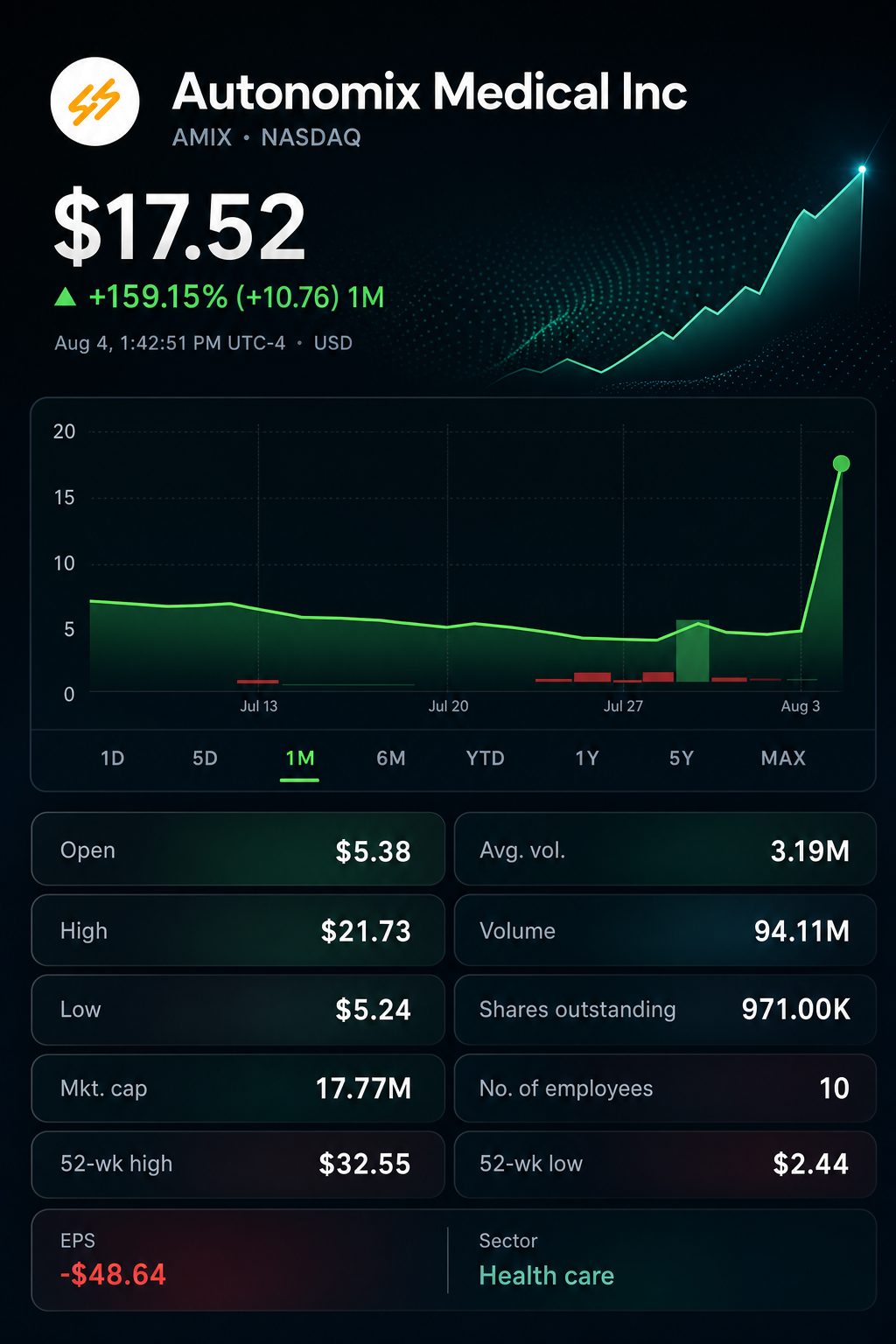
The timing difference is significant. Tuesday’s rally increased basic equity value by around $14.1 million, calculated with the July 29 share count. The surge also brought two major warrant series well into the money.
As of 1:02 p.m. EDT, the tape presented the following. Early figures are based on Google Finance information and 971,043 reported shares.
| Trading measure | August 4 snapshot | Comparison |
|---|---|---|
| Share price | $18.20 | Closed previously at $3.65; up 398.5% |
| Trading volume | 80.75 million | Average is 3.19 million; 25.3 times higher |
| Filed basic shares | 971,043 | Volume was 83.2 times this number |
| Estimated basic equity value | $17.7 million | Previously $3.5 million |
| Estimated value added | $14.1 million | Roughly double March cash |
The company stated that the patent includes technology for detecting and mapping nerve activity in proximity to tumors. These instruments may support more precise application of energy or pharmaceuticals. Chief Executive Brad Hauser described it as “another meaningful expansion of our intellectual property portfolio.” GlobeNewswire
The August 4 announcement omitted the patent’s grant date. According to the USPTO Official Gazette, it appears in the list of patents granted on October 7, 2025. Google Patents lists a June 2022 filing and the identical grant date.
| Patent milestone | Date |
|---|---|
| US application submitted | June 7, 2022 |
| Patent issued and made public | October 7, 2025 |
| Announcement by company | August 4, 2026 |
| Time from grant to announcement | 301 days |
The update contained no additional results from human trials and did not mention any FDA ruling. According to Autonomix’s annual report, the company currently lacks approved products. The report also cautions that FDA authorization may not be secured.
Trading activity was unusual, with volume reaching 83 times the reported basic share count by early afternoon. While shares may change hands multiple times, this elevated turnover highlights how scarce supply boosted demand.
The financing connection is straightforward. In July, Autonomix secured roughly $2.6 million in gross proceeds when an investor exercised 428,731 previous warrants at a price of $6. Following this, the company created two new warrant series, each covering a combined total twice the original number of shares.
The 857,462 newly issued warrants have an exercise price set at $5.75. Should all be exercised for cash, the gross proceeds would total approximately $4.93 million. This action would lift the basic share count by 88.3%.
| Capital source | Illustrative new shares | Price assumption | Increase from basic count | Potential gross cash |
|---|---|---|---|---|
| Outstanding common shares | — | — | 971,043 base | — |
| Series D-1 and D-2 warrants | 857,462 | $5.75 exercise | +88.3% | $4.93 million |
| ATM prospectus scenario | 295,404 | $4.57 assumed | +30.4% | Up to $1.35 million |
| Combined illustrative total | 1,152,866 | Full use | +118.7% | $6.28 million |
The table does not project future figures. Real ATM shares issued will vary with sale prices. Whether warrants are exercised remains unpredictable because of ownership restrictions. July agreement conditions also prohibit new ATM issuance for 60 days following closing.
Nonetheless, the motivation is significant. Possible proceeds from warrants represent approximately 70% of Autonomix’s March cash balance. This would account for just 15% to 20% of the management’s projected financing requirement up to the initial launch.
Challenging financial conditions continue. Data reflects fiscal years concluding March 31.
| $ millions | FY2026 | FY2025 | Change |
|---|---|---|---|
| Cash and equivalents | 7.00 | 9.14 | -23.3% |
| Operating cash used | 12.28 | 8.26 | +48.7% |
| Net loss | 16.72 | 11.41 | +46.5% |
Management stated that current resources are expected to be sufficient through the fourth quarter of 2026, but not thereafter. The annual report expressed significant doubt regarding the company’s capacity to remain a going concern.
Clinical performance further constrains the patent interpretation. On July 29, a filing disclosed that enrollment in the expansion study had been halted due to inconsistent initial results. The company pointed to variations in vascular access and anatomical targeting as reasons.
The response on Tuesday was notable, even by AMIX standards. Finviz listed these intraday swings alongside previous patent news. These numbers do not establish a causal link.
| Patent headline date | Patent subject | AMIX share reaction |
|---|---|---|
| July 23, 2026 | Advanced neuromodulation platform | -12.1% |
| May 19, 2026 | Real-time monitoring and validation | -10.0% |
| July 21, 2025 | Minimally invasive nerve procedures | +15.8% |
| June 27, 2025 | Catheter-based system | +60.8% |
| May 15, 2025 | Catheter-based system | +9.2% |
| December 30, 2024 | Tumor treatments and pain management | +20.6% |
According to Google Finance, just one analyst rating has been reported recently. On June 1, Maxim Group’s Anthony Vendetti reiterated a Buy rating along with a $42 price target. This analysis was issued prior to both July’s funding round and the rally seen on Tuesday.
Risks: Autonomix is not generating revenue, clinical enrollment is on hold, and additional funding may dilute shareholders. The float is about 900,000 shares, which could intensify both upward and downward moves.
As a capital-markets development, Tuesday’s move appears more significant than simply the granting of a new patent. The bigger valuation challenge, however, lies in new clinical and regulatory data.