
Santa Clara, August 11, 2026, 16:01 EDT
- NVIDIA entered into memorandums with six financial institutions to raise over $500 billion.
- The chipmaker could provide support for as much as $125 billion, representing up to 25% of each individual transaction.
- The initiative aims to address customer financing limitations; however, details regarding commitments and timing have not been revealed.
NVIDIA Corporation NASDAQ:NVDA has partnered with six major financial institutions to raise over $500 billion for artificial-intelligence infrastructure. The initiative aims to convert demand for its computing platforms into projects suitable for financing.
Investors are now concerned with more than just the supply of chips. The focus has shifted to whether clients have the resources to cover the costs of data centres, power, and networking required to operate those chips.
NVIDIA’s approach moves the majority of funding to external sources. This has the potential to expand its client base while avoiding the need to record the entire expansion on its own balance sheet.
“These financing platforms will enable customers to obtain limited compute resources on a large scale and create the AI factories that will drive every sector and nation during the era of AI,” founder and Chief Executive Jensen Huang said. Reuters
The group of partners consists of Apollo Global Management NYSE:APO, BlackRock NYSE:BLK, Blackstone NYSE:BX, Brookfield Asset Management NYSE:BAM, Goldman Sachs Group NYSE:GS, and KKR NYSE:KKR. Their memorandums pertain to dedicated compute-financing platforms.
| Plan element | Verified figure | What it means |
|---|---|---|
| Third-party capital objective | More than $500 billion | Refers to how much capital could potentially be raised, not NVIDIA’s recorded revenue |
| Finance partners | Six | Includes credit providers and infrastructure funds |
| Possible NVIDIA backstop | Up to $125 billion | No more than 25% involvement in eligible transactions |
| Firm commitments and timetable | Not disclosed | Plans still pending finalization |
Reuters covered the main points and highlighted the gaps in information. The difference is significant: while a memorandum can facilitate financing opportunities, it does not assure that funds will actually be deployed.
The magnitude stands out. The $500 billion target is over six times NVIDIA’s most recent quarterly revenue. A complete $125 billion backstop amounts to roughly one and a half quarters of that revenue.
| Scale comparison | Amount | Context |
|---|---|---|
| NVIDIA fund-raising target | More than $500 billion | Intended third-party funds |
| Total tech giants’ forecast 2026 investment | About $750 billion | 38% of estimated revenue |
| U.S. securitized auto-loan sector | About $130 billion | Collateral-based financing parallel |
| NVIDIA potential backstop facility | Up to $125 billion | Residual-value guarantee |
Reuters Breakingviews likened the model to car financing, as NVIDIA hardware would back tailored loans. The commentary also referenced S&P Global Ratings’ projection of expenditure among five major tech firms.
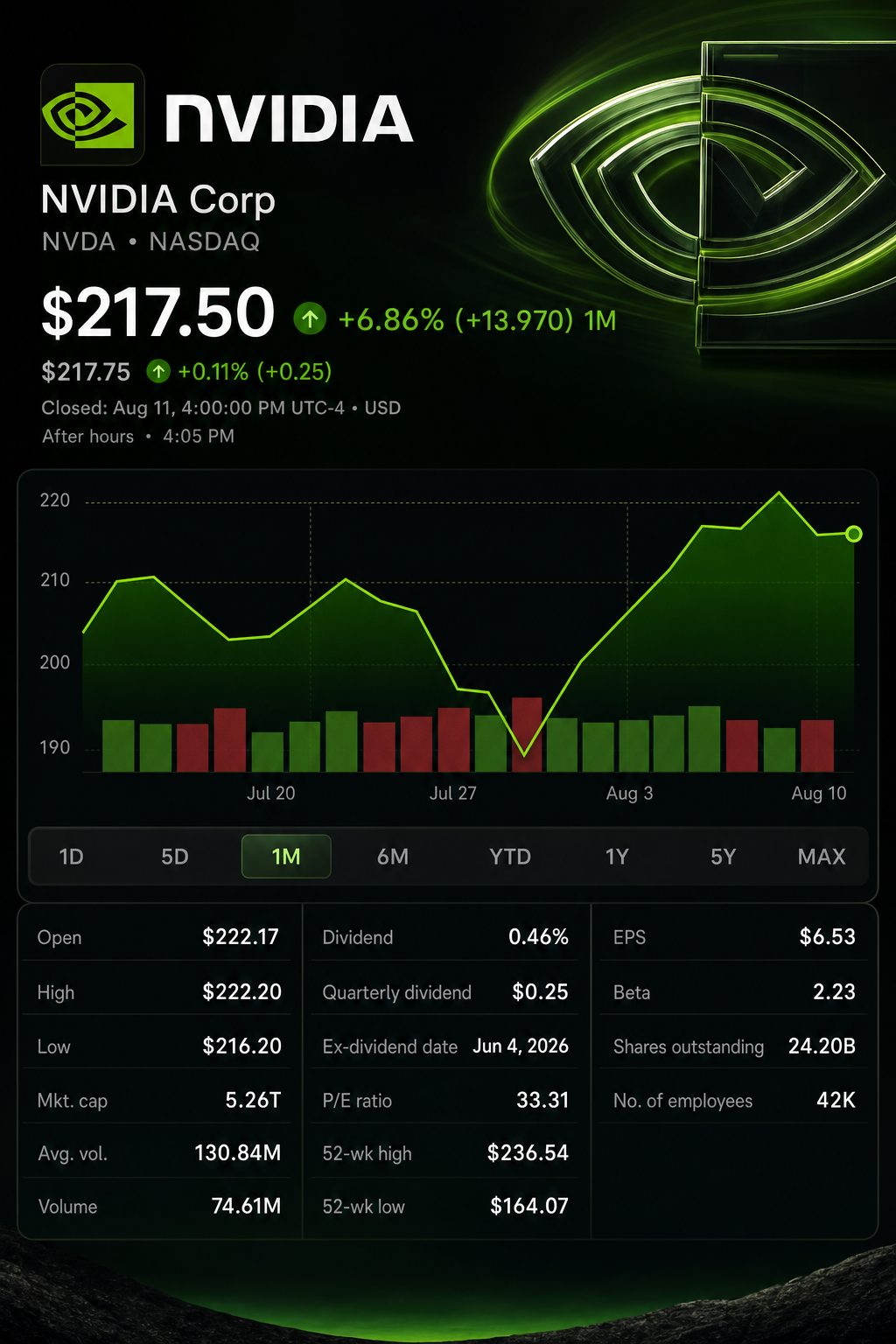
NVIDIA shares saw limited movement. As of 15:29 EDT, the stock had risen 0.17% to $217.92, trading in a range of $216.20 to $222.20. Micron Technology NASDAQ:MU edged up 0.48%, whereas Broadcom NASDAQ:AVGO declined 1.99%. U.S. cash markets closed at 16:00 EDT.
| Stock | Price at snapshot | Day change |
|---|---|---|
| NVIDIA NASDAQ:NVDA | $217.92 | up 0.17% |
| Micron NASDAQ:MU | $865.13 | up 0.48% |
| Broadcom NASDAQ:AVGO | $414.00 | down 1.99% |
Google Finance provided the 15:29 EDT update and the trading range, as well as an estimate of NVIDIA’s market capitalization at about $5.27 trillion.
Following the announcement, sell-side sentiment stayed upbeat. On August 11, three firms confirmed or renewed their buy ratings.
| Analyst and firm | Recommendation | Target | Date |
|---|---|---|---|
| Joseph Moore, Morgan Stanley NYSE:MS | Buy, reaffirmed | $288 | Aug. 11 |
| Srini Pajjuri, RBC Capital Markets, part of Royal Bank of Canada (TSE:RY) | Buy, reaffirmed | $300 | Aug. 11 |
| Vivek Arya, Bank of America Securities NYSE:BAC | Buy, repeated | $350 | Aug. 11 |
| Timothy Arcuri, UBS Group NYSE:UBS | Buy, reaffirmed | $280 | Aug. 10 |
Of 37 analysts tracked by Google Finance, 36 recommend buying, one maintains a hold, and none suggest selling. The consensus 12-month price target stands at $309.94, with estimates ranging from $250 to $500.
NVIDIA begins this trial in a robust financial position. Revenue for the first quarter of fiscal 2027 increased by 85 percent compared to the previous year. GAAP net income was over three times higher.
| GAAP metric | Q1 FY2027 | Q4 FY2026 | Q1 FY2026 |
|---|---|---|---|
| Revenue | $81.62 billion | $68.13 billion | $44.06 billion |
| Gross margin | 74.9% | 75.0% | 60.5% |
| Net income | $58.32 billion | $42.96 billion | $18.78 billion |
NVIDIA reported these numbers in its May results. The company forecast second-quarter revenue of $91 billion, with a margin of error of 2%, and omitted revenue from China data-centre compute from its outlook.
The financing plan is focused on stimulating demand rather than increasing NVIDIA’s production in the near term. The advantage relies on whether projects that receive funding translate into orders and, subsequently, installations.
Risks: The memorandums do not reveal commitments, pricing details or deployment timelines. NVIDIA could also face residual-value risk. Such protection grows more expensive if AI yields fall or rival chips reduce resale prices.
NVIDIA’s next earnings test is set for August 26. The company will announce fiscal second-quarter results and answer analyst queries at 17:00 EDT, giving investors the chance to question executives on customer financing, backstop limits, and the $91 billion revenue forecast.
Related articles: NASDAQ:NVDA