
ST. LOUIS, August 12, 2026, 10:50 EDT — Bunge stock held steady after wheat prices climbed 3%, with oilseed operations contributing 88% of the company’s profit.
- Chicago wheat futures climbed roughly 3% after two Russian grain terminals halted operations.
- Bunge stock showed little change in early market trading.
- Just 8.4% of Bunge’s most recent adjusted segment EBIT was contributed by grain merchandising.
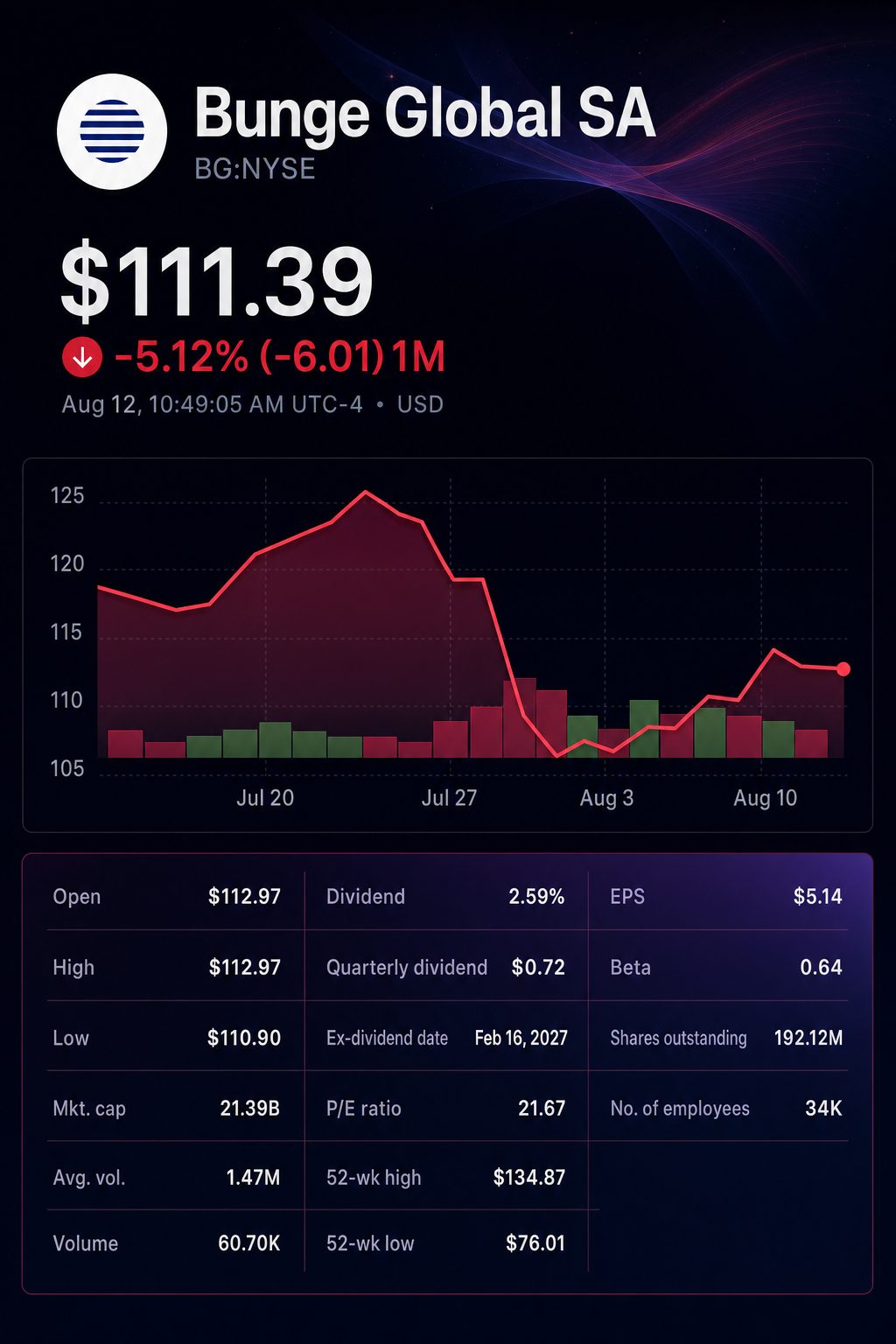
Bunge Global SA NYSE:BG remained largely unchanged on Wednesday, despite a roughly 3% surge in wheat futures. The separation came after a Ukrainian attack disabled two significant grain terminals at Russia’s Novorossiysk port.
The limited change in the stock price is consistent with the numbers. Grain merchandising accounted for only $67 million out of Bunge’s $796 million in adjusted segment EBIT for the second quarter. The majority, $700 million, came from soybean and softseed processing.
Fluctuations in wheat prices may create trading opportunities but can also increase working capital requirements and lead to cargo rerouting. Bunge’s present earnings are significantly more dependent on oilseed crush margins.
| Wednesday market snapshot | Price or move | Time basis |
|---|---|---|
| Chicago wheat futures | Up roughly 3% | Following attack reports |
| Bunge NYSE:BG | $111.47, down 0.12% | Open of Google Finance data |
| Archer-Daniels-Midland NYSE:ADM | $80.28, down 0.22% | Open of Google Finance data |
Reuters said futures shifted following reports from Russian industry sources that both terminals were out of service. Google Finance indicated modest early declines for Bunge and Archer-Daniels-Midland NYSE:ADM. These share prices are snapshots and could fluctuate over the session.
Russia holds the position as the top global wheat exporter, with the majority of exports departing via Black Sea ports like Novorossiysk. According to Ukraine’s agriculture ministry, the country’s grain exports dropped by 76% during the initial two weeks of August compared to the same period last year.
The supply threat is immediate, with its length still uncertain. Demetra Holding acknowledged that one terminal was damaged but has not specified when operations will resume. According to Reuters, no Bunge facility was impacted.
| Bunge Q2 segment | Adjusted EBIT | Share of $796 million total |
|---|---|---|
| Soybean processing and refining | $445 million | 55.9% |
| Softseed processing and refining | $255 million | 32.0% |
| Grain merchandising and milling | $67 million | 8.4% |
| Tropical oils and specialty ingredients | $29 million | 3.6% |
Share of adjusted segment EBIT last quarter was driven primarily by oilseed processing, accounting for 87.9%. Grain merchandising contributed minimally to earnings, even with a significant increase in volumes due to the Viterra acquisition.
Management previously highlighted the issue. “The merchandising environment definitely remains challenging,” Chief Executive Greg Heckman stated during the July earnings call. He further pointed to ongoing uncertainty regarding Black Sea wheat shipments. DTN earnings-call report
However, Bunge posted robust quarterly results going into the turmoil. Adjusted earnings climbed to $2.00 per share from $1.31 the previous year. The company also raised its adjusted EPS outlook for 2026 to a range of $9.25-$9.75.
| Bunge Q2 measure | Reported result | Comparison |
|---|---|---|
| Revenue | $24.04 billion | Analysts expected $22.35 billion |
| Adjusted EPS | $2.00 | Forecast stood at $1.94 |
| Net income attributable to Bunge | $678 million | $354 million for the same quarter last year |
| Adjusted segment EBIT | $796 million | $373 million in the year-ago period |
| 2026 adjusted EPS outlook | $9.25-$9.75 | Prior guidance was $9.00-$9.50 |
Revenue surpassed the Google Finance consensus by 7.6%, while adjusted EPS came in 2.9% above expectations. Segment EBIT posted a bigger increase, driven by the broader platform and improved oilseed margins.
“Our expanded global platform did exactly what it was designed to do,” Heckman stated in the release. The situation in Novorossiysk is now providing a real-time test of that assertion. Bunge needs to reroute supply while maintaining margins.
| Balance-sheet measure | Q2 figure | Why it matters |
|---|---|---|
| Net debt | $14.4 billion | Increases with commodity stockpiles |
| Readily marketable inventory | $13.4 billion | Supports bulk of net debt |
| Net debt excluding inventory | $1.0 billion | Main measure of leverage |
| Adjusted leverage | 1.9 times | Remains inside the firm’s target |
| Revolving credit commitments | $9.7 billion | Ensures trading liquidity |
Bunge possesses sufficient liquidity to manage price volatility. However, increased crop prices may still draw down cash due to inventory and receivables. Management anticipates that working-capital requirements will increase in the latter half of the year.
| Analyst | Recommendation | Price target | Date |
|---|---|---|---|
| Manav Gupta, UBS | Buy | $145 | Aug. 10 |
| Steven Haynes, Morgan Stanley | Buy | $140 | Aug. 5 |
| Thomas Palmer, J.P. Morgan | Buy | $140 | July 30 |
| Andrew Strelzik, BMO Capital | Buy | $150 | July 30 |
| Benjamin Theurer, Barclays | Buy | $150 | July 29 |
According to Google Finance, all five analysts covering Bunge have assigned a buy rating. The consensus price target stands at $145, representing a roughly 30% premium over the $111.47 opening reference. With targets clustered between $140 and $150, analysts show little divergence in their bullish outlook.
Risks: Wheat prices could fall if the terminal reopens soon, erasing recent gains. If the interruption persists, shipping and working-capital expenses may rise. Bunge is also contending with challenges from integrating Viterra, unpredictable crop movements, and fluctuating oilseed profit margins.
Bunge now faces a new challenge beyond the direction of wheat prices: whether its expanded international network can convert trade disruptions into profit, as grain merchandising still accounts for just 8.4% of its segment earnings.
Related articles: Commodities