REDMOND, Washington, August 12, 2026, 4:35 p.m. PDT
Microsoft Corporation NASDAQ:MSFT fell 2.26% to $492.43 on Wednesday. The retreat came as investors shifted toward the hardware powering artificial intelligence. The Nasdaq Composite still gained 0.54%.
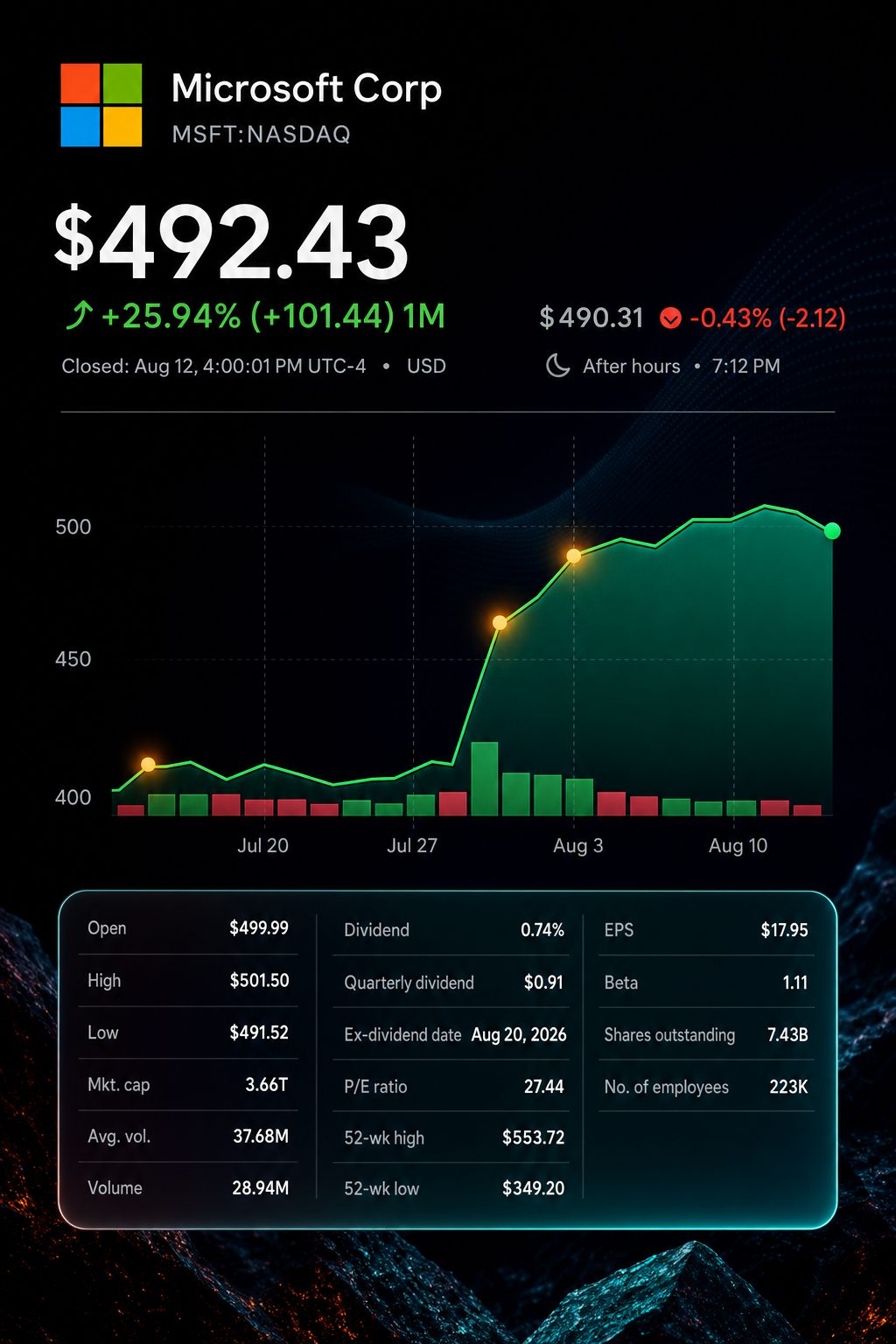
The move exposed a widening split inside the AI trade. Strong results from infrastructure suppliers lifted chip, server and cloud-compute shares. Software names moved the other way.
| AI-linked company | Wednesday move | Investor signal |
|---|---|---|
| Microsoft NASDAQ:MSFT | -2.26% | Software and cloud platform |
| Palantir Technologies NASDAQ:PLTR | about -2.2% | Application software pressure |
| Nvidia NASDAQ:NVDA | about +3.0% | Accelerator demand |
| CoreWeave NASDAQ:CRWV | about +19% | AI-compute demand |
| Super Micro Computer NASDAQ:SMCI | about +19% | Server demand |
That contrast matters because Microsoft straddles both sides. It sells high-margin software, but now funds one of the industry’s largest infrastructure programs. Wednesday’s decline suggests investors still price those cash flows differently.
The pullback followed a fresh bullish call. Bernstein analyst Mark Moerdler raised his target to $660 from $647 on Monday. He kept an Outperform rating and cited Microsoft’s flexible capacity plan. The target stands about 34% above Wednesday’s close.
| Firm | Analyst | Rating | Target | Action date |
|---|---|---|---|---|
| Bernstein | Mark Moerdler | Outperform | $660 | Aug. 10 |
| Goldman Sachs | — | Buy | $640 | July 30 |
| Morgan Stanley | Adam Wood | Overweight | $600 | July 30 |
| D.A. Davidson | — | Buy | $550 | July 30 |
| Barclays | Raimo Lenschow | Overweight | $512 | July 30 |
The original investor tension sits in Microsoft’s cash conversion. Capital spending reached $41 billion last quarter. Free cash flow was $19.6 billion, down 23% year over year. Capex therefore equaled about 2.1 times free cash flow.
| Fiscal Q4 metric | Result | Change or comparison |
|---|---|---|
| Revenue | $90.0 billion | +18% year over year |
| Operating income | $40.6 billion | +18% |
| Capital expenditure | $41.0 billion | more than +70% |
| Free cash flow | $19.6 billion | -23% |
| Azure growth | 43% | about 3 points above consensus |
The spending is producing visible growth. Azure revenue rose 43%, versus a 39.98% consensus estimate. Microsoft guided constant-currency Azure growth near 45% for the current quarter.
Contracted cloud backlog reached $678 billion. It increased by roughly $50 billion sequentially. Paid Microsoft 365 Copilot seats also rose above 30 million from 20 million.
Chief Executive Satya Nadella said Microsoft’s own models and chips were yielding efficiency gains of up to 40%. “That’s really the enterprise design architecture that we are going to evangelize,” he told analysts. Reuters
The shares had risen about 30% since the July earnings release before Wednesday. They now trade near 25 times forward earnings. That remains below the roughly 33 times seen one year ago, according to Moerdler.
For the week ahead, investors will watch whether the hardware-led rotation persists. Microsoft’s next dividend date also approaches. Its $0.91 quarterly payout has an August 20 ex-dividend and record date.
Risks: AI capacity may arrive before demand, depressing cash returns. Faster cloud growth at Alphabet NASDAQ:GOOGL or Amazon.com NASDAQ:AMZN could also pressure Azure. A software selloff would amplify both concerns.
The next test is simple. Microsoft must convert its $678 billion backlog into cash faster than infrastructure costs rise. Wednesday’s split shows investors will reward the suppliers first.
Related articles: NASDAQ:MSFT