
NEW YORK, August 10, 2026, 11:19 EDT
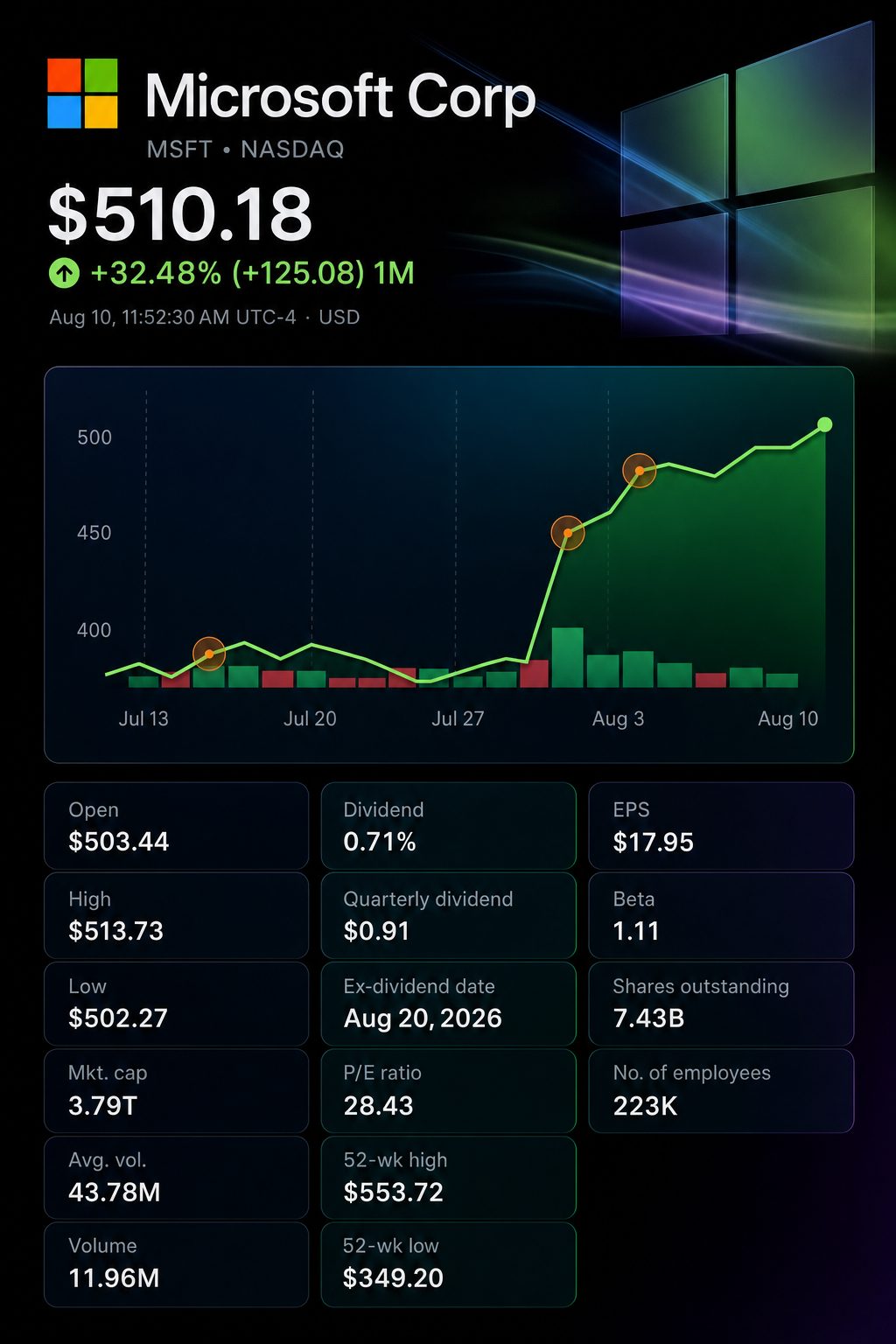
- Microsoft shares rose 1.7% to $508.64 during open U.S. trading.
- Bernstein raised its price target to $660 from $647 and retained Outperform.
- Contracted backlog grew 84%, outpacing capital spending, while free cash flow fell.
Microsoft shares advanced on Monday after Bernstein increased its price target. The stock traded at $508.64 around 11:04 EDT. That left 29.8% implied upside to Bernstein’s new target.
The target increase was modest. The research case was not.
Bernstein said Microsoft’s data-center area has expanded slower than cloud revenue. The firm viewed that pace as measured rather than excessive.
It also said future capacity could support traditional CPU-based cloud workloads. That provides an alternative use if artificial-intelligence demand slows.
Company data support the demand side. Azure revenue grew 43%, while commercial remaining performance obligations reached $678 billion. Chief Financial Officer Amy Hood said, “Customer demand continues to exceed available capacity.” Microsoft
Microsoft quarterly demand, spending and cash
| Metric | Fiscal Q4 2025 | Fiscal Q4 2026 | Change |
|---|---|---|---|
| Revenue | $76.4bn | $90.0bn | +18% |
| Microsoft Cloud revenue | $46.7bn | $59.3bn | +27% |
| Azure revenue growth | 39% | 43% | +4 points |
| Commercial RPO | $368.0bn | $678.0bn | +84% |
| Capital expenditure | $24.2bn | $41.0bn | +69% |
| Operating cash flow | $42.6bn | $55.4bn | +30% |
| Free cash flow | $25.6bn | $19.6bn | -23% |
| Microsoft Cloud gross margin | 68% | 65% | -3 points |
Changes marked with an asterisk are calculated from reported figures.
The investor angle sits in those growth rates. Backlog expanded faster than capital spending. Capital spending, in turn, grew faster than cloud revenue. Free cash flow still fell 23%. Cash is the constraint.
Microsoft expects roughly 30% of RPO to become revenue within 12 months. A calculated estimate puts that amount at $203.4 billion. It equals about 61% of fiscal 2026 revenue.
The backlog also became less concentrated. Microsoft said all sequential RPO growth came from outside frontier-model companies. Excluding OpenAI, RPO increased 25%.
Spending will rise again. First-quarter capital expenditure should exceed $50 billion, including a lease-classification effect. Management expects fiscal 2027 spending growth while remaining free-cash-flow positive.
AI and cloud peer comparison
| Company | Price | Monday change | Market value | Trailing P/E |
|---|---|---|---|---|
| Microsoft NASDAQ:MSFT | $508.64 | +1.7% | $3.79tn | 30.3 |
| Nvidia NASDAQ:NVDA | $219.78 | -1.9% | $5.36tn | 33.5 |
| Alphabet NASDAQ:GOOGL | $354.37 | +0.0% | $4.33tn | 17.8 |
| Amazon NASDAQ:AMZN | $278.83 | +1.6% | $3.04tn | 22.4 |
| Meta Platforms NASDAQ:META | $601.82 | +1.6% | $1.54tn | 22.7 |
Quotes were captured at about 11:04 EDT.
Microsoft trades below Nvidia’s earnings multiple. It carries a clear premium to Alphabet, Amazon and Meta. That premium requires faster backlog conversion and steadier cash returns.
Analysts remain broadly positive. Their targets still reflect sharply different execution assumptions.
Selected analyst recommendations
| Firm or measure | Date | Recommendation | Target change | Target | Implied upside* |
|---|---|---|---|---|---|
| Bernstein | Aug. 10 | Outperform | $647 to $660 | $660 | 29.8% |
| Tigress Financial | Aug. 5 | Buy | $680 to $690 | $690 | 35.7% |
| Daiwa Securities | Aug. 5 | Buy | $572 to $595 | $595 | 17.0% |
| FactSet mean | Aug. 10 | Buy consensus | — | $564.11 | 10.9% |
Upside is calculated from Microsoft’s $508.64 share price.
Bernstein’s target sits well above the FactSet mean. Tigress remains more bullish at $690. The spread makes execution, rather than sentiment, the central debate.
Risks: Free cash flow fell as cloud gross margin dropped three points. Reuters identified $329.1 billion of Microsoft’s uncommenced lease payments, though these are not equivalent to debt. Slower demand could leave costly capacity underused.
The next test is Microsoft’s 45% constant-currency Azure growth forecast. Bernstein’s case requires capacity to convert without a deeper cash squeeze.
Related articles: NASDAQ:MSFT