
REDMOND, Washington, August 19, 2026, 10:20 EDT — U.S. cash markets traded during the session.
- China is said to have moved faster in phasing out a special Windows 10 version made for government use.
- Microsoft has stated that its revenue from China accounts for just 1.5% of its worldwide total.
- The company’s most recent quarterly revenue growth was approximately 2.8 times higher than a China revenue proxy.
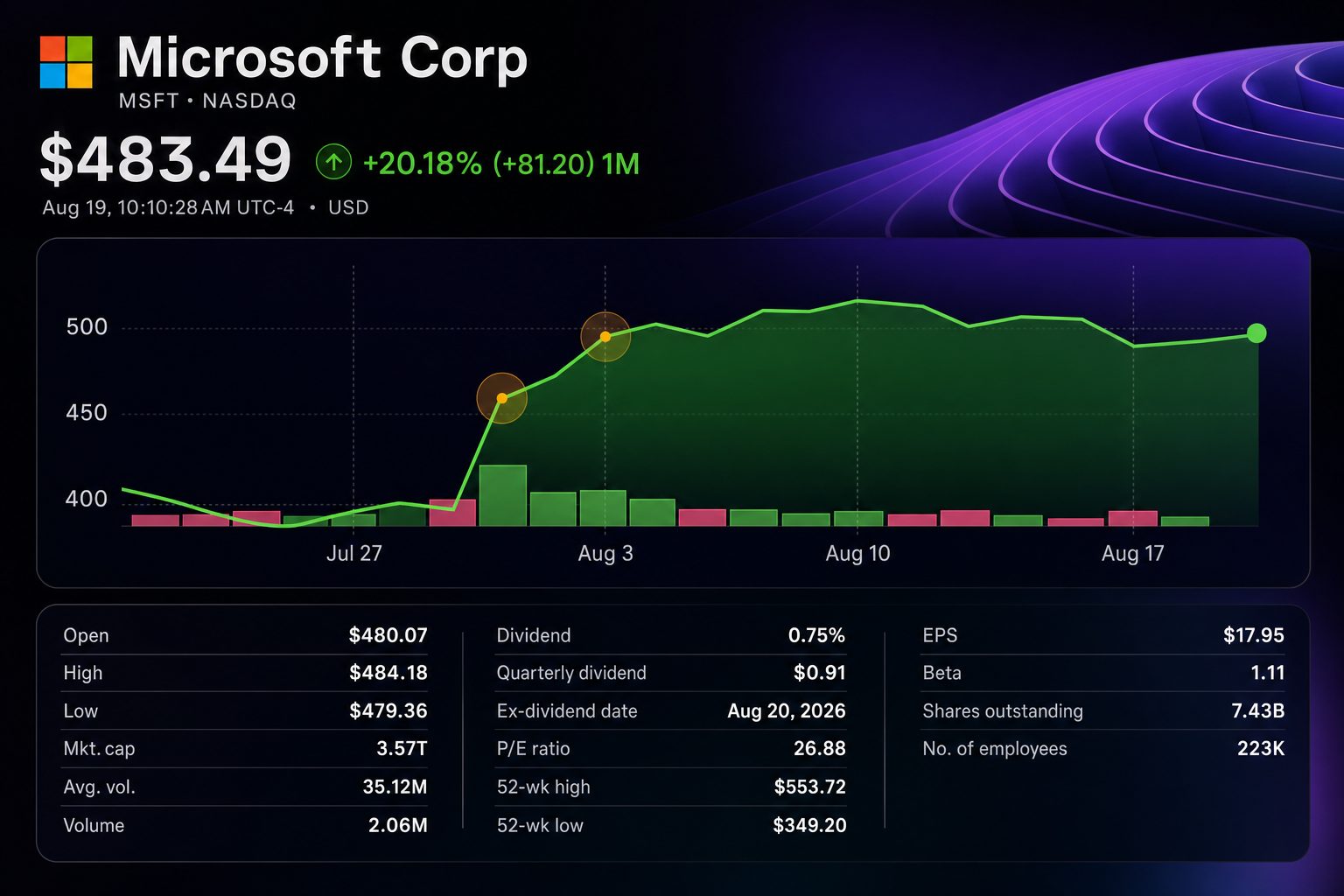
Microsoft Corporation NASDAQ:MSFT shares rose 0.17% to $482.44 at 09:43 EDT. The gain followed news that China has reportedly instructed certain state-affiliated organizations to uninstall a government-edition of Windows 10. The order extends a withdrawal that had already started.
The central issue for investors is scale. In 2024, Microsoft reported that China accounted for only 1.5% of its worldwide revenue. If this proportion is applied to projected fiscal 2026 sales, it results in an estimated annual figure of around $5.0 billion. This calculation is meant to illustrate, not to serve as an official company forecast.
Microsoft reported revenue growth of approximately $13.7 billion in its most recent quarter. This growth equates to nearly 2.8 times the annual figure attributed to the China proxy. The data indicates that direct earnings risk appears limited, although the broader policy implications remain significant.
| Exposure check | Verified input | Derived read-through |
|---|---|---|
| Fiscal 2026 revenue | $331.8 billion | Total worldwide |
| China share disclosed in 2024 | 1.5% | Estimated annual figure: $4.98 billion |
| Fiscal Q4 2026 revenue | $90.0 billion, up 18% | Yearly gain of roughly $13.7 billion |
| Growth versus China proxy | $13.7 billion / $4.98 billion | Nearly 2.8 times |
The product involved is Windows 10 China Government Edition. It was developed by C&M Information Technologies, a joint venture between Microsoft and state-owned China Electronics Technology Group. The order is said to apply to “some” entities connected to the state. The overall number of devices affected has not been revealed.
Microsoft informed Bloomberg it was not aware of any security incident involving the product. Bloomberg reported the software continues to get security updates. However, its removal moves up a previously scheduled retirement set for February 2027.
| China signal | Latest verified evidence | Investor relevance |
|---|---|---|
| Government procurement | Five out of six manuals studied did not include Microsoft as a recommendation | State purchasing demand has already been limited |
| Corporate footprint | No fewer than 15 subsidiaries and ventures have been shut in the past five years | The pullback began before the Windows directive |
| China revenue | 1.5% of total revenue in 2024 | Overall group risk is limited |
| Consumer desktop traffic | Windows captured 87.64% in July 2026 | Consumer habits remain unaffected by government action |
The state channel had declined prior. Reuters examined six procurement documents from China issued between December 2023 and May 2026. Microsoft did not receive a recommendation in five guides. The remaining one set additional administrative conditions for the government version.
The consumer sector tells a different story. StatCounter figures, as reported by Tom’s Hardware, show that Windows accounted for 87.64% of desktop web traffic in China in July. Of that share, Windows 10 made up 43.56% of Windows web traffic. This distinction highlights the difference between a setback in public sector procurement and a broad decline in consumer usage.
| Fiscal Q4 2026 engine | Revenue | Year-on-year change |
|---|---|---|
| Microsoft Cloud | $59.3 billion | Up 27% |
| Intelligent Cloud | $39.3 billion | Up 32% |
| Azure and other cloud services | Not separately disclosed | Up 43% |
| More Personal Computing | $12.9 billion | Down 4% |
Cloud gains drive the counterbalance. Microsoft posted quarterly revenue of $90.0 billion, a rise of 18%. Sales from Microsoft Cloud increased 27% to $59.3 billion, with Azure and other cloud services advancing 43%.
Chief Executive Satya Nadella stated, “This year, Azure revenue surpassed $100 billion for the first time.” He also noted that Microsoft 365 Copilot now has over 30 million paid seats. These numbers reflect the new areas of growth.
The share price has already reflected much of this momentum. At Tuesday’s close of $481.63, the stock was up 23.3% compared to the $390.54 closing level before results on July 29. As a result, the China headlines are challenging a higher valuation that follows a strong post-earnings surge, rather than a lower one.
| Analyst recommendation | Date | Rating | Price target |
|---|---|---|---|
| Wells Fargo | August 12 | Overweight | $700, up from $650 |
| Bernstein | August 10 | Target set | $660 |
| Tigress Financial | August 5 | Buy | $690, lifted from $680 |
| 47-analyst consensus | August 19 snapshot | Moderate Buy: 42 Buy, 5 Hold, 0 Sell | $560.27 average |
Wall Street sentiment is still upbeat. The average target suggests a 16.1% potential gain from the 09:43 price. Latest forecasts reflect varying confidence in AI-driven returns, underlining the significance of success in cloud operations over Windows as a headline factor.
Risks persist. China’s measures could extend beyond government computers to private-sector cloud or AI operations. U.S. export restrictions might also hinder Microsoft’s capacity to support Chinese firms internationally. Reduced Azure growth would eliminate the primary buffer against these challenges.
Related articles: NASDAQ:MSFT