
NEW YORK, August 13, 2026, 19:24 EDT — US cash markets were shut. Trading continued during after-hours.
- XLV hit a record high of $169.71 before ending the session down 0.04%.
- SPY rose 0.70%, outpacing health care by 0.74 percentage points.
- Initial contribution calculations indicate underperformance among the holdings outside of XLV’s top ten.
The State Street Health Care Select Sector SPDR ETF (NYSEARCA:XLV) pulled back after touching an all-time high on Thursday. The fund hit $169.71 before ending the session at $168.38, a 0.04% decrease. The closing price was 0.78% short of its intraday high.
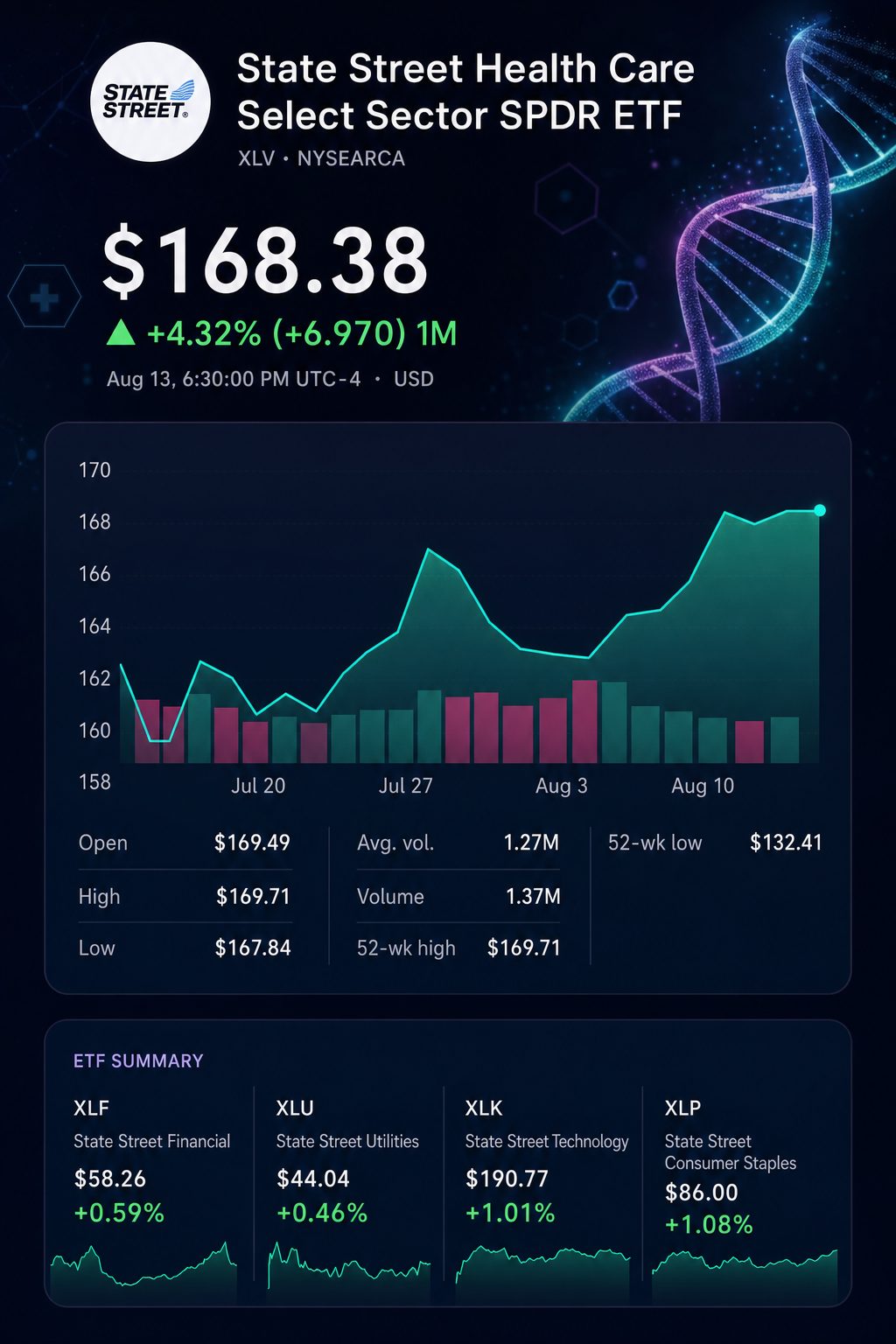
The reversal is significant as the broader market advanced in the opposite direction. The SPDR S&P 500 ETF Trust NYSEARCA:SPY rose by 0.70%. This meant health care underperformed by 0.74 percentage point while the index closed at a record high.
The largest holdings in the fund were not solely responsible for its performance. Early calculations based on State Street’s July 27 portfolio weights indicate the top ten contributed roughly 0.04 percentage point. These stocks made up 61.63% of XLV.
| Market proxy | August 13 close | Daily change | Gap versus XLV |
|---|---|---|---|
| Health Care Select Sector SPDR (NYSEARCA:XLV) | $168.38 | -0.04% | — |
| SPDR S&P 500 ETF Trust NYSEARCA:SPY | $777.88 | +0.70% | +0.74 point |
| Invesco QQQ Trust NASDAQ:QQQ | $732.07 | +1.16% | +1.20 points |
| iShares Russell 2000 ETF NYSEARCA:IWM | $303.50 | +0.26% | +0.30 point |
The S&P 500 climbed 0.65% to close at a new high of 7,798.99. The Nasdaq gained 0.81%, and the Dow increased 0.13%. Seven out of eleven S&P sectors finished higher, with communication services and real estate posting the biggest gains.
Producer prices in July stayed flat compared to June. Prices for goods declined by 0.7%, but service prices increased by 0.2%. Yearly producer inflation slowed to 4.7%, down from 5.5%. The figures tempered expectations for a near-term Federal Reserve rate hike.
| XLV leading holding | Fund allocation | August 13 movement | Estimated impact |
|---|---|---|---|
| Eli Lilly NYSE:LLY | 16.05% | -0.92% | -0.15 point |
| Johnson & Johnson NYSE:JNJ | 10.84% | +0.47% | +0.05 point |
| AbbVie NYSE:ABBV | 7.69% | +0.83% | +0.06 point |
| UnitedHealth Group NYSE:UNH | 6.42% | -1.61% | -0.10 point |
| Merck NYSE:MRK | 5.47% | +1.98% | +0.11 point |
| Thermo Fisher Scientific NYSE:TMO | 3.52% | -1.21% | -0.04 point |
| Amgen NASDAQ:AMGN | 3.44% | +0.40% | +0.01 point |
| Abbott Laboratories NYSE:ABT | 3.08% | +0.32% | +0.01 point |
| Gilead Sciences NASDAQ:GILD | 2.74% | +1.67% | +0.05 point |
| Pfizer NYSE:PFE | 2.38% | +1.86% | +0.04 point |
| Aggregate for top ten | 61.63% | — | +0.04 point |
The other 38.37% of XLV subtracted about 0.08 percentage point. This number is implied rather than reported. It indicates that the late-day weakness extended beyond the top holdings.
On July 27, pharmaceuticals accounted for 37.90% of the fund. Providers and services made up 18.72%, and biotechnology comprised 18.28%. Equipment and supplies contributed 15.64%. This composition highlights why lower yields by themselves were not enough to boost the entire sector.
| Company | Buy | Hold | Sell | Average target upside |
|---|---|---|---|---|
| Eli Lilly | 18 | 2 | 0 | 13.95% |
| Johnson & Johnson | 13 | 3 | 0 | 8.25% |
| AbbVie | 19 | 4 | 0 | 11.48% |
| UnitedHealth Group | 16 | 4 | 0 | 20.70% |
| Merck | 13 | 4 | 0 | 2.50% |
Analysts continue to show a strong buy bias for the top five holdings, but anticipated gains differ widely. Merck’s consensus price target pointed to an increase of only 2.5%, while UnitedHealth’s projected upside reached 20.7%.
Technology continued to dominate market sentiment. Jay Hatfield, CEO of Infrastructure Capital Advisors, described the trend as “an earnings boom, not a bubble.” The shift in health care highlights that declining yields have not boosted all sectors equally. Reuters
Risks: The contribution estimate is based on July 27 weights, which are subject to daily changes. Trading frictions in ETFs and intraday rebalancing may lead to minor discrepancies. A single session is not enough to determine a lasting breadth pattern.
The test on Friday is straightforward. XLV needs to move back above $169.71, with increased participation among its smaller components. If this does not happen, the move will go down as an intraday rejection rather than a confirmed breakout.