
SEATTLE, August 16, 2026, 13:05 PDT —
- US nonstore sales dropped by 2.2% in July following Amazon’s decision to move Prime Day to June.
- AWS generated 60% of Amazon’s operating income in the second quarter, despite accounting for just 21% of total revenue.
- The midpoint of Amazon’s third-quarter sales growth stands at 10.5%, compared to 20% seen in the second quarter.
Amazon.com Inc. NASDAQ:AMZN starts the week as US nonstore retail sales dropped 2.2% in July, a decrease attributed in part to Prime Day’s shift into June. Amazon’s stock finished Friday at $262.65, down 0.94%.
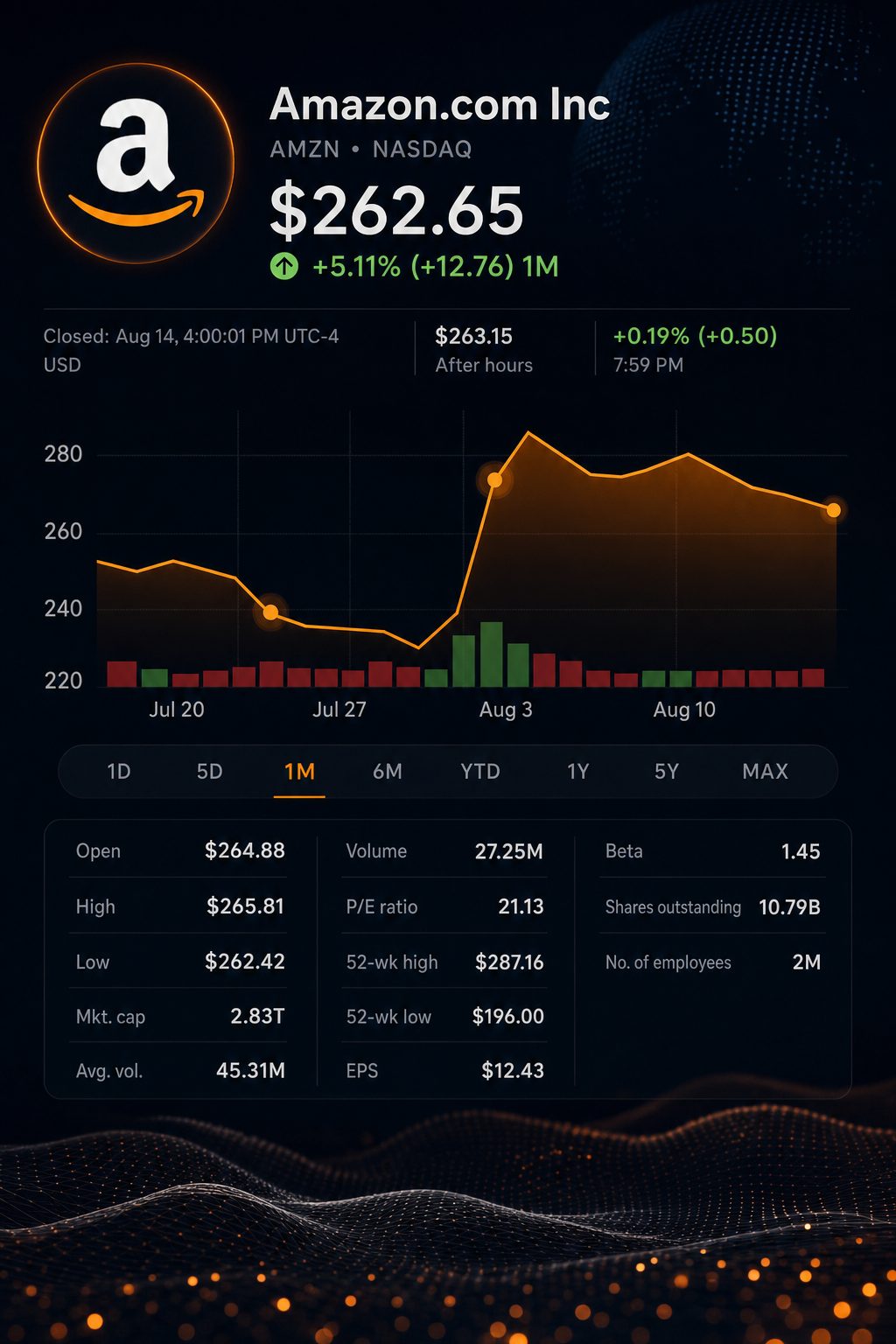
The timing change is significant, as Amazon’s third-quarter revenue midpoint stands at $199.5 billion, marking a 0.5% decrease compared to its second-quarter figure. The projected growth midpoint is 10.5%, which is nearly half the 20% growth rate recorded in the previous quarter.
| Friday market snapshot | Close | Daily move |
|---|---|---|
| Amazon NASDAQ:AMZN | $262.65 | -0.94% |
| S&P 500 | 7,785.76 | -0.17% |
| Nasdaq Composite | 26,729.16 | -0.3% |
The decrease in July was widespread and signals the need for caution. Overall retail sales slipped 0.6%, missing expectations of a 0.1% rise. Core sales, which feed into gross domestic product figures, dropped 0.4%, compared to estimates for a 0.3% gain.
| July US retail data | Reported | Forecast |
|---|---|---|
| Overall retail sales, m/m | -0.6% | +0.1% |
| E-commerce and mail-order retailers | -2.2% | Not stated |
| Core retail sales | -0.4% | +0.3% |
| Overall retail sales, y/y | +5.0% | Not stated |
The online drop does not clearly reflect Amazon demand. Prime Day shifted buying into June, while rival retailers also moved promotions earlier. Nonetheless, softer consumer sentiment and reduced core spending set a higher hurdle for the holiday season.
AWS delivers a buffer to profits. Amazon’s cloud business posted $16.6 billion in operating income for the second quarter, accounting for 60.4% of overall profit while representing only 21.0% of total revenue. The figures are based on segment data released by Amazon.
| Q2 segment | Revenue | Revenue growth | Operating income | Operating margin |
|---|---|---|---|---|
| North America | $116.2B | 16% | $9.1B | 7.8% |
| International | $42.2B | 15% | $1.7B | 4.0% |
| AWS | $42.2B | 37% | $16.6B | 39.3% |
| Amazon total | $200.6B | 20% | $27.5B | 13.7% |
Chief Executive Andy Jassy said, “AWS is booming, growing 36.7% year-over-year in Q2—our fastest growth in 18 quarters.” Both AWS’s AI and chip operations passed $25 billion each in annual revenue run rates. Amazon
The outlook for the next quarter appears more challenging. Amazon forecast revenue in the range of $197 billion to $202 billion, with operating income expected between $22.5 billion and $26.5 billion. The midpoint suggests a modest drop in sales from the prior quarter and an 11% decrease in operating income.
| Amazon measure | Q2 actual | Q3 midpoint | Sequential change |
|---|---|---|---|
| Revenue | $200.6B | $199.5B | -0.5% |
| Year-over-year revenue growth | 20.0% | 10.5% | -9.5 percentage points |
| Operating income | $27.5B | $24.5B | -10.9% |
Analysts are upbeat following AWS’s faster growth. FactSet reports an average price target of $320.01 after the earnings, representing a 21.8% gain from Friday’s close. Some upper-end targets of $365 suggest potential upside of 39.0%.
| Analyst recommendation | Rating | Target | Upside from $262.65 |
|---|---|---|---|
| Piper Sandler Companies NYSE:PIPR | Overweight | $320 | 21.8% |
| Cantor Fitzgerald | Overweight | $320 | 21.8% |
| Barclays PLC LON:BARC | Overweight | $365 | 39.0% |
| JPMorgan Chase & Co. NYSE:JPM | Overweight | $365 | 39.0% |
Risks are centered on consumer activity and expenditure. Trailing free cash flow shifted to a $7.6 billion outflow, reversing from an $18.2 billion inflow. The $25.8 billion decline came after increased AI infrastructure acquisitions. A persistent slowdown in retail could mean AWS becomes more crucial to the company’s valuation.
Monday’s initial challenge is seeing if investors view July’s decline in online sales as a timing fluctuation. The real test arrives with third-quarter results, as AWS expansion needs to balance the absence of the Prime Day boost and Amazon works to restore cash flow.
Related articles: NASDAQ:AMZN