
SUNNYVALE, California, August 17, 2026, 10:55 EDT – Cerebras shares climbed 17%, boosting the company’s market value by $8.8 billion as investors reassessed the impact of its collaboration with OpenAI.
- Cerebras stock surged 17%, increasing its market capitalization by roughly $8.8 billion.
- The rebound offset last week’s earnings-driven selloff, even though revenue fell short by 7%.
- The current share price assigns a multiple of about 68 times to the 2026 core-revenue guidance.
Cerebras Systems Inc. NASDAQ:CBRS jumped 17% to $256.20 on Monday, lifting its market capitalization by approximately $8.8 billion to $60.26 billion. The gain erased last week’s earnings-driven losses in a single day.
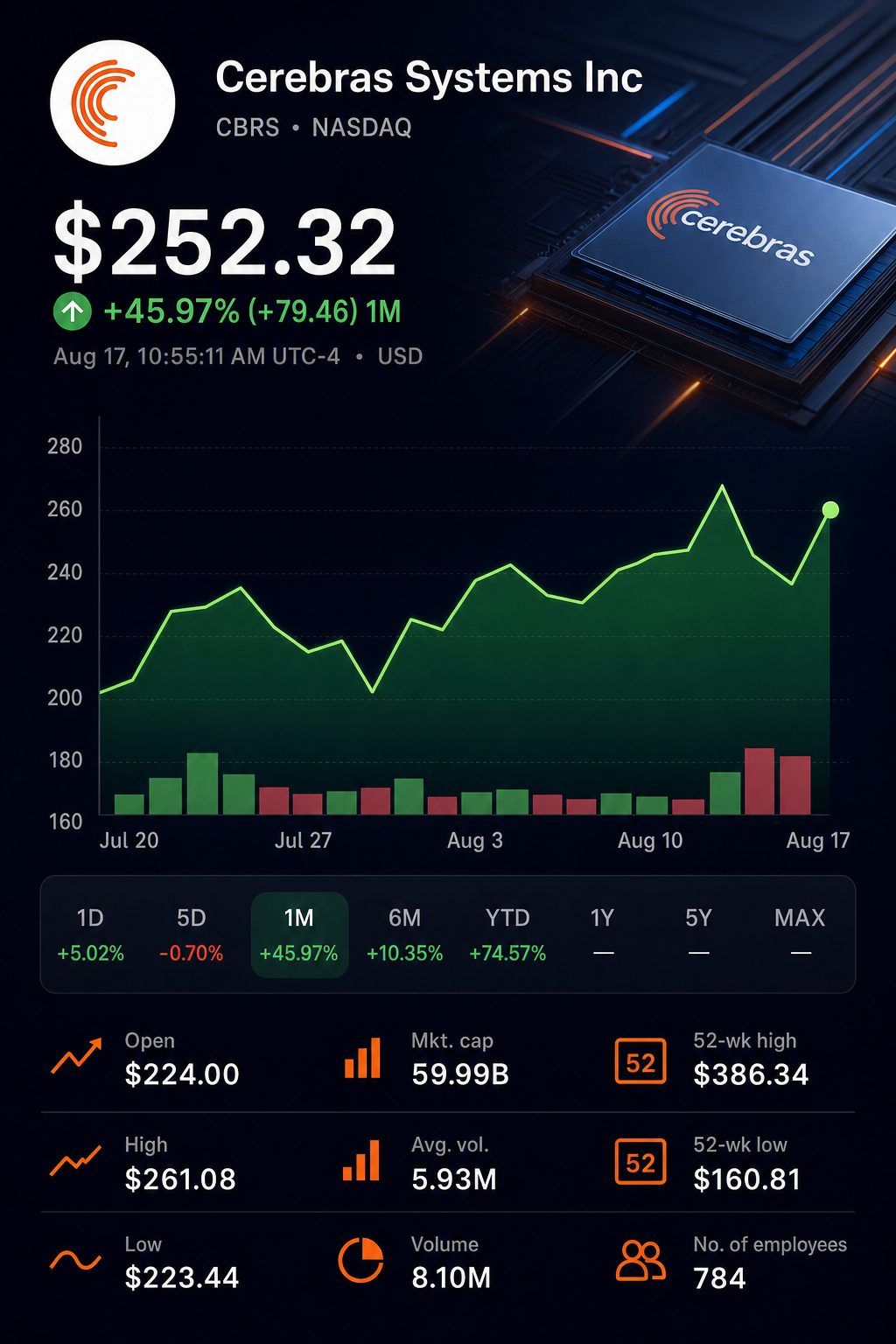
The rebound was notable as the overall chip sector remained relatively steady. Shares of Nvidia Corporation NASDAQ:NVDA increased 0.6%, and Broadcom Inc. NASDAQ:AVGO also gained 0.6%. Advanced Micro Devices Inc. NASDAQ:AMD fell roughly 0.8%. Cerebras was adjusting due to expectations focused on its own outlook.
| AI infrastructure stock | Price snapshot | Session move | Market value |
|---|---|---|---|
| Cerebras NASDAQ:CBRS | $256.20 | up 17.00% | $60.26 billion |
| Nvidia NASDAQ:NVDA | $226.59 | up 0.64% | $5.49 trillion |
| Broadcom NASDAQ:AVGO | $395.40 | up 0.61% | $1.88 trillion |
| AMD NASDAQ:AMD | $510.44 | down 0.77% | Not used |
A favourable report from Wedbush supported the recovery, underlining Cerebras’ capacity to deliver OpenAI models at rapid speeds, Investing.com reported. OpenAI stated that GPT-5.6 Sol is capable of running on Cerebras infrastructure at as much as 750 output tokens per second. Access started with chosen customers as more capacity was added.
Optimism came after a challenging report. GAAP revenue for the second quarter increased by 74% to $180.11 million, falling short of the $194.23 million estimate from LSEG. Adjusted gross margin declined to 40.6% from 46.5% compared to the previous quarter. Shares slipped 16% after hours on August 12.
| Q2 indicator | Reported | Comparison | Investor read |
|---|---|---|---|
| GAAP revenue | $180.11 million | Up 74.3% year-on-year | Strong growth, result misses forecast |
| Cloud and services revenue | About $126 million | Close to quadruple last year’s | Faster shift to recurring revenues |
| Hardware revenue | $54.1 million | Lower than $70.3 million previously | Weaker product performance |
| Adjusted gross margin | 40.6% | Q1 was 46.5% | Margins pressured by rental expenses |
| Adjusted loss | $6.91 million | $40.5 million a year ago | Core loss reduced |
The main concern for investors is the change in revenue mix. Cloud revenue accounted for around 70% of GAAP sales, up from approximately 32% the previous year. This transition enhances revenue predictability. However, it means that Cerebras must fund data centers ahead of receiving payments from customers.
Chief Executive Andrew Feldman views supply economics as a benefit. “Nvidia’s prices have gone through the roof because of HBM prices,” he told Reuters. Cerebras integrates memory directly onto its wafer-scale processor and relies on an older 5-nanometer foundry method. This approach can help reduce some component strains.
The OpenAI deal provides the scale trial. Cerebras announced a multiyear contract worth more than $20 billion for 750 megawatts of inference computing power. The firm also plans to add 200 megawatts of European capacity before the end of 2027.
| Capacity milestone | Scale | Timing | Execution question |
|---|---|---|---|
| OpenAI contract | Above $20 billion; 750 MW | Several years, into 2028 | Construction expense and usage |
| Total data-center plan | Over 600 MW | By fourth quarter 2027 | Energy and site availability |
| Expansion in Europe | 200 MW | By close of 2027 | Turning local demand |
| Manufacturing growth | More than ten times | Throughout 2026 | Output levels and supply control |
Management lifted its 2026 core revenue outlook to a range of $880 million–$890 million. It also projects that revenue will more than triple in 2027. Those projections account for the recovery, but the valuation remains expensive.
| Valuation bridge | Calculation | Result |
|---|---|---|
| Market capitalization added Monday | $60.26B less previous value calculated using a 17% increase | Roughly $8.8 billion |
| Median 2026 core revenue | ($880M plus $890M) divided by 2 | $885 million |
| Market capitalization to 2026 core revenue | $60.26B divided by $885M | Approximately 68.1 |
| Minimum 2027 simple revenue | $885M multiplied by 3 | $2.655 billion |
| Market capitalization to 2027 minimum | $60.26B divided by $2.655B | Close to 22.7 times |
Google’s latest analyst panel shows unanimous bullishness on Wall Street for Cerebras, with all ten analysts assigning a buy rating. However, following Monday’s rally, the average price target implies just a 16.7% potential upside. Consensus projections for Nvidia and Broadcom indicate greater upside, even as their near-term volatility is lower.
| Company | Buy | Hold | Sell | Average target | Implied upside |
|---|---|---|---|---|---|
| Cerebras | 10 | 0 | 0 | $298.90 | 16.7% |
| Nvidia | 36 | 1 | 0 | $309.94 | 36.8% |
| Broadcom | 23 | 4 | 0 | $512.87 | 29.7% |
The GAAP net loss reported stood at $450.5 million. The difference between GAAP and adjusted figures was increased by stock-based compensation and warrant accounting. Both metrics require close monitoring by investors. Cash requirements may rise more rapidly than reported revenue as the company scales up capacity.
Risks: Cerebras relies significantly on major clients and projects that have yet to be constructed. Hardware revenue is declining, and cloud profit margins are still short of the target for the long-term. Setbacks, underused resources or the need for additional funding may swiftly put pressure on the high sales multiple.
Monday’s surge indicates investors continue to prioritize rapid progress over immediate accounting concerns. The next significant step will be more subdued. Cerebras now needs to turn 750 megawatts of contracted compute into sustained revenue, improved margins, and cash flow.