

TORONTO, August 20, 2026, 22:58 EDT — McDonald’s Corporation NYSE:MCD is testing whether a seven-item “World Heist” menu can lift Canadian traffic without adding a material new earnings driver. The limited-time menu returned across Canada on August 18, drawing products from six overseas markets. Daily Hive
- Canada represented 3.35% of McDonald’s 2025 global restaurant count.
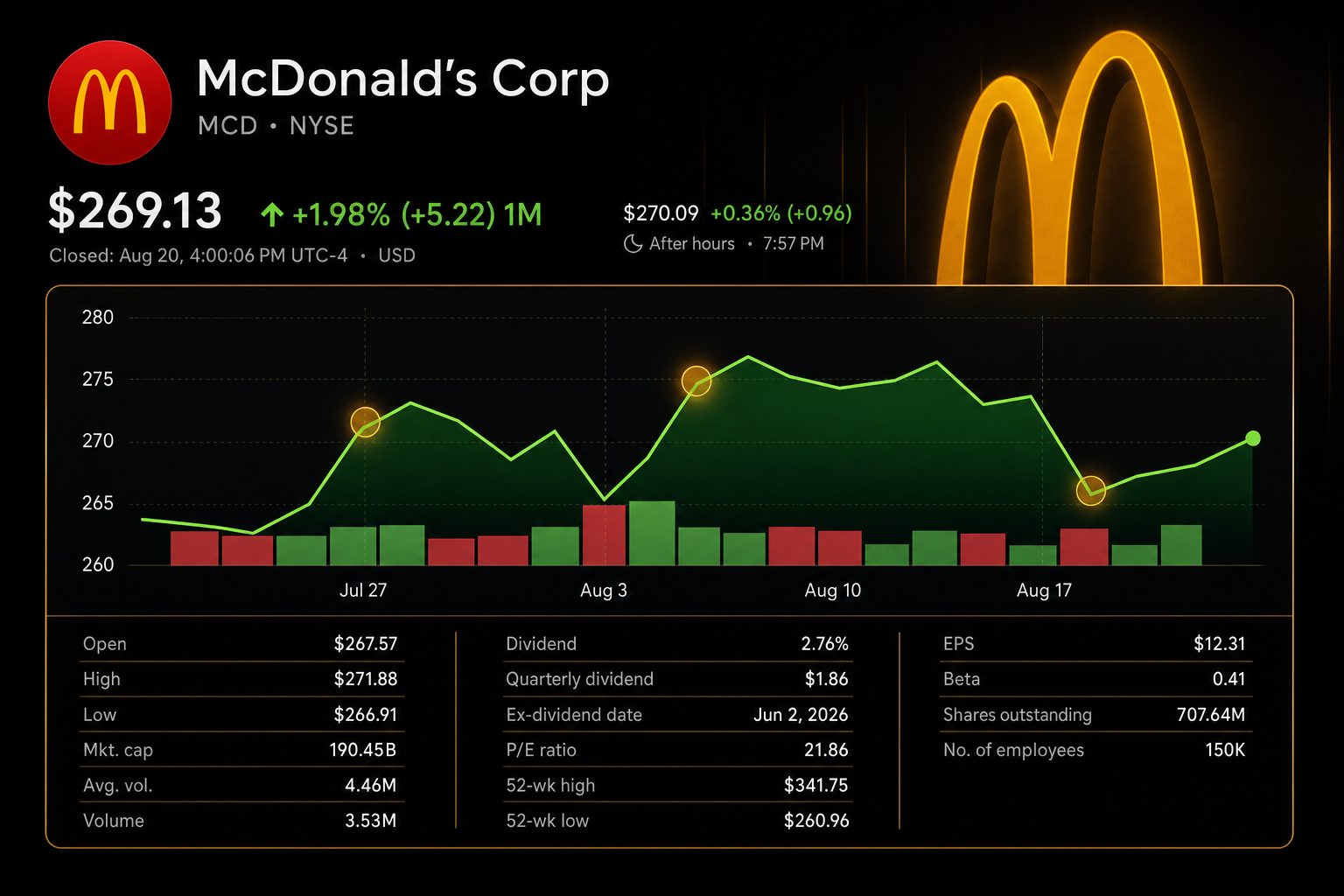
- MCD closed at $269.13 on August 20, up 0.63%.
- The average analyst target was $316.06, implying 17.44% upside.
The investor signal is narrower than the menu’s geographic sweep. Canada had 1,520 restaurants at the end of 2025, versus 45,356 worldwide. That makes the rollout a useful traffic laboratory, but not a stand-alone reason to reset group forecasts.
| Canada footprint proxy | Restaurants | Canada share |
|---|---|---|
| Canada | 1,520 | — |
| Global system | 45,356 | 3.35% |
| International Operated Markets | 10,845 | 14.02% |
The menu mixes familiar formats with unusual flavours. It also lets McDonald’s reuse products already tested elsewhere. That may lower development risk, although Canadian supply and kitchen execution still matter.
| World Heist item | Original market |
|---|---|
| Chicken Parmi Burger | Australia |
| McExtreme Pulled Pork | Spain |
| Cheesy Bacon McFlavour Fries | France |
| Garlic & Black Pepper McNuggets | Japan |
| Stroopwafel McFlurry | Netherlands |
| Truffle-flavoured mayo-style sauce | Sweden |
| Black Garlic Sauce | Japan |
Canada’s scale is still meaningful operationally. McDonald’s says its Canadian network spans more than 1,400 restaurants and serves over 2.5 million people daily. A traffic response should therefore appear quickly in franchisee orders and store-level throughput.
Yet consolidated economics dilute the effect. About 95% of McDonald’s restaurants were franchised at the end of 2025. Corporate revenue comes mainly from rents, royalties and fees rather than the full value of franchisee sales.
That structure makes comparable sales the key measure. McDonald’s reported positive second-quarter growth in every segment, but the pace remained modest. International Operated Markets, which includes Canada, grew slightly faster than the United States.
| Q2 2026 measure | Result | Year-on-year change |
|---|---|---|
| Global comparable sales | — | +1.3% |
| U.S. comparable sales | — | +0.8% |
| International Operated Markets comparable sales | — | +1.5% |
| Revenue | $7.10 billion | +4% |
| Diluted EPS | $3.32 | +6% |
“This quarter McDonald’s delivered positive comparable sales growth across every segment,” Chief Executive Chris Kempczinski said on August 4. Global systemwide sales rose 5% to $37 billion. Loyalty-member sales exceeded $40 billion over the trailing year. McDonald’s Q2 results
The Canada launch follows another local menu push. McDonald’s Canada added Red Bull Energizers on August 11. The quick succession suggests management is using limited-time products to keep the menu news cycle active.
The stock offered no clear launch-day verdict. MCD closed Thursday at $269.13, up 0.63%, while the S&P 500 fell 0.87%. The shares still lost 1.36% from the previous Friday’s close. Those moves cannot be attributed solely to the Canadian promotion.
| Analyst recommendations | March 2026 | August 2026 |
|---|---|---|
| Strong Buy | 16 | 15 |
| Buy | 4 | 4 |
| Hold | 15 | 14 |
| Sell | 0 | 0 |
| Strong Sell | 2 | 1 |
| Total | 37 | 34 |
Analysts expect 2026 revenue of about $28.21 billion and earnings of $12.94 per share, according to compiled estimates. Those forecasts imply growth near 5% and 6%, respectively. A single-country promotion must scale or repeat to alter that path.
The next useful evidence will come from Canadian transaction counts, franchisee commentary and International Operated Markets comparable sales. Investors should also watch whether winning products migrate to other markets. Replication would raise the menu’s value beyond Canada.
Risks: The promotion could create operational complexity, food waste or discount-led traffic with weak margins. Conversely, a strong response may be too small to detect in group results. Currency movements can also obscure Canada’s contribution.
Related articles: NYSE:MCD