
NEW YORK, August 20, 2026, 20:00 EDT — U.S. markets have closed.
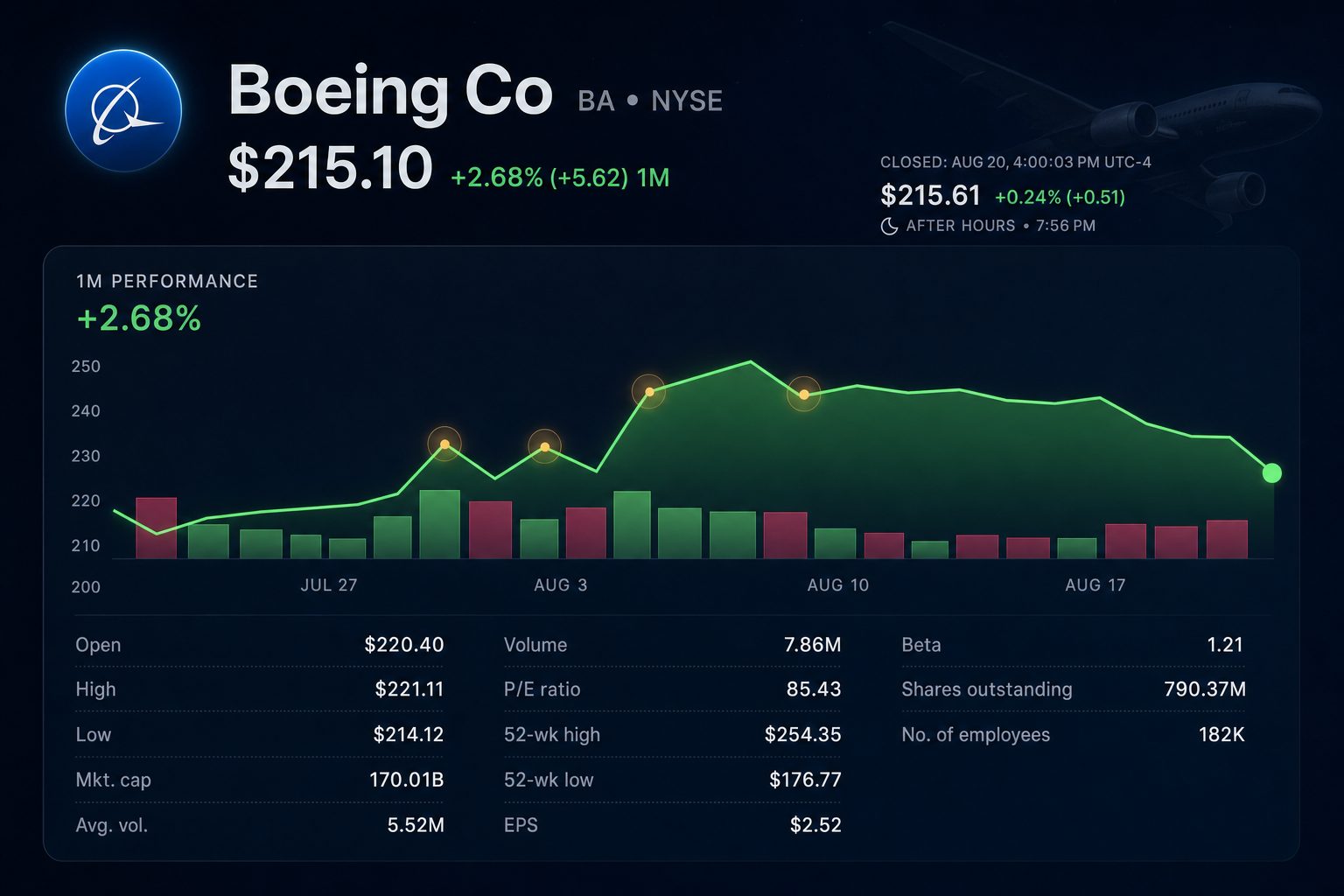
- Boeing ended the session 3.2% lower at $215.10, wiping out roughly $5.6 billion in market capitalization.
- A new Netflix movie has brought whistleblower claims back into focus while regulators continue to monitor the production closely.
- The FAA’s direct inspection bill is minimal. The main investor risk involves confidence in successful execution.
Boeing shares NYSE:BA declined 3.2%, closing at $215.10 on Thursday. The $7.09 slide wiped out roughly $5.6 billion in market value based on 790.37 million shares outstanding. A new documentary has brought renewed scrutiny to Boeing’s safety culture as the company works to restore production levels and cash flow.
The timing is more significant than the film’s specific financial impact. Netflix debuted Freefall: A Reckoning for Boeing on August 19. According to its official synopsis, whistleblowers claim that cost-cutting and concealment played a role in deadly safety lapses. These are still only allegations.
Thursday did not present a straightforward event-driven move. Shares of RTX Corporation NYSE:RTX declined 3.66%, while Lockheed Martin Corporation NYSE:LMT was down 3.00%. The S&P 500 slipped 0.87%. Boeing’s decline reflected both company-focused factors and a broader selloff in the aerospace sector.
| August 20 close | Price | Daily move | Read-through |
|---|---|---|---|
| Boeing NYSE:BA | $215.10 | -3.20% | Trailing S&P 500 by 2.33 points |
| RTX NYSE:RTX | $212.29 | -3.66% | Lagged Boeing |
| Lockheed Martin NYSE:LMT | $571.48 | -3.00% | Sector showed similar weakness |
| S&P 500 | 7,641.16 | -0.87% | Broadly defensive market |
The newest inspection directive highlights that the market response stems from concerns over trust. The Federal Aviation Administration projects an upfront visual inspection expense of $40,035 for each of the 471 737 MAX aircraft registered in the United States. More extensive, including eddy-current assessments, may total as much as $160,140 per cycle.
The maximum cycle estimate falls roughly 35,000-fold below the market-value loss calculated on Thursday. Although the comparison is not exact, as the full extent of repairs and disruption remains unclear, it highlights the concern: investors are factoring in the risk that oversight issues may hamper production or trigger expensive rework.
| 737 MAX inspection item | FAA estimate | Scope or timing |
|---|---|---|
| Aircraft covered | 471 U.S.-registered jets | 737-8, 737-9 and 737-8200 |
| Visual inspection, initial | $40,035 total | $85 for each jet |
| Detailed plus eddy-current inspections | Up to $160,140 per cycle | As much as $340 for each jet |
| Date in effect | September 10, 2026 | No reports of MAX cracks at time of ruling |
Regulatory data points in the opposite direction as well. On July 17, the FAA reported that eight months of monitoring indicated steady production quality. The agency restored Boeing’s ability to issue airworthiness certificates for every 737 MAX and 787 jet, while maintaining ongoing inspections and audits.
The FAA granted certification to the 737 MAX-7 on August 3. According to the agency, enhancements to the aircraft include revised flight-control software, new cockpit alert systems, and an improved engine anti-ice system. FAA inspectors continue their presence at Boeing manufacturing locations.
Boeing posted an 8% rise in second-quarter revenue, reaching $24.56 billion. The company delivered 171 commercial aircraft, up 14%, and free cash flow swung to $631 million from a $200 million negative figure.
| Turnaround measure | Q2 2026 | Q2 2025 | Change |
|---|---|---|---|
| Revenue | $24.56bn | $22.75bn | +8% |
| Commercial deliveries | 171 | 150 | +14% |
| Commercial operating margin | -2.7% | -5.1% | +2.4 points |
| Free cash flow | $631m | -$200m | +$831m |
Chief Executive Kelly Ortberg stated that Boeing’s priority had been on “restoring trust.” Ortberg also noted that there was still more to achieve in the second half. The backlog hit an all-time high of $715 billion, with over 6,200 commercial airplanes included. Boeing
Wall Street remains optimistic about a recovery. In August, out of 28 analysts surveyed, 23 rated the stock as Buy or Strong Buy, while five assigned a Hold. The consensus price target averaged $274.69, suggesting a 27.7% potential increase from Thursday’s closing price, although price targets are not guarantees.
| Analyst recommendation summary | Count | Target | Change from $215.10 |
|---|---|---|---|
| Strong Buy | 18 | — | — |
| Buy | 5 | — | — |
| Hold | 5 | — | — |
| Sell / Strong Sell | 0 | — | — |
| Low / Average / High target | 28 in all | $246 / $274.69 / $305 | +14.4% / +27.7% / +41.8% |
The documentary’s short-term financial effect is closely linked to Thursday’s broader market decline. Its main significance for investors is the fresh spotlight on accusations by ex-workers, among them the late John Barnett, a former quality manager. Boeing maintains it is improving both safety and corporate culture, and its latest performance metrics indicate tangible advancements.
Risks: New defects, findings of retaliation or action by regulators risk postponing production ramp-ups and raising working capital needs. Conversely, ongoing clean FAA audits and increased deliveries would challenge the trust-discount argument.
The next assessment is underway. Investors are looking for sustained growth in deliveries and strong cash conversion as scrutiny intensifies. Should either falter, the minor inspection charge will become irrelevant.
Related articles: NYSE:BA