

MELBOURNE, August 23, 2026, 11:00 AEST – National Australia Bank (NAB) has seen its market capitalisation drop by A$10 billion in the past week as a decline in the mortgage sector prompts a reset of its valuation by investors.
- NAB declined 7.7% over the past week, reducing its market capitalisation by about A$9.95 billion.
- Almost 60% of the week’s drop came from Monday’s 4.6% decline after the update.
- Mortgage applications dropped by 15%, as quarterly cash earnings increased by 2%.
- The average price target from 14 analysts indicates an upside of just around 0.7%.
National Australia Bank Limited ASX:NAB saw its market value decline by approximately A$9.95 billion last week, an amount about 5.4 times greater than its most recent quarterly cash earnings. Shares dropped 7.7% to A$38.17.
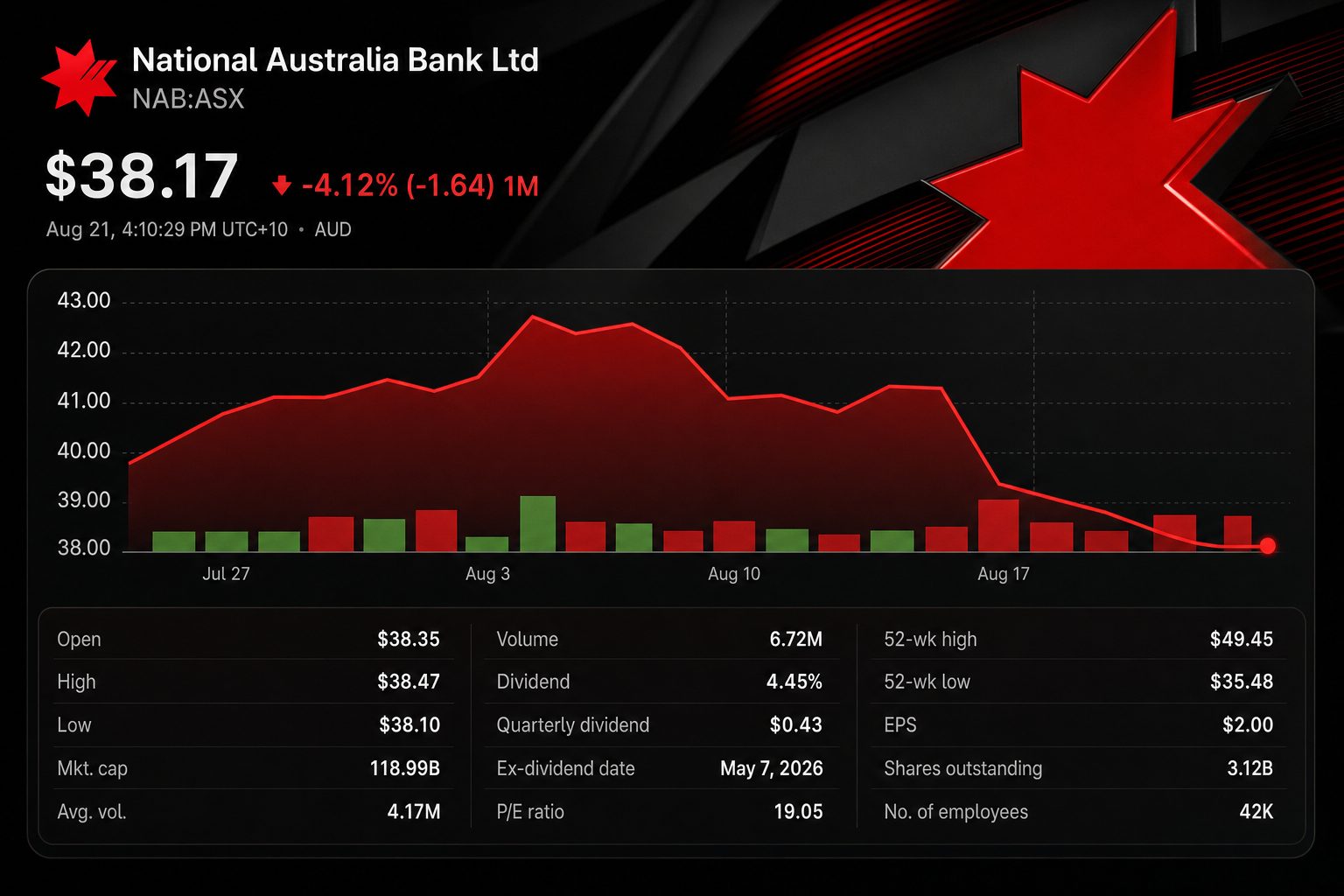
The decline has not resulted in a clear consensus buying opportunity. Fourteen analysts have set an average price target of A$38.45, just 0.7% above Friday’s closing level. Their estimates range from A$29.00 to A$48.50.
The bulk of the losses came on Monday, with NAB falling 4.6% after its third-quarter update. That single session made up nearly 60% of the A$3.20 fall for the week. The stock went on to record four consecutive negative closes.
| Session | Close (A$) | Daily move | Context |
|---|---|---|---|
| Aug. 14 | 41.37 | -0.10% | Closing before update |
| Aug. 17 | 39.46 | -4.62% | Third-quarter statement |
| Aug. 18 | 39.20 | -0.66% | Continued selling |
| Aug. 19 | 38.92 | -0.71% | Market adjusts to target revisions |
| Aug. 20 | 38.43 | -1.26% | Mortgage worries remain |
| Aug. 21 | 38.17 | -0.68% | Friday’s last trade |
The decrease in valuation significantly exceeded the reported profit. NAB reported cash earnings of A$1.83 billion for the June quarter. Based on Friday’s market capitalisation of A$118.66 billion, its implied share count was around 3.11 billion.
| Weekly reset | Estimate | Comparison |
|---|---|---|
| Drop in share price | A$3.20 | -7.74% |
| Market value lost | A$9.95bn | Preliminary |
| Most recent quarterly cash profit | A$1.83bn | +2% |
| Loss in value relative to quarterly profit | 5.4× | TS2 calculation |
| Monday’s contribution to weekly drop | 59.7% | A$1.91 per share |
The update generated profit, but was not straightforward. Cash earnings increased by 2% to A$1.83 billion. Statutory profit climbed 9% year-on-year to A$1.81 billion. Net interest margin edged down two basis points to 1.79%.
| June-quarter measure | Result | Change / signal |
|---|---|---|
| Cash earnings | A$1.83bn | 2% higher |
| Statutory profit | A$1.81bn | 9% up from a year ago |
| Net operating income | A$5.50bn | Rose from A$5.00bn |
| Net interest margin | 1.79% | Decreased by 2 bps |
| Business lending | Up 2% | Compared to previous quarter |
| Forward-looking provisions | Close to A$2bn | Set aside as stress buffer |
Chief Executive Andrew Irvine noted that rising interest rates, conflict in the Middle East and modifications to tax rules were adding to uncertainty. “While the ratio of non-performing loans declined over 3Q26, watch loans were higher,” he stated. NAB statement carried by Capital Brief
Housing demand provided a stronger signal. NAB reported a 15% decline in home-loan applications from the previous quarter. Investor applications decreased by 17%. This reduction was similar to that of Commonwealth Bank of Australia ASX:CBA, though less pronounced than the drop at Westpac Banking Corporation ASX:WBC.
| Bank | Change in recent mortgage applications | Quarterly earnings update |
|---|---|---|
| NAB | -15% | Cash earnings up 2% |
| CBA | -15% | FY cash profit up 7.1% |
| Westpac | -20% | Weakest demand for mortgages |
| ANZ Group Holdings Limited ASX:ANZ | -12% | Cash profit up 1% |
Business banking acts as a balance. Group business lending increased by 2% during the quarter. The business and personal banking segment expanded by 4%. NAB continues to be Australia’s top business lender, resulting in greater exposure to stable commercial credit.
NAB is trading at 19.9 times trailing earnings, giving it the second-highest earnings multiple among the big four. This figure sits below CBA’s 24.3 times but stands higher than ANZ’s 19.0 times and Westpac’s 16.7 times.
| Bank | Friday price | Trailing P/E | Dividend yield | Analyst signal |
|---|---|---|---|---|
| CBA | A$157.99 | 24.34 | 3.13% | Strong Sell |
| NAB | A$38.17 | 19.88 | 4.45% | Neutral |
| ANZ | A$37.13 | 18.97 | 4.47% | Neutral |
| Westpac | A$33.83 | 16.67 | 4.55% | Sell |
Analysts remain divided. Three suggest buying NAB, six recommend holding, and five advise selling. Citi increased its price target to A$40 on Wednesday. UBS kept its buy rating but lowered its target to A$48.50.
| Recommendation | Analysts | Share |
|---|---|---|
| Buy | 3 | 21% |
| Hold | 6 | 43% |
| Sell | 5 | 36% |
| Average target | A$38.45 | +0.73% |
| High target | A$48.50 | +27.06% |
| Low target | A$29.00 | -24.02% |
Macroeconomic conditions provide scant respite. Australian consumer confidence climbed 6% in August as the Reserve Bank kept its cash rate steady at 4.35%. Despite the increase, the index stayed about 10% lower than a year ago. Optimism among mortgage holders rebounded more quickly.
The initial support for Monday is at A$38.06, marking Thursday’s intraday low. Falling below this level could open the way to the 52-week low of A$35.48. The closest resistance is at A$39.46, which was Monday’s closing price after the update.
| Next checkpoint | Level / date | Investor meaning |
|---|---|---|
| ASX opens again | Aug. 24, around 10:00 AEST | Indicates if selling pressure has eased |
| Approaching support | A$38.06 | Lowest point reached on Thursday |
| Friday’s finish | A$38.17 | Recent support level |
| Initial rebound mark | A$39.46 | Monday’s closing price following update |
| Year’s lowest point | A$35.48 | Key downside marker |
| Annual results | Nov. 5 | Data on margins, expenses and credit trends |
Risks: Demand for mortgages could stay subdued due to high interest rates and tax adjustments. Loans on watch lists risk turning into losses. If sentiment weakens, business lending might lose momentum. NAB continues to trade at a premium to two leading rivals.
The decline last week was driven by more than a single disappointing earnings response. Analysts continue to forecast minimal average upside. NAB faces the challenge of demonstrating that growth in business lending can counterbalance softer housing, while maintaining both margin and credit standards.
Related articles: ASX:NAB







![Asia Stock Market Today 23/08/2026 [UPDATE: 08:08 SGT] [Yield Shock Splits Asia: Weekly Recap and Week Ahead]](https://ts2.tech/wp-content/uploads/2026/08/Asia-market-dashboard-2026-08-23-0808-480x384.jpg "Asia Stock Market Today 23/08/2026 [UPDATE: 08:08 SGT] [Yield Shock Splits Asia: Weekly Recap and Week Ahead]")