
AMSTERDAM, August 24, 2026, 13:00 CEST — Trading was brisk across Europe with U.S. premarket activity also unfolding.
- Stellantis stock declined roughly 3% in Paris as trade negotiations between the U.S. and Canada broke down.
- The drop wiped out about 60% of last week’s net increase in Paris.
- Revenue climbed 32% in North America, but tariffs could lead to costs of €1.0–€1.2 billion this year.
- Although analysts project a 29% upside, four out of ten have now assigned a sell rating to the ADR.
Shares of Stellantis N.V. NYSE:STLA slipped roughly 3% in Paris on Monday after U.S.–Canada trade negotiations broke down, renewing concerns over potential North American cost risks to its recovery.
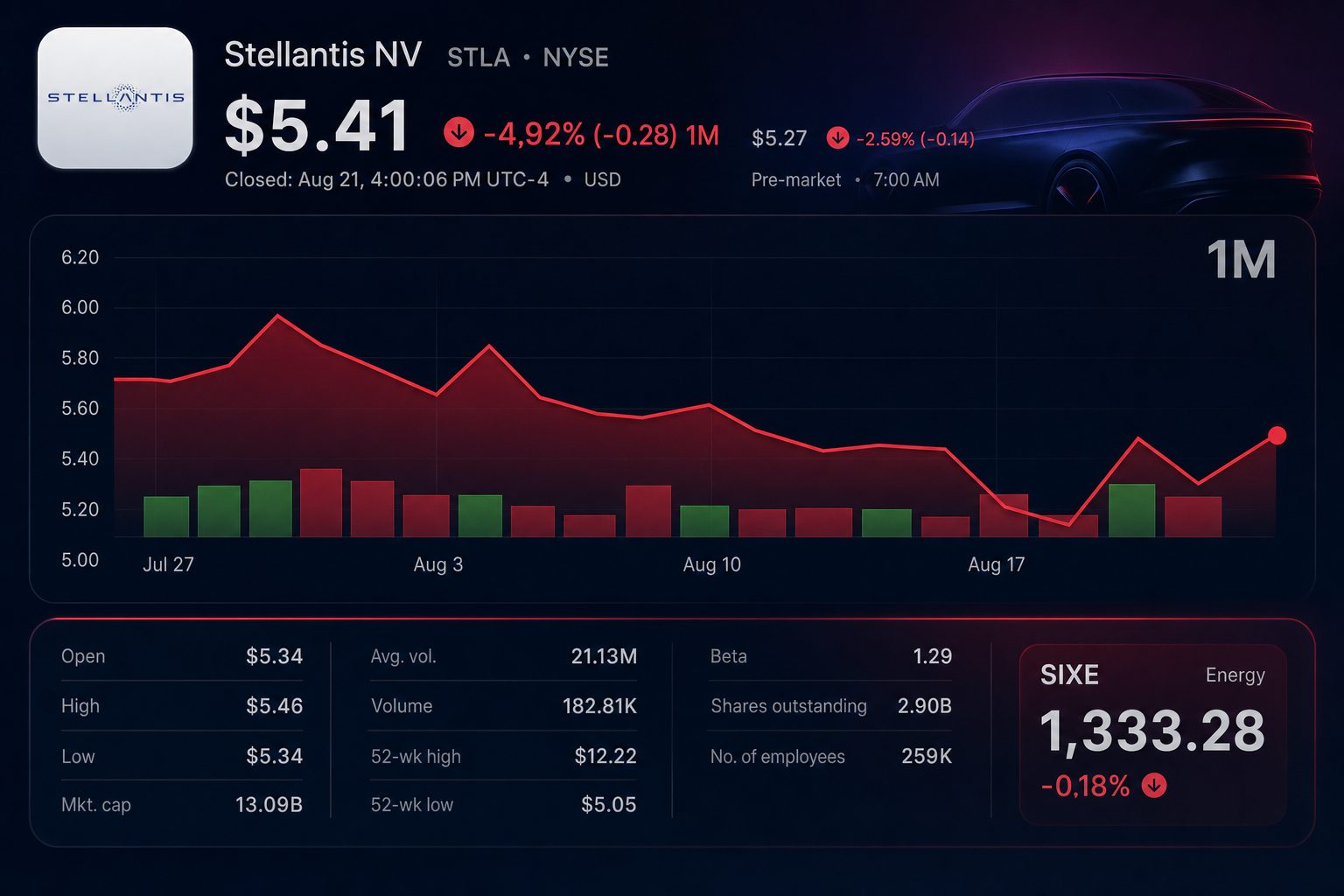
The decision is significant as tariff relief had factored into the rebound narrative. Paris stocks jumped 5.84% on Wednesday and added 4.21% on Friday. Monday’s decline wiped out roughly 62% of the cumulative increase seen from August 17 to August 21.
The shift reveals a disconnect. Last quarter, Stellantis saw its fastest growth in North America. However, this is also the region where the company faces the greatest impact from fluctuating border costs.
| Date | Trade or market event | Investor signal |
|---|---|---|
| Aug. 19 | U.S. 50% tariffs had been set to take effect; a three-day delay was announced by Washington | Deal hopes pushed Stellantis Paris shares up 5.84% |
| Aug. 21 | Stellantis closed at €4.649 on the Paris exchange | Shares rose 4.21% on the day |
| Aug. 22 | Negotiations failed; Ottawa readied reciprocal actions | Tariff relief prospects declined |
| Aug. 24 | Stellantis shares dropped by approximately 3% in Paris | About 62% of the prior week’s total gain was lost |
| Sept. 8 | Canadian countermeasures are set to start | Upcoming policy milestone |
The United States is imposing extra tariffs on selected Canadian goods, such as motor vehicles. These duties are set at 50%, in addition to other relevant charges.
Stellantis’ outlook already reflects that strain. The group forecasts a net tariff burden of €1.0 billion to €1.2 billion in 2026. Net tariff expenses reached €0.3 billion in the first half, following a €0.4 billion rebate.
| Q2 2026 measure | Result | Year-on-year or context |
|---|---|---|
| Net revenue | €43.5 billion | Increase of 13% |
| North America revenue | Not separately disclosed | Climbed 32% |
| Net profit | €0.3 billion | Returned to positive |
| Adjusted operating income | €0.8 billion | 1.8% margin, gained 120 basis points |
| Industrial free cash flow | €1.0 billion | Improved by €1.0 billion |
| 2026 tariff headwind | €1.0–€1.2 billion | Roughly 1.25–1.5 times Q2 adjusted operating income |
Chief Executive Antonio Filosa described the quarter as showing “continued progress, led by North America.” Revenue in the region increased by 32%, with sales up 6%. U.S. market share hit 7.4%.
The recent gains leave scant margin for a further border shock. A tariff impact of €1.2 billion would amount to 1.5 times adjusted operating profit in the second quarter. While such a hit would not be distributed evenly, the ratio highlights the vulnerability of earnings.
Canada is similarly an asset issue. Unifor says Stellantis has explored a sale of its idled Brampton facility. The plant’s intended Jeep Compass production shifted to Illinois after tariffs affected its restart.
Windsor serves as the counterbalance. In February, Stellantis introduced a third shift at this facility, raising total plant employment to almost 6,000 workers. The plant produces Dodge Charger vehicles as well as Chrysler minivans.
| Canadian operation | Current position | Investor relevance |
|---|---|---|
| Windsor Assembly | Three shifts; close to 6,000 employed | Central Charger and minivan production |
| Brampton Assembly | Idle; possible sale being considered | Jeep Compass production shifted to Illinois |
| Etobicoke Casting | Active Canadian component facility | Exposure to cross-border supply risks |
| Canada workforce | Roughly 10,000 employees | Significant impact on labor and regulation |
Wall Street remains careful. The NYSE ADR finished Friday at $5.41. The consensus price target among ten analysts stands at $6.98, suggesting a 29% increase is possible. Projections, however, vary from $4.00 to $11.06.
| August recommendation | Analysts | Share of total |
|---|---|---|
| Strong buy | 2 | 20% |
| Buy | 1 | 10% |
| Hold | 3 | 30% |
| Sell | 4 | 40% |
| Strong sell | 0 | 0% |
The division is notable. A low share price means that gains can be recognised swiftly. However, the projected tariff is significant relative to present earnings, and four analysts currently advise selling.
Another test arrives ahead of earnings. Investors are monitoring if either government reduces tariff lists before Canada’s September 8 reply. Easing measures would bring back some previously lost optionality.
Risks: A swift trade agreement might undo Monday’s drop. An expanded tariff dispute, additional factory stoppages, or softer U.S. demand could increase downward pressure.
Related articles: NYSE:STLA