
SYDNEY, August 24, 2026, 20:04 AEST —
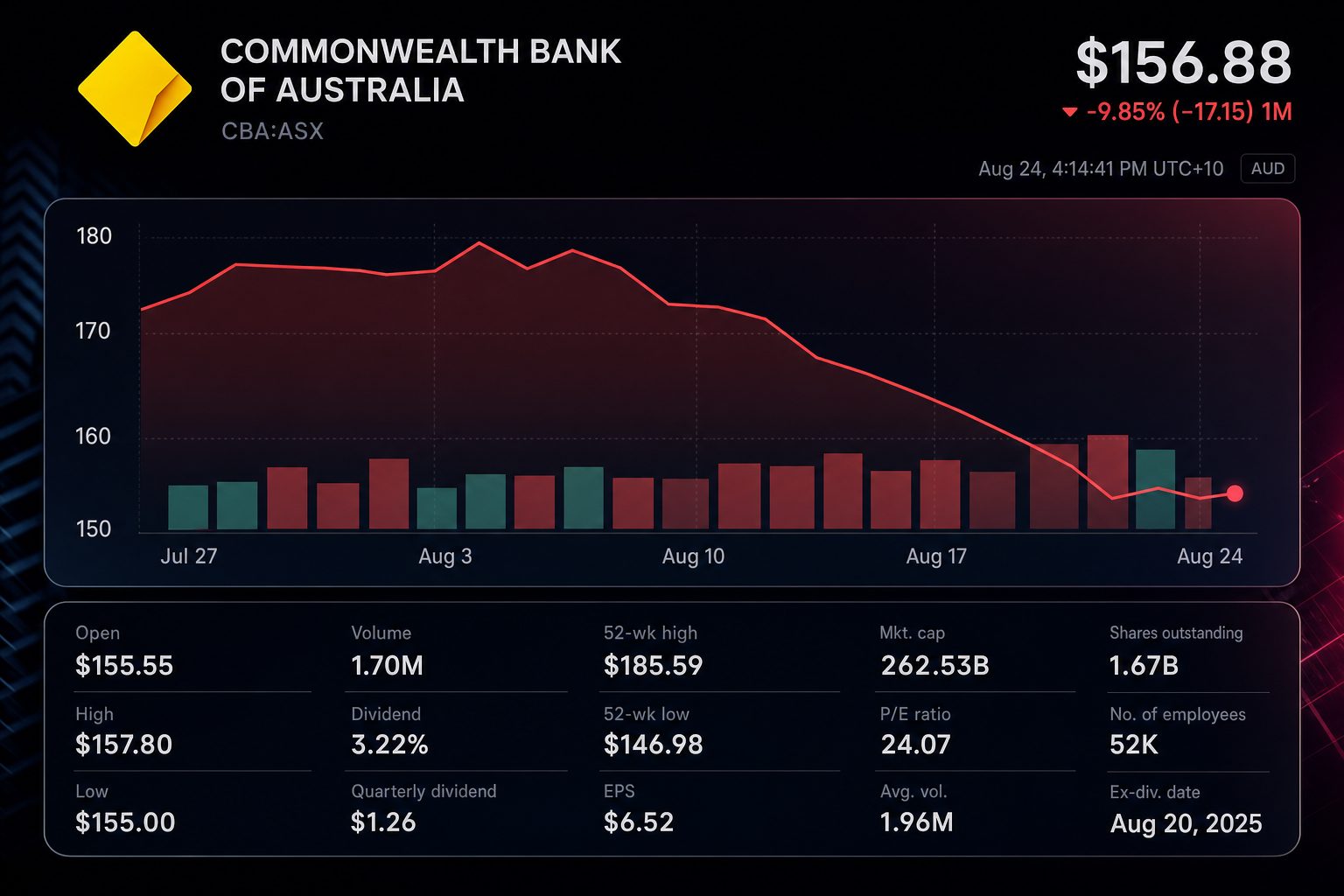
- Commonwealth Bank ended down 0.7% at A$156.88, with shares of all four leading Australian banks declining.
- The Reserve Bank of Australia expects its credit card reforms implemented in October to reduce issuer interchange revenue by A$660 million each year.
- CBA is expanding its loyalty program from card spending alone to a whole-of-bank model, covering nine million customers.
- The stock trades 9.8% lower than its August 11 close, with analysts projecting a further 20.2% fall to reach their average price target.
Commonwealth Bank of Australia ASX:CBA finished down 0.7% at A$156.88 on Monday, with major Australian banks under pressure and investors assessing a card-fee overhaul that is already impacting rewards schemes. The S&P/ASX 200 gained 0.49% to reach 9,103.10, putting the bank’s decline in contrast with the wider market.
Interchange, the charge a merchant’s bank incurs to pay the card issuer, is at the center of attention. The Reserve Bank of Australia will lower the consumer-credit cap to 0.3% from 0.8%, effective October 1. This updated maximum is 36% less than the existing 0.47% average rate.
| Card economics | Current setting | From Oct. 1 | Change |
|---|---|---|---|
| Consumer credit cap | 0.80% | 0.30% | -62.5% |
| Average consumer credit interchange | 0.47% | 0.30% maximum | At least -36.2% |
| Debit cap, fixed fee | A$0.10 | A$0.08 | -20.0% |
| Estimated issuer revenue effect | — | -A$660m a year | Applies to entire sector |
The A$660 million estimate covers all local issuers. Assigning the entire sum to CBA, which is not feasible, would represent 2.2% of FY26 operating income and 6.0% of cash profit. However, CBA’s true exposure is expected to be significantly lower. The figures highlight that retention rates and pricing ability are more critical than potential earnings drops.
CBA is set to incentivise customers who utilise a full suite of its banking products. Over nine million customers will be able to collect Yello points on products ranging from home loans and deposits to insurance and credit cards. “At a time when every dollar counts, that’s value we’re putting back in our customers’ pockets,” retail banking chief Angus Sullivan said. The initiative launches October 1. CommBank Yello announcement
| Issuer | Visible response before October | Investor read-through |
|---|---|---|
| Commonwealth Bank ASX:CBA | Yello widens offering past cards; card fee and rewards adjusted | Monitors product stickiness |
| Westpac ASX:WBC | Selected rewards cards see fee and rate hikes | Moves faster to reprice |
| National Australia Bank ASX:NAB | Alters certain earning and purchase rates | Maintains card profitability |
| ANZ Group ASX:ANZ | Reduced incentives for sign-ups | Brings down customer acquisition expense |
The four strategies highlight the same balance. Banks may offset lost interchange by increasing fees, raising interest charges, or reducing rewards. Every option could prompt customers to switch providers. CBA, however, is linking perks to broader product usage, which could make it more expensive for clients to exit.
CBA heads into the reset supported by solid earnings. Cash profit increased by 7.1% to A$10.98 billion in FY26. Return on equity was 14.0%, while the net interest margin narrowed by three basis points. The dividend rose by 4.1% to A$5.05 per share.
| CBA metric | FY25 | FY26 | Change |
|---|---|---|---|
| Cash profit | A$10.25bn | A$10.98bn | +7.1% |
| Operating income | A$28.47bn | A$30.22bn | +6.2% |
| Net interest margin | 2.08% | 2.05% | -3 bp |
| Return on equity | 13.5% | 14.0% | +50 bp |
| Dividend per share | A$4.85 | A$5.05 | +4.1% |
The shares continue to face downward pressure after the announcement. At Monday’s close, the stock was trading 9.8% lower than its pre-results closing level on August 11, and 12.8% down from the close on August 6. The decline has lessened but has not closed the gap between CBA’s valuation and broker targets.
| Date | CBA close | Change to Aug. 24 | Context |
|---|---|---|---|
| Aug. 6 | A$179.87 | -12.8% | Month-to-date high close |
| Aug. 11 | A$173.92 | -9.8% | Last closing price before results |
| Aug. 21 | A$157.99 | -0.7% | Day prior close |
| Aug. 24 | A$156.88 | — | Closed at 4:14 p.m. AEST |
Broker views continue to show consistent caution. Of those followed by S&P Global, 14 analysts assign a Sell or Strong Sell rating to CBA. Their average price target, A$125.21, indicates a potential decline of 20.2% from Monday’s closing level. The top price target among analysts remains under the current market value.
| Analyst / firm | Recommendation | Target | Date |
|---|---|---|---|
| Andrew Lyons / Jefferies | Sell | A$144.99 | Aug. 13 |
| Richard Wiles / Morgan Stanley | Sell | A$124.00 | Aug. 13 |
| John Storey / UBS | Sell | A$135.00 | Aug. 12 |
| Matthew Wilson / Jarden | Sell | A$90.00 | Aug. 12 |
| S&P Global consensus | Strong Sell | A$125.21 | as of Aug. 13 |
Risks: CBA may hold onto a larger share of customers than projected should Yello demonstrate value across offerings. On the other hand, increased card expenses may prompt customer departures as mortgage expansion decelerates. Shifts in customer balances, fee revenues and October-quarter merchant metrics would be the earliest indicators in either scenario.
The next major challenge comes on October 1, as new caps and ban on surcharges come into effect. By October 30, card schemes and leading acquirers are required to release their initial quarterly fee figures. These reports are expected to show the share of the reset that benefits merchants compared to the portion issuers recoup through other means.
Related articles: ASX:CBA