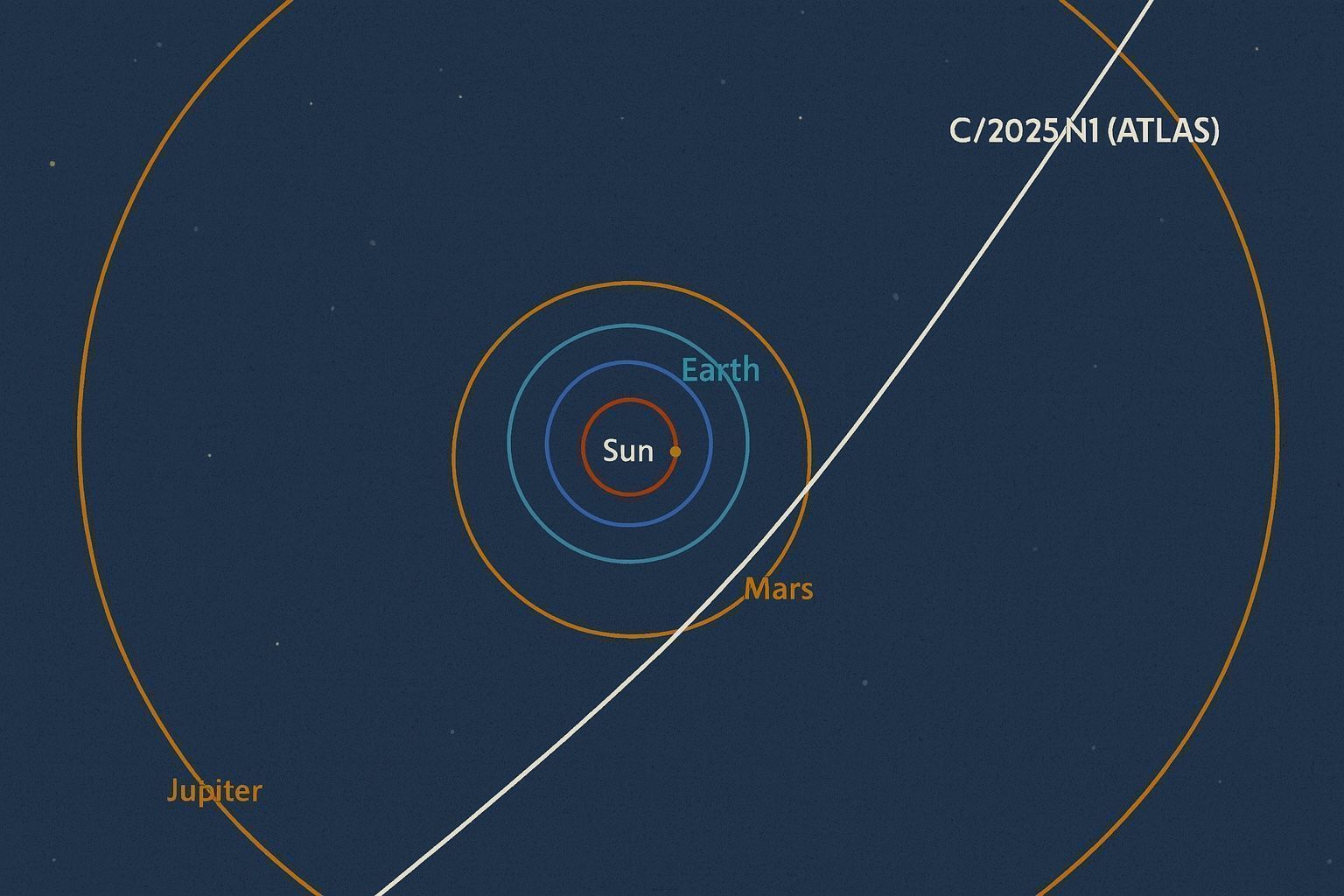

- 3I/ATLAS (C/2025 N1) is the third identified interstellar object, discovered on 1 July 2025 by the ATLAS telescope in Chile.
- It is on an extremely hyperbolic trajectory with a velocity of about 68 km/s and will reach perihelion on 29 October 2025 at 1.36 au, inside Mars’s orbit.
- It poses no threat to Earth.
- Early images show a faint coma and a short 3-arcsecond tail, confirming cometary activity.
- Detected at 4.5 au from the Sun months before perihelion, it offers an unprecedented window to study its composition, rotation, and size.
- The hyperbolic excess velocity v∞ is 57 km/s, making 3I/ATLAS the fastest interstellar object observed to date.
- Official designations are C/2025 N1 (ATLAS) and 3I/ATLAS, assigned in MPC MPEC 2025-N12.
- The inbound path comes from near the direction of Sagittarius toward the solar apex, consistent with models for inbound interstellar objects.
- A global observing campaign for 2025–2026 will use JWST, VLT, Keck, and Rubin Observatory to measure primitive volatiles and dust, with inbound observations at 4.5→1.8 au (Jul–Sep 2025) and solar conjunction Oct–Nov 2025, and outbound observations 1.4→5 au (Dec 2025–Mar 2026).
- Population statistics suggest the Milky Way may harbor about 10^6 interstellar objects per cubic astronomical unit, with Rubin Observatory expected to discover several per year.
The newly confirmed comet 3I/ATLAS (C/2025 N1) is the third identified interstellar object after 1I/ʻOumuamua (2017) and 2I/Borisov (2019). Discovered on 1 July 2025 by the NASA‑funded ATLAS telescope in Chile, it is racing through the solar system on an extremely hyperbolic path at ∼68 km s⁻¹, will reach perihelion just inside Mars’s orbit on 29 October 2025, and poses no threat to Earth. Early images reveal a faint coma and short tail, confirming cometary activity. Because 3I/ATLAS was detected far from the Sun (4.5 au) and months before perihelion, astronomers have an unprecedented window to characterise an interstellar comet’s composition, rotation, and size. Experts say the find heralds a coming flood of interstellar detections as next‑generation surveys like the Vera C. Rubin Observatory come fully online.
1. Discovery, designation and first look
- Detection. ATLAS–CHL telescope images from 1 July 2025 revealed a magnitude‑18 object moving against the dense Milky Way star field. Automatic orbit fitting showed an eccentricity > 5, flagging an interstellar trajectory science.nasa.govhawaii.edu.
- Rapid confirmation. Archival data from ZTF and other ATLAS sites traced the object back to 14 June 2025, extending the observational arc to 18 days science.nasa.gov.
- Official names. The Minor Planet Center issued MPEC 2025‑N12, assigning the designations C/2025 N1 (ATLAS) and 3I/ATLAS once cometary activity and interstellar origin were judged secure minorplanetcenter.net.
- First images. Gianluca Masi’s Virtual Telescope Project and David Rankin’s Deep Random Survey released stacked CCD frames showing a stellar‑like nucleus with a very short 3″ tail livescience.comspace.com.
“Spotting a possible interstellar object is incredibly rare, and it’s exciting that our UH‑operated system caught it.” — John Tonry, University of Hawaiʻi Institute for Astronomy hawaii.edu
2. Orbit, speed and interstellar proof
| Parameter | Value (±1 σ) | Implication |
|---|---|---|
| Eccentricity (e) | 5.8 ± 0.2 | Unbound hyperbola |
| Inclination (i) | 175 ° | Retrograde, almost polar |
| Hyperbolic excess velocity (v∞) | 57 km s⁻¹ | Fastest ISO so far |
| Perihelion distance (q) | 1.36 au | Inside Mars’s orbit |
| Perihelion date | 29 Oct 2025 | Excellent observing geometry |
The extremely high e and v∞ cannot be produced by planetary scattering inside the solar system, proving an origin beyond the Sun’s gravitational sphere en.wikipedia.orgen.wikipedia.org. ATLAS is arriving from the direction of Sagittarius near the solar apex, consistent with dynamical models predicting where most inbound interstellar objects (ISOs) should appear arxiv.org.
“Its orbit says it’s going too fast to be gravitationally bound to the Sun, so therefore it’s probably an interstellar object.” — Larry Denneau, ATLAS co‑PI washingtonpost.com
3. Physical characteristics
- Activity. A marginal coma and 3″ tail were reported by the MPC, confirming cometary outgassing rather than a bare asteroid space.comtheguardian.com.
- Size. Initial absolute‑magnitude estimates (H ≈ 14.8) would correspond to a 20 km asteroid, but once coma contribution is removed, the nucleus may be only a few hundred metres to ~1 km across theguardian.comabc.net.au.
- Brightness evolution. Models predict peak visual magnitude 12–13 near perihelion—too faint for naked‑eye viewing but within reach of moderate amateur telescopes, especially from Mars orbit where it passes at 0.4 au livescience.comspace.com.
- Composition prospects. Because the comet is inbound, JWST, ALMA, and large ground‑based telescopes can attempt near‑infrared spectroscopy of ices while they are still pristine, before solar heating modifies the surface.
“Based on the brightness … it is likely that the solid nucleus is smaller.” — Prof. Colin Snodgrass, University of Edinburgh theguardian.com
4. Comparison with ʻOumuamua and Borisov
| Property | 1I/ʻOumuamua | 2I/Borisov | 3I/ATLAS |
|---|---|---|---|
| Discovery distance | 0.25 au (post‑peri.) | 3 au | 4.5 au |
| Nature | Asteroidal? | Comet | Comet |
| v∞ (km s⁻¹) | 26 | 32 | 57 |
| Peak mag. | 20→28 | 15 | 12–13 (pred.) |
| Lead time before peri. | –40 days | 225 days | 120 days |
ATLAS is both the fastest and the earliest‑detected ISO, offering scientists months longer to plan deep observations than they had for either predecessor thetimes.co.ukuniversetoday.com.
“Of the three interstellar objects we have seen, this is by far the fastest.” — Prof. Jonti Horner, University of Southern Queensland abc.net.au
5. Global observing campaign
| Phase | Dates (2025‑26) | Best Facilities | Goals |
|---|---|---|---|
| Inbound (4.5 → 1.8 au) | Jul – Sep 2025 | JWST, VLT, Keck, Rubin (LSST) | Measure primitive volatiles and dust production |
| Solar conjunction | Oct – Nov 2025 | Solar observatories, Mars orbiters | Thermal response, coma evolution near perihelion |
| Outbound (1.4 → 5 au) | Dec 2025 – Mar 2026 | HST, ALMA, large amateur network | Spin state, nucleus size via fading curve |
| Long tail | 2026‑27 | Radio arrays | Search for refractory molecules, isotopes |
Live webcasts are already under way; the Virtual Telescope Project streams nightly tracking from Italy livescience.comspace.com. Mars Reconnaissance Orbiter may attempt imaging during the 3 Oct 2025 0.2 au encounter washingtonpost.com. NASA’s CNEOS has circulated ephemerides to professional and amateur observatories worldwide.
“We have a lot more time to throw telescopes at it to find out what it’s made of.” — Larry Denneau washingtonpost.com
6. Why 3I/ATLAS matters
- Galactic sampling. Each ISO is a “free sample return mission” from another planetary system. Spectroscopy can reveal isotope ratios, volatile chemistry and dust mineralogy impossible to measure in situ otherwise iowapublicradio.org.
- Population statistics. Three detections in eight years suggest that the Milky Way may teem with ∼10⁶ ISO au⁻³; Rubin is expected to discover several per year abc.net.auiowapublicradio.org.
- Planetary‑defence context. Knowing ISO flux helps refine impact‑hazard assessments; although objects this fast are vanishingly unlikely to hit Earth, their extreme kinetic energy would dwarf typical asteroid threats hawaii.edu.
- Mission planning. 3I/ATLAS’s early discovery rekindles interest in a stand‑by “interstellar interceptor” spacecraft capable of rapid response, concepts previously studied by ESA, NASA and the UK Space Agency iowapublicradio.org.
“This is like our chance to randomly sample what’s going on in the rest of the galaxy.” — Prof. Chris Lintott, University of Oxford iowapublicradio.org
7. Outlook
If current brightness predictions hold, 3I/ATLAS will be an easy CCD target for backyard observatories throughout July and August, fade behind the Sun in October, and re‑emerge in December about magnitude 15 on its outbound leg. Amateur contributions—especially time‑series photometry for rotation studies—will complement flagship‑class telescopes hunting for rare volatiles.
Dr Mark Norris sums up the excitement:
“It will be the third known interstellar object we have discovered, providing more evidence that such interstellar wanderers are relatively common in our galaxy.” theguardian.com
On present course, 3I/ATLAS will exit the solar system forever in mid‑2027, but the scientific legacy of this serendipitous visitor is likely to endure—both in the data it yields and in the motivation it gives astronomers to prepare for the next, inevitably sooner, interstellar encounter.