
Fremont, California, May 9, 2026, 09:03 PDT
Aehr Test Systems finished at $97.23, gaining 6.5% from the prior close. Earlier, the stock reached $103.72 during U.S. trading as buyers piled into the semiconductor test-equipment name on its ongoing AI order momentum. Roughly 3.84 million shares changed hands. Market cap hovered just under $3 billion.
This isn’t just another routine order for Aehr. On April 16, the company announced a record $41 million follow-on production order from its top hyperscale AI client. That’s for package-level burn-in on custom AI processor ASICs—specialized chips made for dedicated tasks—with shipments slated to start in fiscal 2027. CEO Gayn Erickson said this order pushed second-half bookings past $92 million, surpassing the earlier $60 million to $80 million target.
For Aehr, it’s all about bookings right now—not immediate sales. Fiscal Q3 bookings totaled $37.2 million, with the book-to-bill coming in above 3.5x; so, orders outpaced revenue by more than three and a half times in the quarter. Management kept its outlook for fiscal 2026, expecting revenue to come in at the high end of the $45 million to $50 million target.
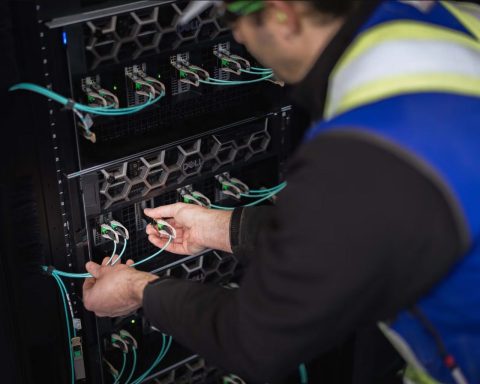
Burn-in, a type of stress test, pushes chips to their limits to catch any weak ones before they’re deployed. Aehr supplies equipment for both wafer and package-level burn-in. Right now, investor attention is fixed on the company’s exposure to AI accelerators, silicon photonics, and data-center interconnects—areas where even small failure rates or extra power consumption can get expensive.
Erickson touted the order as evidence that Aehr’s Sonoma platform is up to the task of high-volume production burn-in for very-high-power AI processor ASICs. He added that the customer is working on a next-generation, higher-power AI accelerator, which should hit production later this year. That prospect has caught investors’ attention, with many seeing it as a potential trigger for additional deals.
Wall Street’s taken note of the move. After a recent silicon photonics order, Jed Dorsheimer and his team at William Blair called it “another strong signal” for Aehr’s standing in the AI end-market, adding they expect the pace of AI-linked order wins to pick up. Barron’s
Bigger players like Teradyne and Advantest dominate the wide-open field of semiconductor test gear, pushing out automated systems that vet chips for quality and performance. Aehr takes a tighter angle. The company isn’t pitching itself as a play on the whole chip testing sector—instead, it’s a focused wager on the demand for greater burn-in capacity as power consumption jumps in AI processors, optical connections, and power devices.
But there’s a downside. Aehr’s revenue for the fiscal third quarter tumbled 44% to $10.3 million, down from $18.3 million a year ago. The company swung to a GAAP net loss—$3.2 million, or 10 cents per share. In its filing, Aehr blamed the decline mostly on reduced shipments of wafer-level burn-in systems and contactors.
Margins took a hit this quarter, dropping to 32.7% from 39.2%. The company blamed the decline on a heavier mix of lower-margin package-level burn-in products, plus increased assembly and warranty costs, freight charges, and tariffs.
Customer concentration is tight—there’s not much margin for error. According to a filing, Customer A represented 42.1% of the company’s revenue for the quarter and 36.8% of gross accounts receivable as of Feb. 27. Customer B brought in another 10.5% of revenue. Should a key AI client slow its ramp, the current order-book narrative around the stock could flip fast.
Aehr’s balance sheet picked up some muscle as shares moved higher. The company tapped its at-the-market stock-sale program in April, pulling in roughly $60 million in gross proceeds, according to an SEC filing. The cash came in under a Form S-3 registration and prospectus supplement dated April 8.
AEHR stock’s price action suggests investors are focused less on recent earnings and more on what might come next for revenue. Right now, those orders are carrying the weight, not profits.