
Amazon’s stock is ending the first week of December 2025 in a strange place: fundamentals are surging, AI and cloud announcements are flying, logistics strategy is being rewritten in real time – and yet the share price has mostly moved sideways this year.
Here’s a detailed look at where AMZN stands today, what just changed around AWS and U.S. delivery, and how Wall Street and various models see the stock into 2026–2030.
Amazon stock today: price, valuation and recent performance
As of the latest trade on December 6, 2025, Amazon.com Inc. NASDAQ:AMZN is trading around $229.53 per share, with an intraday range of roughly $228.6–$231.2 and a market capitalization of about $2.45 trillion.
Over the last 12 months, AMZN has been much less explosive than some of its mega‑cap peers:
- Up roughly 4–7% in 2025 (estimates vary slightly by data provider), versus ~16–18% gains for the S&P 500, making it one of the weaker performers among the “Magnificent Seven.”FinancialContent+1
- 52‑week low: $161.38 (April 2025)
- 52‑week high: about $254–259 (early November 2025).
Key valuation and balance‑sheet metrics today:
- Trailing P/E: ~32x earnings
- PEG ratio: ~1.6 (price vs. expected growth)
- Debt‑to‑equity: about 0.14 – low for a giant with massive capex
- Liquidity: current ratio ~1.0, quick ratio ~0.8.
Longer‑term performance paints a very different picture from the “meh” 2025:
- 5‑year return (Dec 2020–Dec 2025): ~45%, about 7.7% compound annual growth
- 10‑year return (Dec 2015–Dec 2025): ~579%, around 21% per year.
In other words: in 2025, AMZN looks like a consolidating mega‑cap – not a broken story, but a giant digesting years of gains while fundamentals quietly accelerate again.
Q3 2025 earnings: AWS and AI pull the train
Amazon’s Q3 2025 results, released on October 30, are the financial anchor for everything investors are watching now.
Highlights:
- Net sales: $180.2 billion
- Up 13% year over year (12% excluding FX) from $158.9 billion
- North America: $106.3B (+11%)
- International: $40.9B (+14%)
- AWS: about $33.0B, +20% YoY – its fastest growth since 2022.
- Operating income: $17.4B – flat vs. Q3 2024, but that includes:
- ~$2.5B FTC legal settlement
- ~$1.8B severance costs
- Excluding those, operating income would have been $21.7B.
- Net income: $21.2B, up from $15.3B a year earlier, helped by a $9.5B pre‑tax gain on Amazon’s investment in Anthropic.
- EPS: $1.95 vs. $1.43 last year, beating analyst expectations (~$1.56–1.58) by around 25%.
Cash‑flow and capex:
- Operating cash flow (TTM): up 16% to $130.7B.
- Free cash flow (TTM): down to $14.8B, mainly because Amazon ramped purchases of property and equipment by about $50.9B year‑on‑year.
- Management now expects ~$125B of capital expenditures in 2025, and has already flagged even higher capex in 2026, largely for AI and cloud infrastructure.
Q4 2025 guidance:
- Net sales forecast: $206B–$213B, bracketing Street expectations (~$208B).
In short, the AI‑driven capex spree is compressing free cash flow in the short term, but AWS and advertising are growing rapidly and driving margins higher beneath the temporary noise from legal and restructuring charges.
AWS, Graviton5, Trainium and the AI pivot
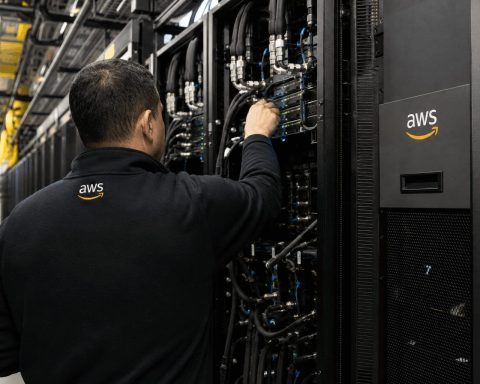
The other big story for AMZN this week is AWS re:Invent 2025 in Las Vegas, where Amazon rolled out a flurry of new chips, models and cloud features that directly feed into the long‑term investment case.
Graviton5: custom CPU muscle
AWS formally introduced Graviton5, its latest in‑house ARM server CPU, and previewed new EC2 M9g instances based on the chip:About Amazon+2TechRadar+2
- Up to 192 CPU cores per chip
- Up to 25% higher compute performance vs Graviton4
- 5x larger L3 cache and improved memory bandwidth
- Designed on 3nm process technology
- Up to 30–35% faster than prior generation for databases, web apps and ML workloads
Graviton now powers more than half of all new AWS CPU capacity, and Amazon says 98% of its top 1,000 EC2 customers use Graviton‑based instances somewhere in their fleets.
Independent coverage notes that Graviton5’s architecture leans heavily into memory bandwidth and energy efficiency, and is built around Arm’s Neoverse V3 core design – reflecting Amazon’s push to squeeze more performance per watt out of its cloud.
Trainium3, Trainium4 and the Nvidia tie‑up
On the AI acceleration side, AWS also launched Trainium3, a new AI training chip that Amazon says is roughly 4x faster than its predecessor and uses about 40% less power in new servers with 144 chips each.
At the same time, Amazon announced:
- A future Trainium4 that will incorporate Nvidia’s NVLink Fusion technology for high‑bandwidth GPU/accelerator connectivity
- Expanded use of Nvidia technology alongside its own silicon, trying to give customers flexibility rather than forcing a single‑vendor choice.
Nova models and Nova Forge: AI services on top
AWS also pushed deeper into AI services:
- Nova 2 model family, including a multimodal model (text, images, video, speech) and a speech‑focused version
- Nova Forge, a platform that lets enterprises customize advanced models using their own data across training and fine‑tuning stages.
This ties directly into Amazon’s earlier launch of Nova and Bedrock services and into the Q3 earnings narrative, where CEO Andy Jassy highlighted that AI is “driving meaningful improvements in every corner” of Amazon’s business, from AWS to logistics and retail.Amazon+1
Multicloud: AWS Interconnect with Google
In a move that would have sounded science‑fictional a few years ago, Amazon also announced AWS Interconnect, a multicloud connectivity service that allows customers to link AWS with other clouds at high speed and low latency – with Google Cloud as the first partner and Microsoft expected to follow in 2026.
This is both a product story and a regulatory one: multicloud interoperability answers growing antitrust scrutiny about hyperscalers locking customers in.
For investors, the takeaway is simple: AWS is no longer just “cloud hosting” – it’s an AI hardware and services platform in its own right, with custom CPUs, training chips, and full‑stack AI services layered on top.
USPS shock: Amazon’s delivery strategy is in flux
The most controversial AMZN headline going into December 6 isn’t cloud at all – it’s the potential breakup with the U.S. Postal Service (USPS).
Multiple outlets, including The Washington Post, Reuters and others, report that:Reuters+3The Washington Post+3Reuters+3
- Amazon’s long‑running USPS contract expires in October 2026.
- USPS plans to shift to a reverse auction model for facility access in 2026, which would open last‑mile delivery to the highest bidders instead of giving Amazon a bespoke agreement.
- Amazon currently pays USPS around $6B per year, estimated at ~7.5% of USPS revenue. Losing that business would be a major blow to the already‑struggling postal agency.
- Amazon is modeling scenarios where it pulls billions of parcels off USPS by the end of 2026 and routes them through its own network and other carriers – effectively becoming a direct, nationwide competitor to USPS.
At the same time, Amazon spokespeople have stressed that USPS remains a “trusted, longstanding partner” and that the company is not yet committed to ending the relationship, but is “evaluating all of our options” after nearly a year of difficult negotiations.Newsweek+1
Why this matters to AMZN stock:
- Amazon already delivered about 6.3B parcels in 2024, close behind USPS’s 6.9B and ahead of UPS and FedEx, and is projected to surpass USPS volumes by 2028 if its growth continues.
- The company has committed over $4B to expand its rural delivery network, a key part of any USPS replacement strategy.
- Shifting away from USPS could raise Amazon’s capex and operating complexity in the near term, but potentially give it more control over logistics costs and delivery speed in the long run.
For investors, the USPS saga is a classic double‑edged sword: it could improve Amazon’s strategic moat in delivery, but will require heavy spending and may invite additional regulatory and political scrutiny.
Institutional buying and analyst sentiment on December 6, 2025
Jupiter Asset Management adds to AMZN
A fresh 13F‑driven headline on December 6 highlighted that Jupiter Asset Management Ltd. increased its Amazon stake by about 1.3%, to 880,415 shares worth roughly $193.2M. AMZN now makes up about 1.6% of Jupiter’s portfolio and is its sixth‑largest holding.
MarketBeat’s summary of institutional holdings shows that about 72% of Amazon’s stock is owned by hedge funds and other institutions, underscoring how tightly AMZN is woven into large‑cap portfolios.
Wall Street ratings and price targets
Across major analyst aggregators, sentiment remains decisively positive:
- MarketBeat:
- Consensus rating: “Moderate Buy”
- 1 analyst rates it Strong Buy, 57 Buy, 3 Hold
- Average 12‑month price target:$295.93
- Implied upside from ~$229: ~29%.
- StockAnalysis.com:
- 46 covering analysts
- Consensus rating: “Strong Buy”
- Average target:$283.85 (about 24% upside)
- Range: low $195, high $340.
- Recent high‑profile target changes:
- Oppenheimer raised its target from $290 to $305, arguing Amazon’s cloud business and AI capacity expansion could drive roughly 30% upside, with AWS revenue potentially growing 36% YoY to $175B by end‑2026, vs Street’s ~$154B.
- Other firms such as CIBC, Telsey Advisory and Barclays have also pushed targets up into the $300+ range.
At the same time, some commentary points out that despite the bullishness, Amazon has been one of the weaker performers among Big Tech in 2025, which is exactly why several analysts describe it as a “sleeping giant” – a large, profitable platform whose share price has not fully reflected the inflection in AWS and ads.MarketBeat+1
Forecasts for Amazon stock: 2026–2030
Forecasts aren’t destiny, but they do show how different camps are thinking about AMZN’s future.
Short‑term: the next few days
On the purely quantitative side, algorithmic models like CoinCodex’s predict very modest moves over the next week:
- Forecast range for December 7–11, 2025 is roughly $228–231, implying oscillations of less than 1% around today’s price.
These kinds of near‑term models are typically driven by recent price action and volatility rather than fundamentals and should be treated as trading noise, not investment roadmaps.
12‑month view: 2026 targets
The 12‑month analyst targets (roughly through late 2026) cluster in the high‑$200s, with a few outliers:
- Average target: around $284–296 across major aggregators
- Bearish end: low‑$190s (implying downside risk if growth or margins disappoint)
- Bullish end: around $340, roughly 48% above current levels.
Independent “fair value” models referenced by MarketWatch and Morningstar suggest roughly 30% upside based primarily on AWS growth and margin assumptions, particularly if AWS capex intensity normalizes around 2027.MarketWatch+1
Longer‑term: to 2030 and beyond
Several recent pieces have tried to sketch where Amazon could be by 2030:
- Wall Street revenue & profit forecasts:
- Revenue projected to rise from about $710B in 2025 to roughly $1.15T in 2030
- Net income expected to grow from ~$49B to ~ $111B over the same period.
- Valuation scenarios (24/7 Wall St and others):
- Base‑case 2030 price scenarios are built around those revenue and earnings forecasts; they generally imply meaningful upside from current levels but also highlight that multiples could compress if growth slows or regulation bites.
- More aggressive takes (e.g., Nasdaq / long‑term growth bulls) suggest Amazon could approach $5T market cap by 2030 if AWS, ads and new businesses (Kuiper, healthcare, AI services) compound faster than expected.
It’s crucial to underline that all 2030+ price predictions are highly speculative. Small changes in assumptions about margins, regulation, capital intensity or interest rates produce wildly different outcomes.
Key risks investors are watching
Despite the bullish forecasts, AMZN is not a risk‑free story. Some of the main concerns showing up in recent research and news coverage include:
- Capex and free cash flow pressure
- Operating cash flow is growing strongly, but free cash flow has shrunk because Amazon is spending tens of billions on AI data centers, chips and logistics capacity.
- If AWS demand or AI monetization were to under‑deliver, that capex could weigh on returns for longer than bulls expect.
- Cloud competition
- Microsoft Azure and Google Cloud are pushing hard in generative AI, and some earlier commentary framed AWS as an AI “laggard.” Recent 20% AWS growth has eased those fears but not erased them.Reuters+1
- Regulatory and antitrust scrutiny
- Amazon faces major antitrust actions in the U.S. and tougher digital‑market rules in Europe, as well as political attention tied to USPS, labor practices and AI deployment.
- USPS breakup and logistics risk
- Walking away from USPS would likely require huge additional logistics investment, and could invite political blowback, especially in rural areas that depend on USPS for last‑mile delivery.
- Macro and consumer spending
- While Amazon is more diversified than ever, it still depends on global consumer demand. Persistent high rates or a sharp slowdown could hit discretionary spending and advertising budgets.
What to watch after December 6, 2025
Heading into 2026, here are the catalysts most likely to move AMZN:
- Holiday‑quarter results (Q4 2025) – whether Amazon hits its $206–213B revenue guidance and how margins hold up under heavy capex.
- AWS growth path – can AWS sustain ~20%+ growth as new Graviton5, Trainium3 and Nova services ramp?
- Capex commentary for 2026–2027 – investors will scrutinize whether spending remains at or above the current $125B level, and when free cash flow is expected to normalize.
- USPS negotiations – any new agreement, or confirmation that Amazon will pull parcels by 2026, could materially affect logistics costs and political risk.
- Regulatory milestones – updates on antitrust cases and digital‑market rules, especially in the U.S. and EU.
FAQ: AMZN stock in December 2025
Is Amazon stock “cheap” right now?
Relative to its own history and to some AI‑fueled peers, AMZN’s ~32x trailing P/E and ~1.6x PEG are not extreme, especially given double‑digit revenue growth and 20% AWS growth.
However, valuation depends heavily on whether Amazon’s AI and cloud investments convert into sustained margin expansion over the next 3–5 years.
Why has Amazon underperformed other Big Tech stocks in 2025?
Several factors have held AMZN back relative to some of the Magnificent Seven:MarketWatch+1
- It spent much of early 2025 proving that AI capex would actually translate into faster AWS growth.
- Legal charges (FTC settlement) and severance costs weighed on reported operating income.
- Macro worries about consumer demand and tariffs hit e‑commerce‑heavy names harder.
The recent Q3 print – with AWS reaccelerating to 20% growth and strong EPS – is precisely what bulls had been waiting for.
How central is AI to Amazon’s long‑term story?
Very. Across the latest earnings and re:Invent announcements, Amazon framed AI as:
- A revenue driver via AWS AI services, Bedrock, Nova and custom silicon (Trainium, Graviton).
- A margin driver in retail, through automation, robotics and better demand forecasting.
- A product driver in advertising and content (personalization, recommendations, ad targeting).
The investment risk is that AI capex is front‑loaded and very expensive, while the revenue and margin benefits arrive gradually and are heavily competitive.
Related articles: NASDAQ:AMZN