
Dec. 16, 2025 — Amazon.com Inc. NASDAQ:AMZN is back at the center of Wall Street’s AI-and-cloud conversation as fresh analyst commentary collides with a fast-moving news cycle around data centers, power constraints, and the economics of building “AI-ready” cloud capacity.
The immediate catalyst for renewed attention is a more constructive tone from parts of the sell-side — including Guggenheim initiating coverage with a Buy rating and a $300 price target — alongside a broader debate about whether Amazon’s “AI cloud” strategy is now translating into clearer returns. Finviz+1
At the same time, today’s news flow highlights the environment Amazon is operating in: data-center electricity demand continues to surge, investors are increasingly sensitive to whether AI capex is sustainable, and Amazon-linked stories — from iRobot’s bankruptcy fallout to a new Project Kuiper satellite launch — keep the company’s long-term investment profile in the spotlight.
Why Amazon stock keeps coming up now: “underperformer” narrative meets an AI reset
A key theme in recent market coverage is that Amazon has lagged other mega-cap peers during a period when AI-linked stocks have dominated headlines and performance. In one widely circulated analysis published via Nasdaq, Amazon is framed as a relative underperformer versus major indexes and other “Magnificent Seven” names — with the piece noting the stock’s modest year-to-date performance versus stronger gains in the S&P 500 and Nasdaq Composite. Nasdaq
But the same analysis argues that the “AMZN is dead money” narrative may be overstated because the company is now getting simultaneous lift from three engines:
- AWS (cloud infrastructure), still central to enterprise AI buildouts
- E-commerce, with post-pandemic normalization and operational improvements
- Advertising, which has become a meaningful growth driver inside Amazon’s ecosystem Nasdaq
What’s changed into mid-December is not just the usual “AWS matters” refrain — it’s the growing focus on cloud unit economics: who can deliver AI compute at competitive cost, at scale, with enough power and infrastructure behind it, while still protecting margins.
Guggenheim initiates with Buy and a $300 target: what the call signals
Guggenheim’s initiation (as reported by TheFly and summarized in market coverage) lands at a moment when investors are trying to separate two overlapping stories:
- Amazon as a retail-and-logistics business, exposed to consumer demand, shipping costs, and tariffs
- Amazon as an AI infrastructure provider, where AWS economics, silicon strategy, and data-center expansion matter most
According to coverage summarizing the initiation, Guggenheim started coverage with a Buy rating and a $300 price target. The same report notes Guggenheim’s view that parts of retail remain “structurally” challenged, while also pointing to positive momentum through the holiday season and tariff impacts being “tolerable.” Finviz+1
The market takeaway: even when analysts acknowledge retail pressures, the thesis increasingly hinges on whether Amazon can translate AI-driven cloud demand into durable earnings power — and whether investors will reward that with a higher multiple.
The “AI cloud economics” shift: why analysts are watching AWS cost curves more than hype
The question many analysts are implicitly asking now is: Can Amazon deliver AI infrastructure at a cost (and reliability level) that makes customers stick — and makes the investment pay back?
A major part of Amazon’s answer is custom silicon and more efficient compute inside AWS.
AWS Graviton5: price-performance becomes part of the bull case
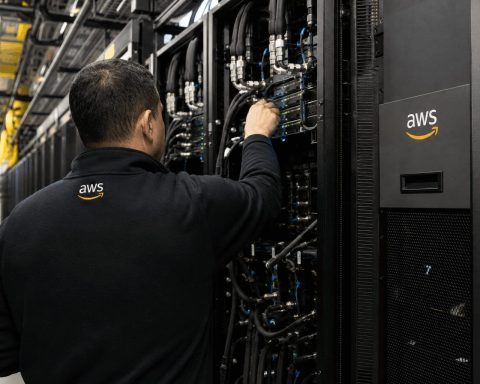
AWS has introduced Graviton5, positioning it as its most powerful and efficient CPU to date, and emphasizing that Graviton chips power a significant share of new AWS CPU capacity additions.
AWS has also put new EC2 M9g instances powered by Graviton5 into preview, describing gains versus prior generations — including up to 25% better compute performance compared with Graviton4-based instances — which is exactly the kind of “economics story” cloud buyers want in an AI world where compute bills can spiral quickly. Amazon Web Services, Inc.
Industry coverage adds more color on the design focus — including reduced inter-core latency and a much larger cache — reinforcing why Amazon’s silicon roadmap is increasingly viewed as an AWS differentiator rather than an engineering side quest.
Why this matters for Amazon stock: If AWS can consistently deliver better price-performance, it strengthens Amazon’s ability to (a) win workloads and (b) defend margins even as competition intensifies across hyperscalers.
Today’s biggest Amazon-adjacent headlines: why they matter for AMZN’s 2026 setup
Amazon’s stock story today isn’t just “analysts like it” — it’s also shaped by what’s happening around the infrastructure and regulatory landscape that underpins AI and cloud growth.
1) iRobot files for bankruptcy: a reminder of regulatory headwinds and smart-home scrutiny
iRobot, maker of the Roomba, has filed for Chapter 11 bankruptcy protection and is pursuing a restructuring that will take the company private under a court-supervised process. Coverage also revisits the previously proposed Amazon-iRobot deal that ultimately fell apart amid regulatory pressure, and notes Amazon’s termination fee.
While iRobot isn’t an Amazon business, the bankruptcy headline pulls Amazon back into discussions about regulatory friction and smart-home data sensitivities — themes that can influence investor perception, especially when Amazon is simultaneously expanding AI and consumer ecosystems.
2) Data-center power demand keeps climbing — and it’s becoming a real constraint
A Reuters report citing U.S. Energy Information Administration (EIA) forecasts points to record-high U.S. power consumption in 2025 and 2026, with data centers (including AI-driven demand) identified as a key driver.
This matters directly to Amazon because AWS growth is increasingly bounded not just by chip supply and real estate, but by grid access and energy availability. The market’s AI winners will be those that can secure power, permits, and build timelines — not just those with the best models.
3) Big money is still pouring into hyperscale capacity — even as timelines stretch
Another Reuters report highlights a major planned hyperscale data-center campus in Amsterdam that is expected to be leased to a single hyperscaler (with companies like Amazon among the likely categories of tenant), underscoring that capital is still flowing into long-dated infrastructure projects.
The implication for investors: the “AI cloud buildout” is not slowing down in ambition — but returns may come over years, not quarters.
4) Bridgewater warns the AI boom’s financing mix is getting “dangerous”
Bridgewater has warned that Big Tech’s reliance on external capital to fund AI expansion could be “dangerous,” pointing to concerns about spending running ahead of internally generated cash and raising bubble-risk questions. Reuters
Even if Amazon is not the only company in that framing, the message is clear: investors are becoming more selective about capex discipline and the credibility of payback narratives.
5) Project Kuiper launch: Amazon’s satellite push adds to the “builder” profile
Separately, a Space.com report tracks a United Launch Alliance Atlas V mission slated to launch 27 Amazon satellite internet spacecraft (Project Kuiper) in the early hours of Dec. 16, advancing Amazon’s broader connectivity ambitions.
While Kuiper is not the core driver of AMZN’s near-term earnings, it reinforces a consistent theme: Amazon is a company willing to invest heavily in long-cycle infrastructure — and markets will continue to debate when and how that investment converts into shareholder returns.
India investment adds a long runway — and a clear AI angle
Beyond today’s headlines, one of the most consequential medium-term strategic threads remains Amazon’s commitment to India.
Reuters reported that Amazon plans to invest more than $35 billion in India by 2030, aimed at expanding operations, improving AI capabilities, building logistics, and boosting exports — part of a broader race among U.S. tech giants to deepen AI and cloud infrastructure footprints in the country.
That same investment plan is echoed in market coverage tied to the Guggenheim initiation, which also references Amazon’s historical investment base in India and its export ambitions.
For the AMZN story, India functions as both:
- a commerce growth runway (market expansion, fulfillment, small business enablement), and
- an AI/cloud infrastructure runway (data centers, compute demand, enterprise adoption)
What analysts and investors will watch next for AMZN
Amazon’s bull case is increasingly being written around execution and economics, not slogans. The next checkpoints most likely to shape AMZN sentiment include:
AWS reacceleration and mix
- Can AWS sustain growth that reflects rising AI workloads while protecting margin?
Compute cost and differentiation
- Does AWS’s silicon strategy (e.g., Graviton5 and related instances) meaningfully improve customer economics and retention? About Amazon+2Amazon Web Services, Inc.+2
Capex confidence
- Does Amazon convince investors that the scale of AI/data-center spending is matched by credible demand visibility — in a market increasingly wary of “build now, monetize later”? Reuters+1
Infrastructure constraints
- Power availability, permitting, and build timelines are becoming competitive battlegrounds, not background details.
Regulatory overhang
- High-profile adjacent stories like iRobot’s bankruptcy keep the regulatory conversation alive, even if not directly tied to AWS performance.
Bottom line: Amazon’s story is turning into a test of “AI economics,” not just AI exposure
The emerging picture on Dec. 16, 2025 is that Amazon’s investment narrative is being pulled upward by a mix of analyst optimism (including Guggenheim’s Buy initiation) and a renewed focus on what truly differentiates hyperscalers in 2026: efficient compute, massive infrastructure, and the ability to deliver AI workloads profitably.
But the same day’s headlines — from power-demand warnings to capex skepticism — show why the market is also demanding proof that the AI cloud buildout can generate returns commensurate with its cost.
Related articles: NASDAQ:AMZN