SÃO PAULO, July 28, 2026, 14:05 BRT — B3 regular session.
Ambev stock rose approximately 2.5% to near R$16.26 on Tuesday.
The current price is marginally higher than the consensus 12-month target set by analysts.
Initial Q2 EBITDA projections range from R$6.50 billion to R$6.68 billion.
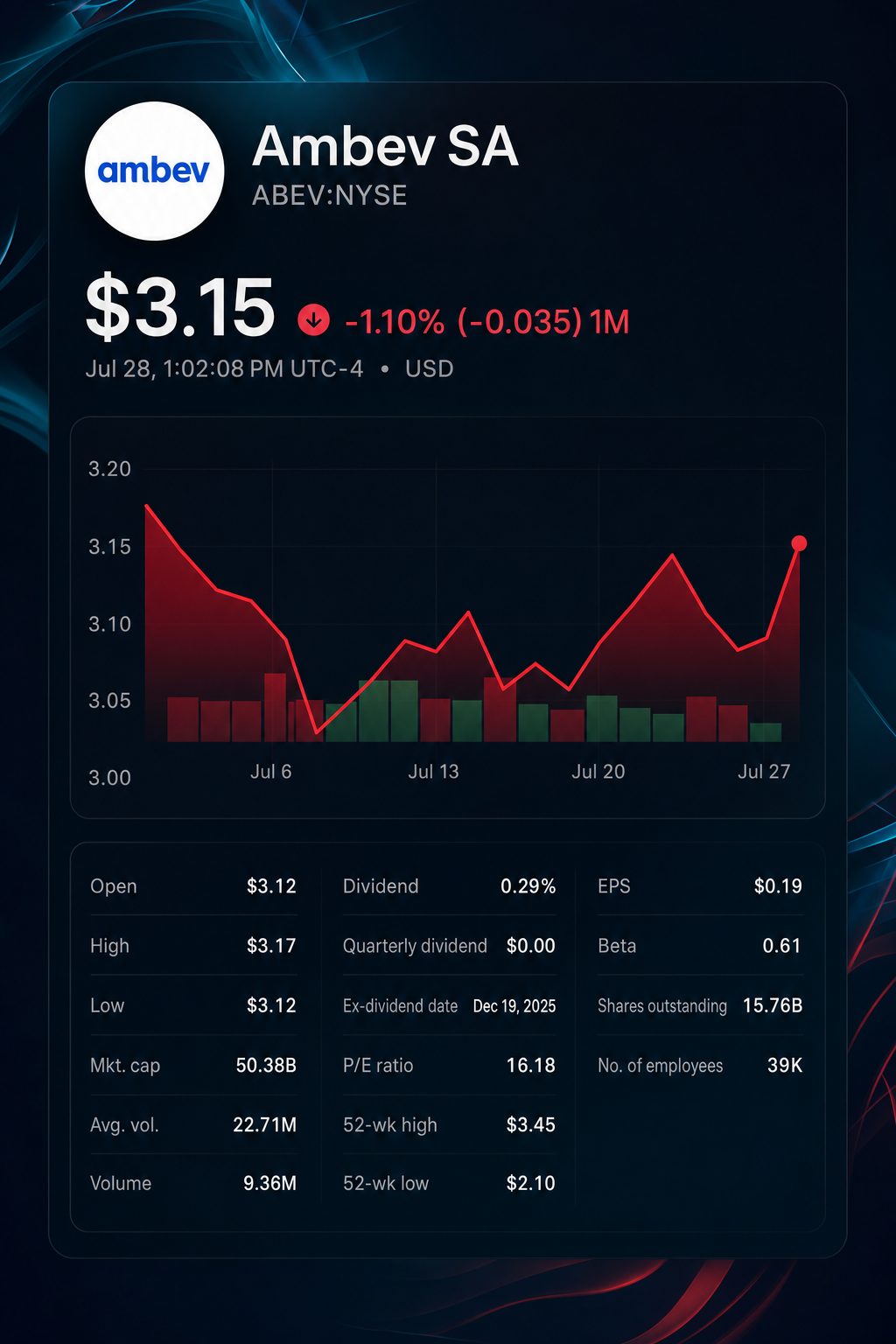
Shares of Ambev S.A. (BVMF:ABEV3; NYSE:ABEV) climbed approximately 2.5% on Tuesday, with the stock changing hands close to R$16.26 in afternoon trading.
Ambev has climbed past the analyst average target of R$16.21, leaving the stock with little valuation support in the event of a typical quarter.
Ambev is set to release its second-quarter earnings before trading opens on both B3 and the New York exchanges on July 30. The company will begin its webcast at 12:30 BRT.
Published previews indicate rare consensus on EBITDA figures. Four initial forecasts span from R$6.50 billion to R$6.68 billion.
The difference is just 2.8%. With such a tight range, reaching the lower bound comes at a higher cost.
XP Inc. NASDAQ:XP, Bradesco BBI, Itaú BBA, and JPMorgan Chase & Co. NYSE:JPM provided the forecasts.
Q2 2026 preliminary projection
XP
Bradesco BBI
Itaú BBA
JPMorgan
Net revenue, R$ billion
21.10
20.80
—
—
Adjusted EBITDA, R$ billion
6.60
6.60
6.50
6.68
Net profit, R$ billion
2.90
3.00 adjusted
—
3.11
Brazil Beer volume, year-on-year
+5%
—
+8%
+7%
Figures are based on XP’s projected R$21.1 billion in revenue and a 31.3% margin. All numbers in the table are preliminary.
The main divergence concerns Brazil beer volumes, with estimates for growth varying between 5% at XP and 8% at Itaú BBA.
JPMorgan is positioned in the middle at 7%. This places the focus on volume-to-margin conversion as the better indicator for earnings.
XP analysts Leonardo Alencar and Leonardo Paiva project revenue of R$21.1 billion. Their forecast for net income stands at R$2.9 billion.
XP noted that milder weather and soft demand in Canada and Latin America South impacted results. These factors partially countered the benefits from less challenging comparisons in Brazil Beer.
Chief Executive Carlos Lisboa described the first quarter as “a solid start to 2026.” Organic revenue was up 8.1%, and normalized EBITDA climbed 10.1%.
The normalized EBITDA margin for the company rose by 60 basis points, reaching 33.6%.
Brazil Beer illustrated the choice investors will reassess. In the first quarter, cash cost per hectolitre increased by 14.6%.
The segment’s EBITDA margin decreased by 60 basis points. Ambev maintained its cash-cost growth forecast for the full year at 4.5% to 7.5%.
The stock trading above the average target shifts the earnings outlook. Strong volume growth alone may fall short unless supported by stable pricing and tight cost management.
A figure near R$6.5 billion would align with certain projections. However, it may let down investors who drove the shares up ahead of the announcement.
Risks: Cooler temperatures, soft international demand, and a resurgence of cost pressures in Brazil could drive EBITDA closer to its lower range. Higher pricing or a better product mix could help offset these risks.
When is Ambev set to release results, and what is the consensus expectation?
Ambev is set to announce its second-quarter earnings before markets open on B3 and NYSE on Thursday, July 30. The company's webcast is scheduled to start at 12:30 p.m. Brasília time, or 11:30 a.m. in New York. Revenue projections from Google Finance are around R$20.83 billion, while Public.com shows an ADR EPS estimate close to $0.04. These are independent analyst forecasts, not official company guidance. Ambev reported normalized local EPS of R$0.24 in the first quarter, but seasonality impacts limit direct comparison.
What is the stock's performance ahead of the earnings report?
ABEV changed hands at $3.15 as of 16:47 UTC on Tuesday, rising approximately 2.6%. Trading volume stood at 9.13 million shares, compared with a daily average of 22.71 million. The ADR traded between $3.09 and $3.17 during the session. Shares of Brazil's ABEV3 were near R$16.25, also advancing about 2.5%. Market capitalization was reported at nearly $49.6 billion at that point. The ADR was still about 9% under its yearly peak of $3.45.
What would be considered a strong performance for the second quarter?
Net revenue for the first quarter was R$22.46 billion, remaining almost unchanged as reported. Organic revenue increased by 8.1%, while normalized EBITDA climbed 10.1%. This resulted in a 60 basis point improvement in normalized EBITDA margin, now at 33.6%. Normalized profit edged up just 0.3%, totaling R$3.83 billion for the quarter. Robust Thursday numbers are expected to sustain double-digit EBITDA growth and additional margin gains. However, investors require a wider base of volume support, not just price increases. Growth quality is a key issue.
Is there real evidence that beer volumes are bouncing back?
Overall organic volume edged up 0.1% in the first quarter. Brazil Beer increased by 1.2%, with Central America and Caribbean volumes up 7.7%. Latin America South slipped 0.5%, while Canada volumes were down 2.0%. Brazil's non-alcoholic beverage volume decreased 3.9% over the period. Across the company, revenue per hectoliter rose 8.0% organically. Pricing and mix remained the main drivers of earnings. An upcoming breakdown of regional volumes on Thursday will indicate if demand recovery has become more widespread.
Is Ambev able to shield its Brazil Beer margins from rising input costs?
Brazil Beer reported a 14.6% year-on-year organic rise in cash cost per hectoliter in Q1, a figure that does not factor in sales of non-Ambev marketplace items. Despite this, Brazil Beer normalized EBITDA increased 7.6%, although margin slipped by 60 basis points. Management reaffirmed its full-year cost growth forecast of 4.5% to 7.5%, signaling an expectation of notable cost moderation over the next three quarters. However, when this will occur is still unclear. Investors are expected to scrutinize that outlook as it relates to currency, aluminum, and agricultural commodity price developments.
Is Ambev’s balance sheet positioned to enable buybacks and shareholder distributions?
Ambev reported R$17.99 billion in cash and cash equivalents on its March balance sheet. Current investment securities contributed an additional R$1.65 billion in liquid assets. Interest-bearing debt was recorded at R$3.11 billion, resulting in net cash of R$16.53 billion. Operating cash flow for the first quarter totaled R$3.16 billion, representing a 162.5% increase and marking the company’s highest first-quarter cash generation in a decade. Of the total, R$2.29 billion held in Bolivia remained subject to remittance restrictions. Under the ongoing 208 million-share buyback program, Ambev repurchased 27.48 million shares for R$413 million.
What caused earnings to trail behind the increase in operating profit last quarter?
Net finance expense expanded to R$1.06 billion compared with R$856.4 million. Losses on derivatives almost doubled on the year, totaling R$537.6 million. Ambev chiefly attributed this to carry costs tied to Brazilian foreign-exchange and commodity hedging. This factor contributed to capping normalized profit growth at just 0.3%. Normalized EPS for the first quarter edged up only 0.5%, even as EBITDA posted a stronger increase. Finance costs continue to play a significant role in Thursday’s reported bottom line.
What is the severity of the latest tax dispute in Brazil?
In April, Ambev was issued fresh tax assessments amounting to roughly R$4.3 billion, tied to foreign tax credits taken for the 2020 and 2023 tax years. The company contests these assessments and is preparing to challenge them before Brazil’s administrative court. There is no determination yet on any financial obligation. Investors should view the R$4.3 billion as contested exposure rather than a definite outflow. Further detail on timing, provisions, or legal risk may emerge in Thursday’s disclosures.
Does Ambev remain appealingly priced following its recent gains?
Ambev shares at $3.15 changed hands at about 16 times trailing earnings. Trailing EPS was near $0.19, based on Google Finance data. The ADR traded around 50% above its 12-month low of $2.10. The Ambev investor-relations page shows four Buy, eleven Neutral, and three Sell recommendations, reflecting a cautious stance. Thursday’s results will need to deliver either stronger volumes or wider margins to drive further rerating.
Michał Rogucki is a senior markets reporter at TS2.tech. His coverage ranges from stocks and technology to economic developments affecting global markets. He graduated from Humboldt University of Berlin and worked in investment research and market analysis before becoming a financial journalist.
A figure above or below the 12.0 consensus could impact Treasury yields, the dollar, and cyclical stocks by influencing short-term growth outlooks.
#2
NAHB Housing Sentiment
A reading above or below 33 will influence expectations for housing demand, mortgage rate trends, and homebuilder stocks.
#3
Fabrinet After the Close
Investors are focusing on revenue, margins, and comments on datacom as key factors for companies involved in optical networking and AI infrastructure supply chains.