Second-quarter operating cash flow rose 54.5% to R$4.71 billion.
Calculated cash conversion reached 73.9%, up from 49.6% a year earlier.
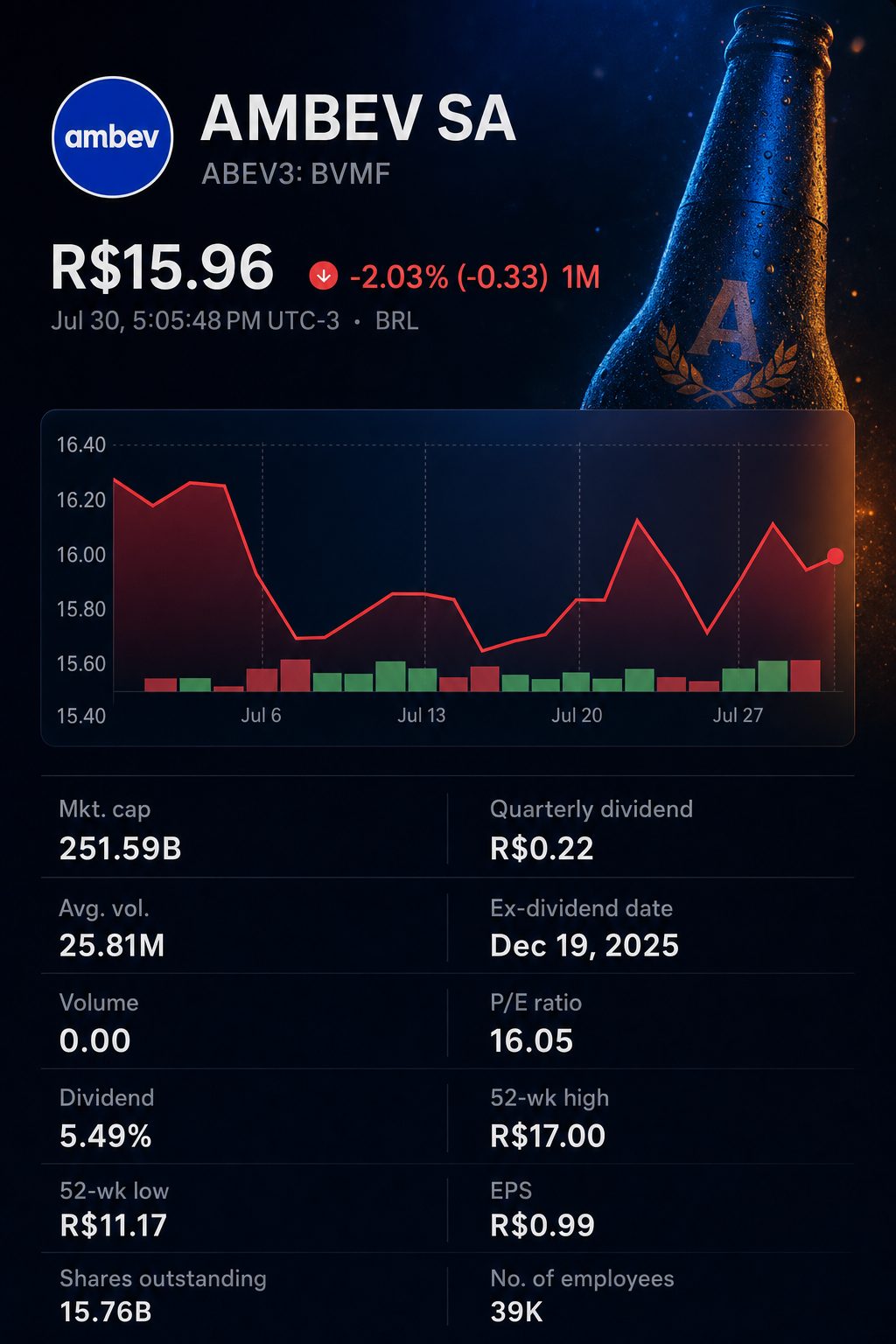
ABEV3 closed Thursday at R$15.96, up 0.38%. U.S. core trading was still pending.
Ambev S.A. (BVMF:ABEV3; NYSE:ABEV) converted 73.9% of quarterly normalized EBITDA into operating cash. The ratio was 49.6% a year earlier. Shares barely moved.
Operating cash flow jumped 54.5%, against 8.9% organic EBITDA growth. Management linked the increase to EBITDA gains and better working capital. That matters after an event-heavy quarter.
At 09:12 BRT, São Paulo’s cash market remained closed. Pre-opening starts at 09:45, followed by trading at 10:00. U.S. core trading also awaited its 09:30 ET open.
The latest tape showed limited follow-through.
Comparison
Earlier level
Latest level
Move
São Paulo, Thursday
R$15.90
R$15.96
+0.38%
São Paulo, July 24–30
R$15.64
R$15.96
+2.0%
NYSE ADR, latest quote
$3.11
$3.12
+0.32%
Period changes marked with an asterisk are calculated from quoted prices.
Thursday’s close recovered from a R$15.12 intraday low. It remained below Tuesday’s R$16.10 close. Since last Friday, the stock gained 2.0%.
Revenue reached R$20.15 billion, up only 0.3% as reported. Organic growth was 6.1%. Normalized profit climbed 23.3%.
Second-quarter metric
2025
2026
Change
Volume
39.57 million hl
39.73 million hl
+1.4% organic
Net revenue
R$20.09 billion
R$20.15 billion
+6.1% organic
Normalized EBITDA
R$6.15 billion
R$6.38 billion
+8.9% organic
Normalized profit
R$2.83 billion
R$3.49 billion
+23.3%
Operating cash flow
R$3.05 billion
R$4.71 billion
+54.5%
Chief Executive Carlos Lisboa said execution delivered another quarter of beer-volume growth. He cited “solid top and bottom-line performance.”
The cash bridge was stronger than the profit bridge. Calculations from reported figures show improvement across both measured periods.
Period
2025 operating cash flow/normalized EBITDA
2026
Change
Second quarter
49.6%
73.9%
+24.3 percentage points
First half
31.3%
56.5%
+25.2 percentage points
Working capital supplied the mechanism. The payables outflow narrowed to R$1.42 billion from R$2.93 billion. Receivables released R$689 million, versus R$209 million.
Still, analysts questioned revenue quality. Itaú BBA’s Gustavo Troyano, Bruno Tomazetto and Ryu Matsuyama called the result “weak.” They cited softer-than-expected revenue, especially in Brazil beer. UOL Economia
Brazil beer volumes rose 5.0%, helped by World Cup demand. Organic EBITDA advanced 12.8%. Its group EBITDA share reached 51.4%, from 46.6%.
The unit economics were less emphatic. Revenue per hectolitre rose 4.4%, excluding marketplace sales. Cash cost per hectolitre increased 4.5%.
Against parent Anheuser-Busch InBev S.A. (EBR:ABI), Ambev grew faster across core organic metrics. Its margin expansion was also wider.
Second-quarter metric
Ambev
AB InBev
Total volume growth
+1.4%
+0.9%
Net revenue growth
+6.1%
+5.6%
Normalized EBITDA growth
+8.9%
+5.8%
EBITDA-margin change
+80 bps
+4 bps
Growth figures are organic; margin changes are reported by each company.
Digital channels added a quality signal. Zé Delivery orders more than doubled on Brazil match days. Users rose 6%, while gross merchandise value increased 16%.
Cash is already reaching shareholders. Ambev had returned about R$5.9 billion through Thursday’s release. It also scheduled R$1.9 billion for October and R$1.1 billion by December.
Risks remain. Brazil beer’s unit-revenue growth trailed unit-cost growth by 0.1 percentage point. World Cup demand may normalize. Foreign exchange, commodities and weather could pressure the unchanged 4.5%-7.5% cost guide.
Friday’s open and next week will test the cash thesis. Investors will watch whether conversion persists beyond the World Cup boost. Cost discipline now matters more than headline volume.
What is the current trading location for Ambev shares?
At 11:25 UTC on July 31, 2026, ABEV was last quoted at $3.12, giving the company an approximate market capitalization of $49.1 billion. The ADR traded roughly 9.6% below its 52-week peak of $3.45 and was 48.6% higher than its 52-week trough of $2.10.
Did Ambev surpass forecasts with its second-quarter results?
Ambev posted net revenue of R$20.15 billion and normalized EBITDA came to R$6.38 billion. Normalized profit hit R$3.49 billion, up 23.3% from a year earlier. One analyst estimate put EPS at $0.043, above the $0.037 consensus. Revenue for the period was $3.92 billion, just below the expected $4.04 billion, with some variability seen in dollar-based numbers between data sources.
Is the increase in volume sufficiently widespread to back the stock?
Consolidated volumes increased by 1.4%, following 0.7% growth in the first half. Beer volumes in Brazil climbed 5.0%, while Central America and Caribbean advanced 5.4%. Non-alcoholic volumes in Brazil dropped 4.4%, with Canada down 1.8%. Latin America South volumes fell by another 2.9% in the quarter. The recovery is taking shape, though major market trends are still uneven.
Is Ambev able to continue increasing its margins?
Normalized EBITDA margin climbed 80 basis points to 31.6%. Gross margin advanced 190 basis points to reach 51.9%. Revenue per hectoliter was up 4.6%, while cash COGS per hectoliter increased by 2.2%. Management continues to project Brazil beer cash COGS growth will range from 4.5% to 7.5%. Additional growth relies on pricing, product mix, and productivity.
What is the current strength of cash flow and the balance sheet?
Operating cash flow totaled R$4.71 billion, up 54.5% compared to Q2 2025. As of the end of June, Ambev reported net cash of R$15.40 billion. Gross debt stayed low at R$2.95 billion. The company’s balance sheet underpins dividend payments and significantly cuts refinancing risk.
Which dividends and share repurchases have been announced?
By July 30, Ambev had returned around R$5.9 billion to its shareholders. Nearly 95% of the company's buyback program set for October 2025 had been executed. An interest-on-capital payment totaling R$1.9 billion is scheduled for October 6. The board further approved an additional distribution of roughly R$1.1 billion to be made by December. The amount for the new distribution was disclosed only as a total figure.
Is ABEV currently trading at a high valuation?
ABEV is currently valued at about 16.1 times its trailing profits and 14.8 times forecasted earnings. Its enterprise value stands at around 7.5 times trailing EBITDA. Despite Ambev’s net cash position, these ratios do not suggest that the stock is trading at distressed levels. They are typical for a major, defensive consumer firm. The current valuation offers limited flexibility in the event of another significant drop in volumes.
How do analysts predict ABEV shares will perform?
According to S&P Global’s survey, the stock holds a Hold recommendation with an average price target of $3.33, representing a potential upside of roughly 6.7% from its latest price at $3.12. The forecast range among analysts is $2.55 to $4.00 per ADR. Meanwhile, MarketBeat’s figure from seven analysts stands at $3.09, indicating a slight downside. The consensus outlook remains neutral, not strongly positive.
How did Ambev shares perform compared to the Ibovespa following its earnings?
ABEV3 ended July 30 at R$15.96, up 0.38% for the day. The Ibovespa index gained 1.88% to close at 177,158.86. Ambev trailed the index by 1.50 percentage points. The stock’s subdued reaction followed a profit beat but fell short on revenue forecasts.
What factors could most strongly boost or weigh on performance?
Premium beer volumes advanced by a high-teens percentage, and no-alcohol beer climbed in the low-twenties range. Gross merchandise value on the BEES Marketplace jumped 58% for the quarter. Despite these gains, volumes fell in Brazil’s non-alcoholic segment, Latin America South, and Canada. First-half normalized profit was cut by R$303.1 million due to Argentina’s hyperinflation accounting. Continued strong performance in Brazil beer is needed to counteract the regional declines and ongoing currency headwinds.
Shan Ahmed Khan is a senior markets reporter at TS2.tech. His coverage ranges from stocks and technology to economic developments across global markets. He worked in investment research and market analysis before becoming a financial journalist and is a graduate of the Lahore University of Management Sciences (LUMS).