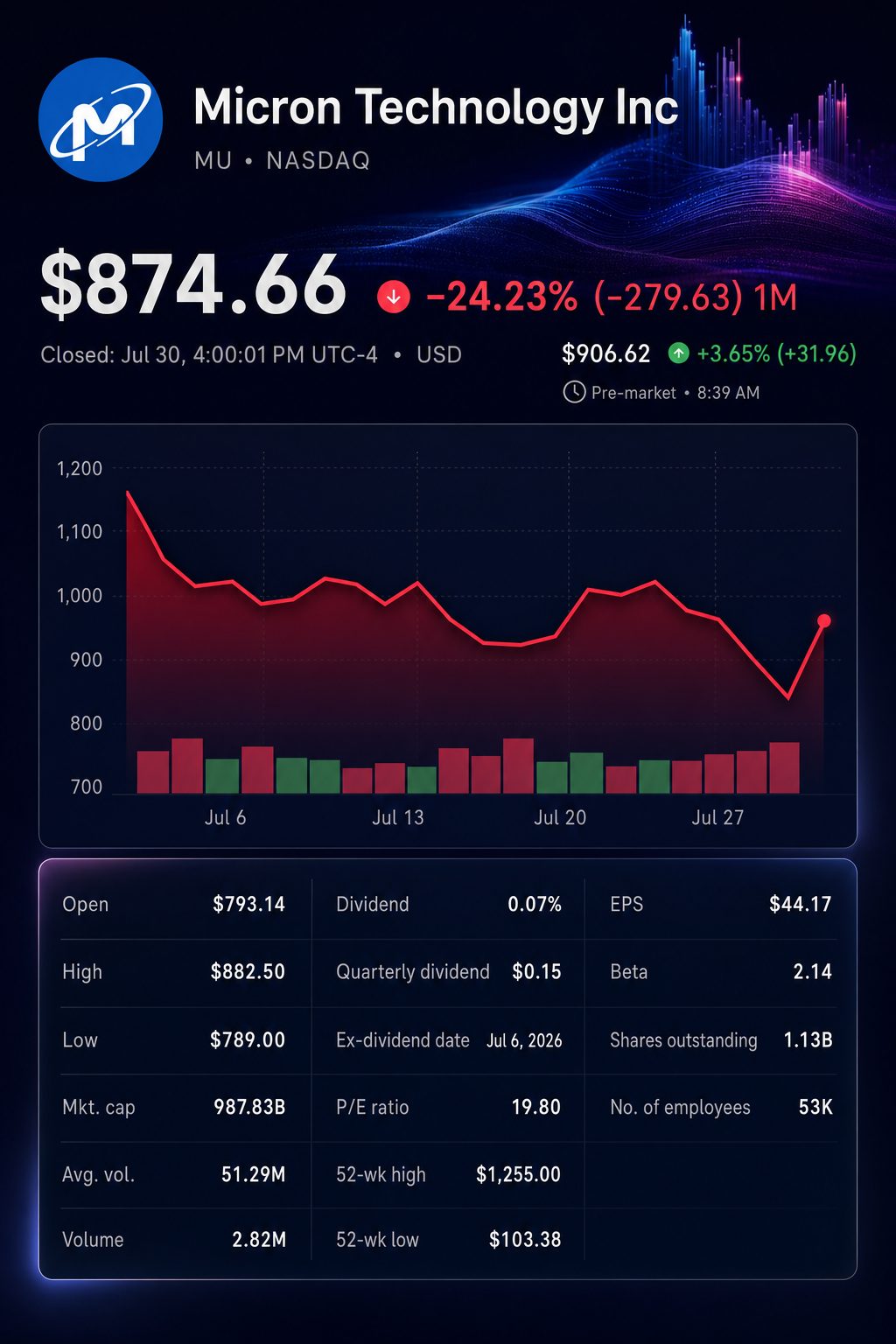
Shares of Micron Technology NASDAQ:MU rose 4.30% premarket to $912.24, following an 18.36% surge on Thursday.
Samsung Electronics KRX:005930 forecasts that supply shortages will persist until 2028. Apple NASDAQ:AAPL has reported that its outlook is being impacted by component constraints and rising memory prices.
Micron’s Mobile and Client segments recorded an 87% gross margin in fiscal Q3, equaling that of Core Data Center.
Micron shares were on track to start trading above $900 on Friday, rebounding as new signs showed memory shortages extending to consumer devices.
Regular U.S. trading stayed shut. Activity was seen in premarket hours, while Nasdaq’s cash market was set to open at 09:30 EDT.
The read-through extends beyond high-bandwidth memory (HBM). Cost controls from Apple and Samsung’s contractual terms highlight strong pricing leverage for suppliers.
Micron’s figures underscore this perspective. Gross margin for Mobile and Client matched Core Data Center at 87%. Units outside the data center accounted for 39% of revenue from business units.
Nevertheless, the tape reflects the impact. Thursday’s rally came after a 19.8% decline that occurred from last Friday to Wednesday.
Micron checkpoint
Price
Comparison
July 24 close
$920.95
Reference point for the week
July 29 close
$739.00
Fell 19.8% compared to July 24
July 30 close
$874.66
Gained 18.36% on Thursday
July 31 premarket, 07:38 EDT
$912.24
Rose 4.30% ahead of Friday open
52-week high
$1,255.00
Premarket was 27.3% under the high
Weekly and peak gaps are derived from reported price data.
Friday’s reading came in just 0.9% lower than last week’s close, but stayed 27.3% under the 52-week peak. The small move for the week concealed significant volatility.
The composition of profits is more significant than the headline increase.
Micron business unit
Fiscal Q3 revenue
Quarter-on-quarter growth
Gross margin
Revenue share
Cloud Memory
$13.77 billion
77.7%
83%
33.2%
Core Data Center
$11.52 billion
102.6%
87%
27.8%
Mobile and Client
$11.52 billion
49.4%
87%
27.8%
Automotive and Embedded
$4.63 billion
71.1%
79%
11.2%
Figures for growth and market share are derived from the results disclosed by Micron.
Cloud and Core Data Center contributed 61% of total business-unit revenue. Gross margins for the other units ranged from 79% to 87%, increasing the earnings base.
Samsung noted the supply situation, forecasting that shortages could intensify and persist until 2028. “Almost all customers are requesting multi-year supply contracts,” said Jaejune Kim, head of memory. Reuters
Samsung aims for deals that account for roughly two-thirds of its memory production. The agreements generally last at least five years and usually feature minimum price terms.
Apple provided the check on the customer side. Tim Cook referred to constraints as “very significant” and noted Apple is assessing other memory options. The gross margin, not accounting for tariff refunds, stood at 48.1%, and the forecast for next quarter was between 47% and 48%. Reuters
Intends to boost 2026 capital spending by about 50%; shares dropped 5.6% Thursday
Samsung’s preliminary second-quarter figures could be revised following external audit. The margin lines reflect distinct accounting bases and provide direction rather than exact comparison.
Micron CEO Sanjay Mehrotra cited the “strategic value of memory in the AI era.” The company forecast revenue for fiscal Q4 at $50 billion, give or take $1 billion. Gross margin is projected to be about 86%. Micron Technology
Stock moves were mixed in Seoul. Samsung slipped 0.7%, with SK hynix down 5.6%. The divergence indicates scarcity is a given, but questions remain about how long it will persist.
The initial hurdle comes with Friday’s cash-session close. In the coming week, investors will monitor if contract pricing can counteract reductions in device demand. Remaining above $900 would keep Micron significantly under its annual high.
Risks persist. Apple is considering other suppliers, and SK hynix intends to significantly boost its investment. Quicker supply or a downturn in device demand could pressure Micron’s standout margins. Market analyst Kim Seok-hwan raised doubts about the longevity of these record margins.
Micron ended Thursday at $874.66, up 18.36%, as trading volumes approached 63 million shares. The Wall Street Journal Shares advanced to around $914 during premarket trading on Friday, climbing another 4.5%. Yahoo Finance The quote remained about 27% under Micron’s 52-week high of $1,255. MarketWatch Thursday’s finish was still around 24% lower than Micron's June 30 close. The Wall Street Journal Market momentum strengthened significantly, though volatility remains extremely elevated.
What caused Micron's rapid surge?
Samsung posted its highest-ever revenue and cautioned that memory supply constraints may continue until 2028. That alert renewed optimism following July’s sharp downturn in global memory shares. Barron's Apple anticipates another increase in memory expenses for its September quarter. Amazon lifted its projected 2026 capital expenditure target from $200 billion to $220 billion. Barron's The developments underpin short-term pricing, though cycle risk remains.
Have Micron’s most recent earnings results supported bullish investor sentiment?
Third-quarter revenue for the fiscal period stood at $41.46 billion, jumping 74% from the previous quarter. Compared to a year ago, revenue surged roughly 346% from $9.30 billion. Non-GAAP EPS rose to $25.11, up from $12.20 in fiscal Q2. Micron Technology Non-GAAP gross margin widened to 84.9%, and adjusted free cash flow was $18.3 billion. These results were exceptional.
What has management projected for the quarter ending in August?
Micron projected fiscal fourth-quarter revenue of $50.0 billion, plus or minus $1.0 billion. This midpoint points to around 21% growth quarter-on-quarter from fiscal Q3. Gross margin is expected to be about 86%, and non-GAAP EPS is forecast near $31.00. That EPS midpoint indicates about 23% sequential increase. Management did not factor in any potential trade or geopolitical impacts, which remains a key consideration for investors.
Is the momentum behind AI and HBM growth proving more sustainable?
Micron reported that HBM4 is now being shipped in volume to its primary customer. The company has also delivered qualification samples to multiple additional potential end customers. HBM4E is projected to enter volume production in calendar 2027. SEC Micron has finalized 16 strategic agreements, accounting for approximately 20% of DRAM volume. Over their duration, these deals cover close to one-third of NAND volume. All agreements feature take-or-pay terms with binding purchase obligations. This enhances visibility, though qualification and execution remain important.
Is Micron's stock still undervalued following its recent recovery?
Micron ended Thursday trading at 19.8 times its trailing earnings. Analysts polled by FactSet project fiscal 2027 earnings at $154.67 per share. The Wall Street Journal With a premarket price close to $914, Micron trades at about 5.9 times that projection. This represents an unusually low forward multiple for a major AI chipmaker. Just three months ago, that earnings forecast was $95.58. The Wall Street Journal Memory sector profit estimates often shift considerably, especially around the top of the cycle.
What target price have analysts set for Micron shares?
The consensus price target from 45 analysts on MarketScreener is $1,507.38 per share, pointing to a 72% potential rise from Thursday’s close, or around 65% from premarket. Analysts’ highest projection is $2,200, with the lowest set at $361. MarketScreener FactSet’s Wall Street Journal average stands at $1,568.74, with a median target of $1,600. The Wall Street Journal The spread in price targets is wide. While sentiment is generally positive, the wide range highlights significant uncertainty in forecasts.
What is Micron's significance for the Nasdaq-100?
As of June 30, Micron accounted for 5.64% of the Nasdaq-100 index, ranking third after Nvidia at 7.60% and Apple at 6.67%. If using this outdated weighting, Thursday’s advance would increase the figure by around one percentage point mechanically. The estimate remains rough, as the June-end weighting is no longer current. The Wall Street Journal Micron is now a major semiconductor name, and its moves can influence the index.
What factors might disrupt the positive outlook?
Micron expects to spend around $10 billion on capital investments in its fiscal fourth quarter, while full-year capital expenditures for fiscal 2026 are projected to total about $27 billion. Quarterly spending in fiscal 2027 is projected to exceed the fourth-quarter amount. Micron Technology New global capacity may soften prices if demand growth moderates. The bulk of 2025 DRAM production was based in Taiwan, heightening geopolitical risks. Micron has cautioned that future oversupply could pressure average selling prices. Micron Technology The bullish scenario is therefore reliant on sustained shortages.
Khadija Saeed is a financial markets reporter at TS2.tech. Her coverage ranges from stocks and technology to emerging industries and developments across global markets. She studied economics and finance at the London School of Economics and worked in market research before becoming a financial journalist. Follow Khadija Saeed on Google News.