
NEW YORK, July 23, 2026, 18:06 EDT — U.S. markets have closed.
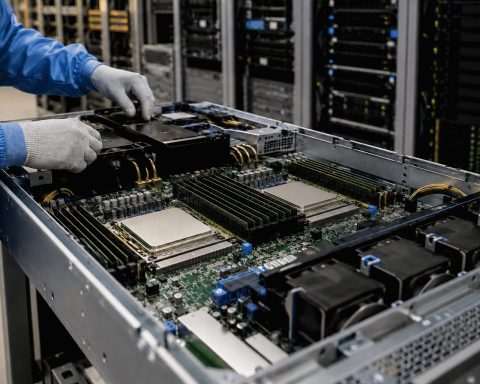
Shares of Advanced Micro Devices, Inc. NASDAQ:AMD dropped 2.29% to $539.69 on Thursday after news that its Helios AI racks are now in production. The stock had risen 11.4% during the previous three sessions.
The divided response centers the key investor issue. Production risks have eased, yet major installations are still months out. AMD anticipates first shipments toward the close of the third quarter. OpenAI’s broad rollout is set for later in 2026.
Markets saw overall declines. The Nasdaq Composite dropped 2.2%, and the semiconductor fund slipped 0.77%. AMD trailed the fund by 1.52 percentage points, yet managed to keep the majority of its gains from the latest rally.
| Security | July 23 close | Daily move | Change since July 17 |
|---|---|---|---|
| Advanced Micro Devices, Inc. NASDAQ:AMD | $539.69 | -2.29% | +8.86% |
| Nvidia Corporation NASDAQ:NVDA | $208.76 | -1.56% | +2.93% |
| iShares Semiconductor ETF NASDAQ:SOXX | $551.24 | -0.77% | +5.64% |
Period shifts are based on FactSet closing prices, unadjusted, from July 17.
AMD’s rise since last Friday outpaced both measures, indicating investors had already factored in significant launch progress ahead of Thursday’s event. The production disclosure lessened concerns about execution but did not accelerate revenue timing.
Chief Executive Lisa Su stated that “Helios is in full production.” Every rack links 72 MI455X accelerators to EPYC processors and AMD networking. Shipments are planned for close to the end of the quarter. Reuters
OpenAI executive Sachin Katti anticipates that “deploying Helios at massive scale” will start later this year. He added that deployment is set to ramp up through 2027. As a result, delivered systems will be the next significant benchmark. Reuters
Anthropic offers a significant long-term revenue opportunity through its deal, which includes up to two gigawatts of MI450 computing power. The first phase is set to launch in the first half of 2027. As various targets are met, AMD could commit as much as $5 billion.
Initial estimates from the company indicate Helios surpasses Nvidia’s Vera Rubin NVL72 in multiple aspects. AMD’s models deliver up to 15% greater AI compute and 50% higher high-bandwidth memory. These comparisons are based on internal projections and reference systems. Actual outcomes may vary.
According to Emarketer analyst Jacob Bourne, the Anthropic deal favors “slow, steady share gains.” Bourne said that Thursday’s drop was largely the result of wider market and semiconductor sector weakness. Reuters
The immediate financial threshold is elevated. Data Center revenue for the first quarter climbed 57% to reach $5.8 billion. AMD projected second-quarter revenue at $11.2 billion, with a possible variation of $300 million. These figures will, for the most part, precede Helios shipments.
Intel Corporation NASDAQ:INTC reinforced processor-demand expectations following Thursday’s closing bell. The company reported quarterly revenue of $16.1 billion, up 25%. Its third-quarter outlook came in above analysts’ consensus forecasts. AMD gained 1.21% in after-hours trading to reach $546.23 as of 18:04 EDT.
Upcoming cloud expenditure updates are expected this week. Microsoft Corporation NASDAQ:MSFT and Meta Platforms, Inc. NASDAQ:META are set to release results on July 29. AMD lists both firms as potential Helios customers. Amazon.com, Inc. NASDAQ:AMZN will announce its results on July 30.
AMD will release its second-quarter earnings on August 4. Investors’ attention will be on guidance for the third quarter, profit margins, and visibility on Helios orders. The main metric to watch is the pace at which announced demand for 2027 is converted into committed revenue.
Risks: AMD’s Helios performance statements are currently based on internal modeling and early data. Timelines for customers, ultimate power requirements, pricing for systems, and supply availability for components are all subject to adjustment. Nvidia continues to hold a leading position in the AI-accelerator sector.
Related articles: NASDAQ:AMD