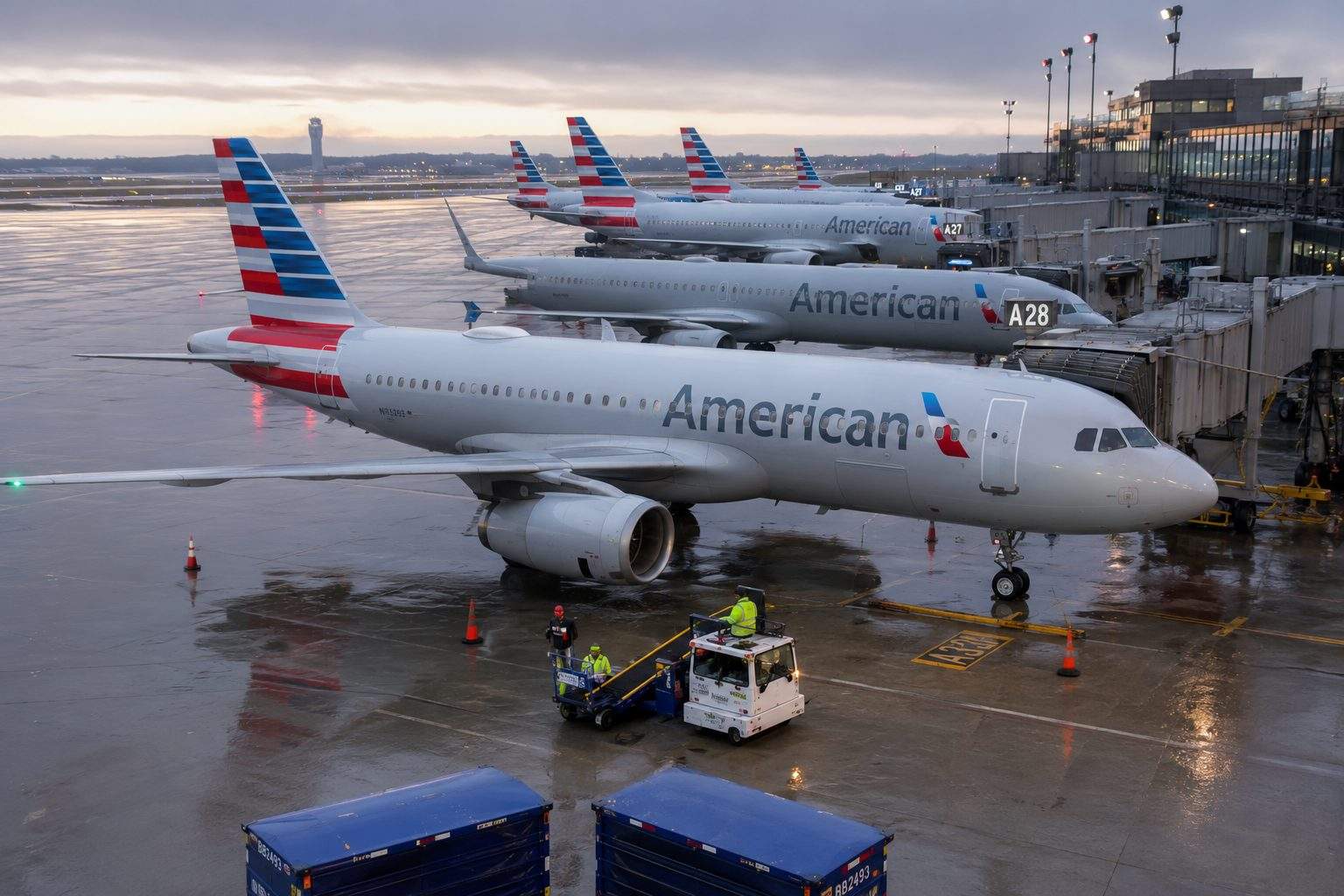

NEW YORK, July 23, 2026, 04:18 EDT — Disruptions involving American Airlines NASDAQ:AAL flight AA108 have brought attention to the airline’s maintenance spending as analysts prepare for the upcoming earnings release.
- AA108 experienced one cancelled flight and diverted twice among its two planned departures.
- Maintenance costs climbed 6.5% in the first quarter. An early per-share estimate is roughly nine cents.
- American ended down 3.2% on Wednesday. Regular U.S. trading hours stayed shut.
American Airlines Group NASDAQ:AAL confronts a maintenance challenge on Thursday. Its Boston-London service saw three mechanical incidents involving three distinct 777-200ER aircraft ahead of second-quarter earnings.
The incidents took place after the June quarter and will not impact the second-quarter cost line reported on Thursday. Investors are expected to focus on the current maintenance trend and outlook for the future.
Measured by total flights, the impact was minor. American runs over 6,000 flights each day. The two disrupted AA108 departures made up under 0.02% of flights over the two-day span. This is an initial estimate.
Cost sensitivity is a concern for investors. In the first quarter, maintenance, materials and repairs increased by 6.5% to $982 million, representing 7.1% of total revenue.
American cited more extensive inspections and parts repairs as reasons for the increase. Additional factors included engine overhauls and elevated material costs. The increase compared to a year earlier amounted to $60 million.
A preliminary estimate distributes the gain across 661.2 million weighted shares. This results in roughly nine cents per share before tax and one-off items. American projected adjusted EPS in a range from a loss of 20 cents to a profit of 20 cents. Nine cents is close to half of either margin from breakeven.
The comparison does not attribute the quarterly rise to AA108. It illustrates why maintenance discussions might carry more weight than the number of flights on a single route.
The July 19 local flight was called off due to a mechanical issue. On the following night, the plane was unable to pull up its landing gear and safely diverted from Boston to New York.
A substitute 777-200ER departed New York en route to London but encountered an engine problem, prompting a safe return to Boston. The incident report stated there were 198 people on board.
Flight records indicated that the following two planned flights arrived at Heathrow. The reports failed to specify any shared cause. This supports the view of a one-off occurrence but does not confirm it.
U.S. regular trading ended at 04:18 EDT. Shares of American ended Wednesday at $14.79, a decline of 3.2%. The NYSE Arca Airline Index dropped 1.8%.
| Period | American | NYSE Arca Airline Index |
|---|---|---|
| Week ended July 17 | -11.6% | -8.3% |
| Week to July 22 | -1.3% | -1.2% |
| July 22 trading day | -3.2% | -1.8% |
Calculations for changes use the referenced closing levels.
American’s lag the prior week occurred before the AA108 issues. Its performance this week until Wednesday tracked the index closely. The steeper fall on Wednesday signals sensitivity, with no established causal link.
Peer outcomes establish a margin reference. Delta Air Lines NYSE:DAL recorded an 8.8% adjusted operating margin along with $1.56 in adjusted EPS. United Airlines Holdings NASDAQ:UAL delivered a 4.8% adjusted pre-tax margin and $1.99 in adjusted EPS. The margin calculations are not the same.
Operational performance is also key. United achieved its strongest on-time departures for any second quarter since 2021. The airline also recorded its lowest rate of seat cancellations outside of the pandemic period.
American reported results showing robust revenue guidance, but projected modest profit figures. CEO Robert Isom stated in April the company remained “on track for another record in the second quarter.” The airline predicted revenue growth between 13.5% and 16.5%, with adjusted EPS expected to be around zero. American Airlines Newsroom
American’s earnings call is scheduled for 7:30 a.m. Central time on Thursday. During the coming week, investors are expected to scrutinize the carrier’s full-year adjusted EPS outlook, which spans from a 40-cent loss to a $1.10 gain. Attention will also be on maintenance costs and the stability of the 777 schedule.
Risks exist in both directions. Additional technical issues or cancellations may increase expenses for repairs and rebookings. Consistent guidance and regular flight operations would reinforce the perspective that this is an isolated incident.
Related articles: NASDAQ:AAL