
New York, May 12, 2026, 13:08 EDT
- ACHR dropped midday, despite Archer’s FAA milestone win; traders zeroed in on cash burn, timing, and rate headwinds.
- Bulls are looking to Phase 3 certification, U.S. pilot-program flights, and the LA28 spotlight. Bears, though, point to steep losses ahead of any meaningful scale.
- Joby and BETA shares slid too—this isn’t isolated to Archer. The eVTOL sector as a whole is taking a hit.
Shares of Archer Aviation dropped hard Tuesday, now changing hands at $6.11, down roughly 6.6%. Even with a positive regulatory update, investors zeroed in on the company’s still-sizeable capital requirements before it can convert flight trials into commercial operations. The price swung throughout the session—opening at $6.34, touching $6.66, and sliding toward $6.06.
That’s the reason behind the chart. Archer actually pushed the narrative forward—it didn’t miss the mark investors were hoping for. Still, shares had already climbed ahead of earnings, and the update served as a reminder of a recurring issue for electric vertical-takeoff-and-landing aircraft, or eVTOL, firms: moving toward certification remains costly and sluggish, and it’s not generating scaled revenue yet.
Archer posted $1.6 million in revenue for the first quarter, with a net loss tallying $217.7 million and adjusted EBITDA in the red by $172.5 million. Adjusted EBITDA, which excludes interest, taxes, depreciation, amortization and various noncash charges, offers a stripped-down look at operating losses. Cash, cash equivalents and short-term investments finished at about $1.78 billion—down $188.8 million from the previous quarter as spending on operations and equipment climbed.
Management pitched the spending as intentional and heavily weighted up front—not reckless. On the earnings call, execs pointed to Archer’s $1.8 billion in liquidity, less than $100 million in debt, and projected a second-quarter adjusted EBITDA loss somewhere between $170 million and $200 million. They kept coming back to one line: “not a deviation from discipline.” Investors heard them, and still, the shares dropped. Investing.com
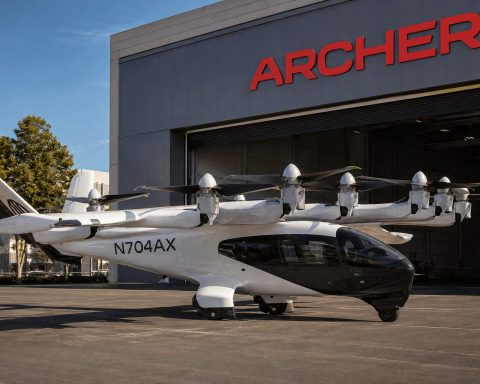
Chief Executive Adam Goldstein called it “another banner quarter,” highlighting record-setting FAA certification progress, expanded flight testing, and increased pace on defense and AI software programs. Archer said its Midnight aircraft is the first eVTOL to wrap up Phase 3 in the FAA’s four-step Type Certification process. That certification is the FAA’s green light for a design; Phase 4 moves to formal testing and analysis to verify the aircraft meets airworthiness standards. Archer Aviation
The bull case comes down to this: Archer’s moved past pitching just an idea. With a certification milestone under its belt and pilots flying nearly every day, there’s substance now. Hawthorne Airport in Los Angeles serves as its base, and the company’s already plugged into LA28 air-taxi prep. Archer says it expects its first U.S. flights under the eVTOL Integration Pilot Program this year, offering a shot at live operational data before any full-scale launch.
Still, the bear argument isn’t easy to dismiss. Revenue’s barely a blip given the size of the losses. Management now says full piloted transition flights are likely pushed to the second half. They’ve got just two aircraft flying. The initial fleet is targeted at eight to ten planes, with infrastructure aimed at handling up to 50 per year. That’s some progress, sure, but it doesn’t add up to production leverage yet.
Wall Street’s mostly sticking with Archer, but some numbers are getting dialed back. Cantor Fitzgerald lowered its price target to $11, down from $13, holding onto that Overweight call and pointing to timing issues, though the company’s guidance for first passenger-carrying flights by year-end remains unchanged. Canaccord, facing a first-quarter loss and higher cash burn, nudged its target down too—$12 from $13—but kept its Buy rating.
Analysts remain mostly positive, though the optimism has cooled a bit. TradingView’s poll of eight analysts now shows an average 12-month price target at $11.38—down from $11.75. The group splits six Buys against two Holds, with zero Sells in the mix. Bulls are still focused on the massive potential if the plane gets certified and starts commercial flights, while skeptics point to dilution, persistent losses, and a long runway before the business model can prove itself.
Rates dragged the tape lower. The Bureau of Labor Statistics reported April CPI climbed 3.8% year-over-year, with core CPI up 2.8% and energy up a sharp 17.9%. Sticky inflation hits pre-profit names hard—higher rates dent the value of future cash flows, especially when profits are years away.
Prediction markets weren’t budging. On Kalshi’s Fed markets page, “exactly 0 cuts” in 2026 led with 58%. Polymarket showed zero cuts for 2026 priced at 61.9%, and odds for a June Fed “no change” call hit 98%. None of that locks in Archer’s certification fate, but it does make things tougher for speculative growth names that depend on long runways and funding. Kalshi Polymarket Polymarket
Peers felt the squeeze, too. Joby Aviation slipped roughly 5.8%, while BETA Technologies dropped 5.4%. The move hints at a broader mark-down across air-mobility stocks—not just a reaction to Archer’s figures. BETA posted its own results this week and is still running alongside the pack on certification, infrastructure, and first-phase operations.
The next hurdle isn’t a flashy headline—sequence matters now. Archer must log a piloted transition flight, sort out those eIPP pathways, show Hawthorne can turn into a real hub, and prove defense or software contracts can ease the spending, not just pile onto it. Otherwise, the stock will keep behaving more like a flying cash clock than a traditional aircraft name.
Related articles: NYSE:ACHR